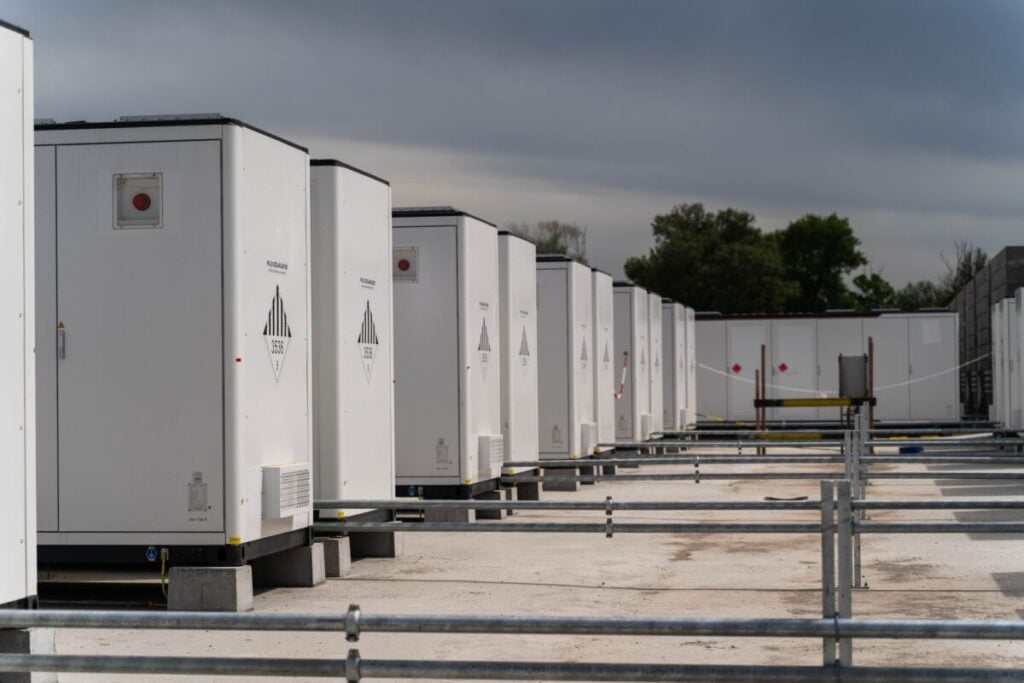
As of the second quarter of this year, installed energy storage capacity in Europe overtook nuclear, according to trade association Energy Storage Europe’s new report.
A record 13.5GW/26.4GWh of new electrochemical energy storage was deployed during 2025, and cumulative installs across the residential, commercial and industrial (C&I) and utility-scale market segments surpassed 100GW in the third quarter of last year.
After Europe ended 2025 with 102.7GW of cumulative installs, continued activity this year meant energy storage capacity overtook Europe’s ~105GW nuclear fleet this quarter, according to the report.
Around half of Europe’s installed capacity (53.3GW) by the end of last year comprised legacy pumped hydro energy storage (PHES). The rest was nearly all electrochemical storage (48.7GW), and of that, nearly all the capacity is accounted for by lithium-ion (Li-ion) batteries. There was also around 400MW of large-scale thermal energy storage (TES) and 300MW of ‘other’ technologies.
Try Premium for just $1
- Full premium access for the first month at only $1
- Converts to an annual rate after 30 days unless cancelled
- Cancel anytime during the trial period
Premium Benefits
- Expert industry analysis and interviews
- Digital access to PV Tech Power journal
- Exclusive event discounts
Or get the full Premium subscription right away
Or continue reading this article for free
The new, 10th annual edition of the European Market Monitor on Energy Storage (EMMES) was published this morning by Energy Storage Europe and energy transition consultancy LCP Delta.
EMMES aims to provide a comprehensive overview of market activity across the European Union (EU) Member States, the UK, Switzerland and Norway, including installed capacity and projects due for commercial operation in 2026. It also features forecasts to 2030.
The report has been published just as much of the European industry converges upon Munich, Germany, this week for the Smarter E conference and expo, including the ees Europe energy storage strand.
Last year’s EMMES 9.0, published in March 2025, found that 11.9GW/21.1GWh was deployed in 2024. It was also the first time that both Europe and the US installed more than 10GW in a single calendar year.
Germany, Italy and the UK each host more than 10GW
With the behind-the-meter (BTM) residential battery segment leading the market for new installed capacity, closely followed by front-of-the-meter (FTM) utility-scale battery energy storage systems (BESS), the European market stands in contrast to the US, where utility-scale additions dwarf BTM installs.
In fact, 2024 was the first year the EMMES authors found FTM capacity additions to have overtaken BTM in Europe. This trend flipped back again last year.
The three leading markets are Germany, Italy and the UK, each hosting more than 10GW of storage. Spain, France and Poland are the next three largest, with between 5GW and 10GW of installed capacity each.
Cumulative installed battery storage capacity in Europe as of the end of 2025:
| Residential (GW) | Residential (GWh) | Commercial & Industrial (GW) | Commercial & Industrial (GWh) | Front-of-the-meter (GW) | Front-of-the-meter (GWh) |
| 26.7 | 40.4 | 3.5 | 5.9 | 18.5 | 34.4 |
Energy Storage Europe and LCP Delta said that heightened market activity has led it to revise its 2030 forecast upwards, predicting 153GW/485GWh of additional installs by the end of this decade. In EMMES 9.0 last spring, an additional 128GW/300GWh was forecast to be deployed by 2030.
In terms of segments, EMMES 10.0 included the following forecasts to 2030:
| Behind-the-meter (GW) | Behind-the-meter (GWh) | C&I (GW) | C&I (GWh) | Front-of-the-meter (GW) | Front-of-the-meter (GWh) |
| 63.9 | 95.4 | 9.5 | 22.3 | 125 | 368 |
However, for all the good news that the current rate of deployment and growth to 2030 implies, the authors said that energy storage has not yet reached its full potential in any European country.
Energy Storage Europe head of policy, deputy secretary-general Jacopo Tosoni said that the market is entering a new phase, highlighting the achievement of surpassing 100GW of installs, which he spoke to Energy-Storage.news about earlier this year in a video interview.
However, “the greatest opportunity still lies ahead,” he said.
“No European country has yet reached its storage potential, while electrification, renewable deployment, and system needs continue to grow,” Tosoni said.
“To unlock this growth, Europe must ensure storage can compete on a level playing field across electricity markets. Clear investment signals, technology-neutral market design, faster permitting and grid connections, and better access to flexibility stability, and capacity mechanisms will be key to delivering the storage volumes needed for Europe’s future energy system.”