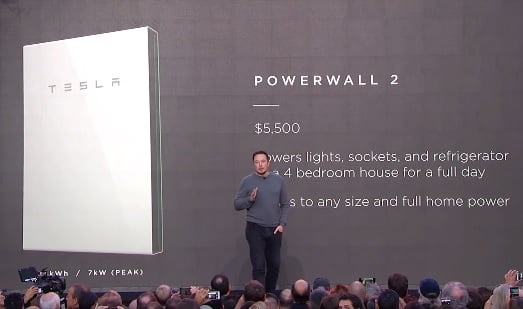
Tesla has announced the first programme to aggregate the capabilities of hundreds of its residential and commercial stationary storage systems in a partnership with Vermont utility Green Mountain Power.
The pair will bundle together up to 2,000 of Tesla’s residential Powerwall and commercial and industrial (C&I) Powerpack systems to create a “single resource of shared energy”, Tesla said, calling it the “next step in tapping the potential” of energy storage systems in the field.
Ever since the launch of the Powerwall was first announced in April 2015, it appeared Tesla, which took over residential solar installer SolarCity in the final quarter of last year, was seeking to develop a business model of aggregated Powerwall and Powerpack resources, as Energy-Storage.News reported at the time.
Meanwhile Green Mountain Power (GMP) was the first utility in the US to offer Powerwalls to customers with a ‘no money down’ option in a business model that depended on the customer then making some of the batteries’ capacity available to the utility to use for grid-balancing or peak demand reduction. At the time that offering was introduced, Lux Research analyst Cosmin Laslau blogged for this site that it was a “clever way” for the utility to “stay relevant” in the rapidly changing and increasingly distributed retail energy landscape.
Try Premium for just $1
- Full premium access for the first month at only $1
- Converts to an annual rate after 30 days unless cancelled
- Cancel anytime during the trial period
Premium Benefits
- Expert industry analysis and interviews
- Digital access to PV Tech Power journal
- Exclusive event discounts
Or get the full Premium subscription right away
Or continue reading this article for free
The value proposition
Green Mountain Power will deploy Powerpacks on its own properties and Powerwalls at the homes of up to 2,000 customers. Customers can either pay US$15 a month, or pay an upfront fee of US$1,500 for a 10-year agreement that allows them to use the batteries for backup power. Essentially, customers are being compensated or rewarded for making some of their Powerwall’s capacity available to the utility and to Tesla.
The utility and Tesla, meanwhile, will be able to use those batteries to provide grid services, including provision of dynamic capacity to meet shortfalls in supply and add grid stability, while at the same time lowering utility costs for ratepayers. The Powerwalls and Powerpacks will also be available for GMP to use in trading their power in wholesale markets in New England.
While the final scope and size of the programme will likely depend on customer demand and on the ratio of the split between Powerwalls and larger Powerpacks, a rough calculation shows that 2,000 residential systems (using the Powerwall 1.0 which has capacity of 6.4kW) would add up to around 12.8MW, making this one of the larger aggregated ‘virtual power plants’ deployed around the world to date.
According to Tesla, the GMP programme is “just the beginning” in the tech company’s close collaborations with utilities, aggregators, grid operators and energy retailers to “unlock the ability for Tesla batteries to deliver grid services while providing reliable power at all times of day,” the company posted on its corporate blog.
Tesla follows other energy storage makers in launching aggregated services, with other notable players in the residential space including Sunverge, which has launched a multi-megawatt virtual power plant in Australia with utility AGL, the UK’s Moixa and Germany’s Sonnen, with its SonnenFlat offering. In commercial and industrial energy storage, providers in the US such as Stem are already aggregating their systems and providing grid services. Navigant Research analyst Alex Eller wrote for Energy-Storage.News that energy storage software and control platforms that “allow energy storage systems to be virtually aggregated to provide a number of new services for an increasingly diverse range of customers” would be one of the main drivers for growth in the energy storage market and help build the grid of the future.