Sungrow has claimed a large-scale fire test proves the safety of its battery energy storage system (BESS) solution even in the event of thermal runaway.
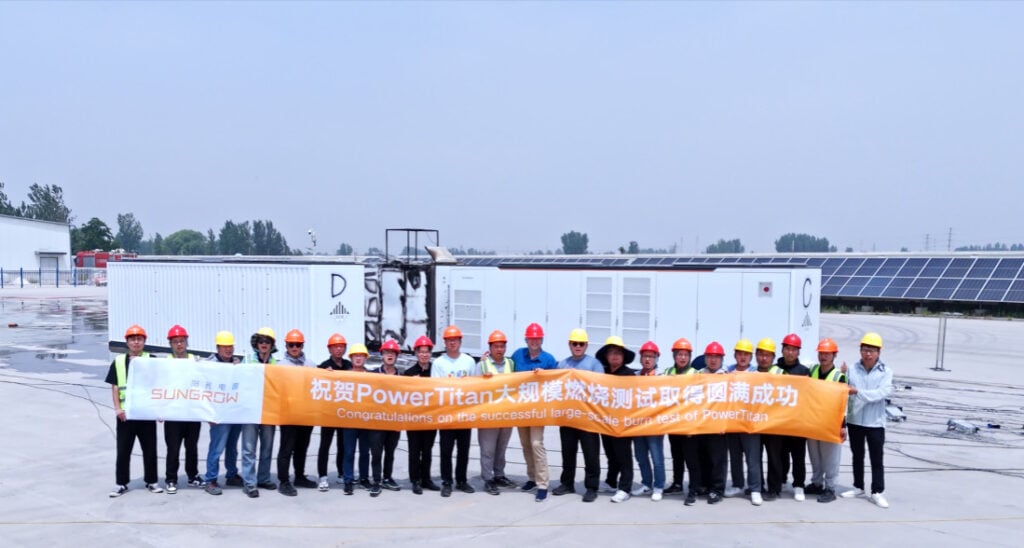
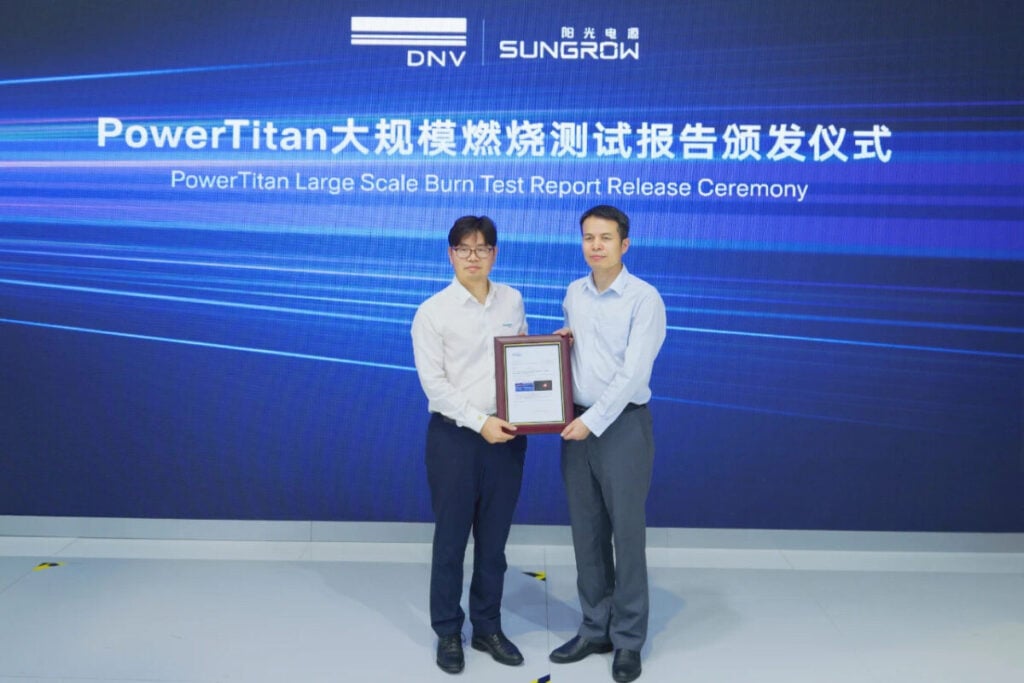
The China-headquartered solar PV inverter and BESS system integrator and manufacturer recently set fire to full-size Sungrow PowerTitan units in what the company claims was the first live-streamed event of its kind.
Four 2.752MWh containerised 20-foot PowerTitan units totalling 10MWh usable capacity were lit on fire at an undisclosed third-party lab facility in Puyang, China’s Henan province.
Aiming to replicate a real-world scenario, no external fire control measures were applied as the units burned at the 23 May event.
Try Premium for just $1
- Full premium access for the first month at only $1
- Converts to an annual rate after 30 days unless cancelled
- Cancel anytime during the trial period
Premium Benefits
- Expert industry analysis and interviews
- Digital access to PV Tech Power journal
- Exclusive event discounts
Or get the full Premium subscription right away
Or continue reading this article for free
Sungrow said the results demonstrated that even if thermal runaway caused cells inside the systems to ignite, the fire would not propagate to neighbouring containers or cause damage to other equipment at both DC block and station control levels.
The PowerTitan’s roof’s deflagration panels automatically activated, sending fire upwards to prevent its spread to other battery cabinets and system equipment.
Large-scale burn tests from other providers
Other BESS providers have conducted publicly announced burn tests on full-scale containerised units, although Sungrow claimed its test to be a world-first in terms of scale and the fact that it was live-streamed to selected stakeholders, including owners’ engineers, subject matter experts and fire protection consultants.
A company spokesperson claimed tests carried out by other providers “were very small, with a limited number of batteries,” versus Sungrow’s “largest” test to date.
In May 2023, Wärtsilä said it had put its GridSolv Quantum containerised unit through close simulation of a “worst-case scenario” event, lighting a fire inside a BESS unit and allowing it to burn for eight hours inside the ventilated unit.
That test proved the GridSolv Quantum’s doors would remain closed and prevent fire from spreading, while third-party fire safety group Fire & Risk Alliance captured gases released by the fire, concluding that the gases would be no more harmful than a fire involving more common consumer products.
This followed the BESS solution undergoing UL9540A thermal runaway propagation testing under accepted conditions and standards a couple of months previously, but the company said it wanted to push further to prove its safety in a scenario closer to a real-world event.
According to Wartsila director of product management and hardware Darrell Furlong, “this kind of bespoke, worst-case scenario testing demonstrates to our stakeholders that we’re serious about safety.”
Furlong told Energy-Storage.news Premium at the time that rather than just passing the minimum requirements of UL9540A and other standard testing, the company was investing in a more rigorous testing programme.
Similarly, in September 2023, Fluence performed a large-scale fire test that Andrew Gilligan, director of commercial strategy at the integrator and manufacturer, said “extended beyond industry standards and demonstrated the safety of our storage products.”
Although the Sungrow spokesperson claimed to Energy-Storage.news that its competitors had not live-streamed their own tests, “considering the possibility of failure to burn,” all three companies will, of course, share a common interest in proving the safety of battery storage as an asset class in energy, power and grid infrastructure.
“Too often, renewable energy sceptics raise fire safety concerns, even though batteries are overwhelmingly safe. These criticisms slow the adoption of such technologies,” Sungrow USA product engineering manager for its ESS division Bryce Laber said.
“At this stage, we are the only energy storage system supplier to execute a test with the complete machine of 10MWh and successfully pass, with unprecedented industry-firsts and transparency.”
Of course, all BESS providers will be hoping that their products will not be put through similar punishment in the field.
Sungrow pointed out that its PowerTitan series, including the newer, higher energy density and capacity PowerTitan 2.0, is equipped with liquid cooling technology that prevents dust and humidity from entering the system, which could be a risk of air-cooled BESS.
PowerTitan also suppresses thermal runaway through rapid arc shutdown technology, coolant loop connectors that self-seal, fusing protection at rack level and advanced temperature management controls that limit variations in cell temperature to within 2.5°C.
Watch Energy-Storage.news’ sponsored webinar with IHI Terrasun from March 2023, “What experts think you should know about UL9540 codes and standards for battery storage,” for more on UL9540A and related topics.
This article has been amended from its original form to accurately reflect the capacity of the units the tests were performed on.