
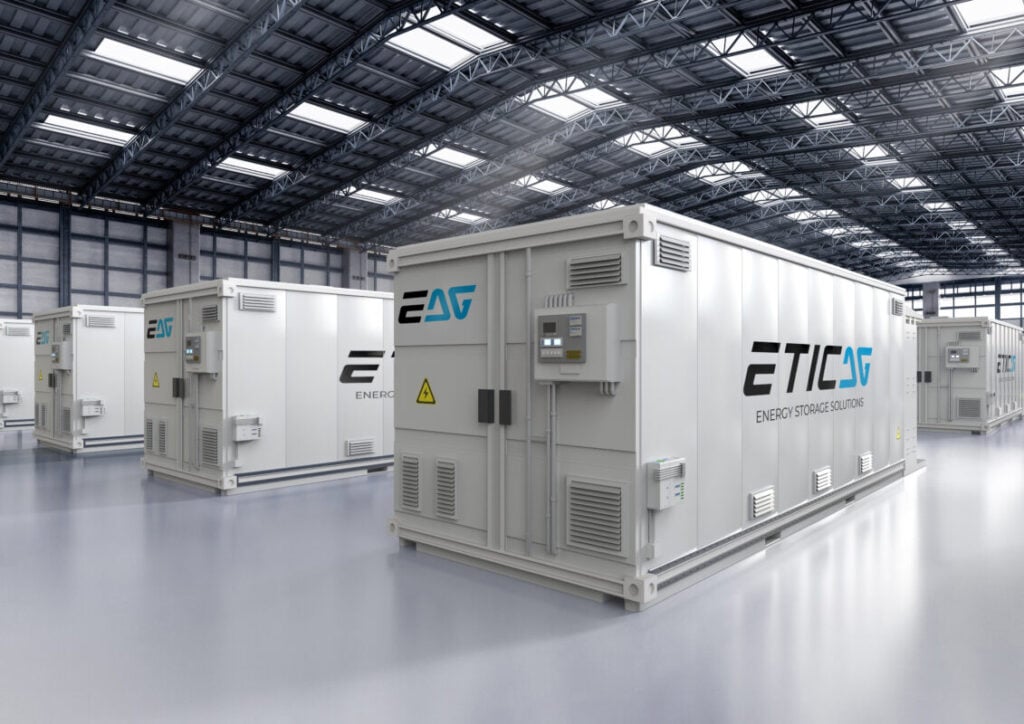
Energy-Storage.news Premium speaks with Pablo Barague, vice president of partnerships & commercial development, and Sam Harper, vice president of marketing & brand, at immersion cooling energy storage company EticaAg.
EticaAG, formed in 2025 between Taiwan-based Etica Battery and procurement and distrubtion company AssetGenie Inc. (AGI), plans to begin domestic manufacturing in the first quarter of 2027.
The company’s technology submerges lithium iron phosphate (LFP) battery cells in a dielectric fluid developed with oil giant Shell, isolating thermal runaway events to single cells rather than allowing propagation across modules or containers.
A dielectric liquid is electrically insulating fluid that prevents electrical current flow while also conducting heat.
Try Premium for just $1
- Full premium access for the first month at only $1
- Converts to an annual rate after 30 days unless cancelled
- Cancel anytime during the trial period
Premium Benefits
- Expert industry analysis and interviews
- Digital access to PV Tech Power journal
- Exclusive event discounts
Or get the full Premium subscription right away
Or continue reading this article for free
Immersion cooling, enabled by specialised dielectric liquids, is therefore another method for addressing thermal runaway in BESS.
Harper and Barrague say the timing of this technology is crucial, as safety perception has increasingly constrained energy storage deployment near population centers.
In New York alone, according to renewables service provider Carina Energy, there are approximately 100 active BESS moratoriums.
The restrictions persist despite statistical improvements in system safety and the phase-out of legacy designs implicated in high-profile fire incidents like the 2025 Moss Landing Energy Storage Facility fire.
“The highest value is close to urban centres, close to the load, where you’re avoiding the constraints of transmission lines,” Barrague says. “But when you get closer to urban centres, you have a lot more community opposition. The perception is still there.”
Single-cell containment in thermal runaway testing
EticaAG’s approach represents what the company claims as the next evolution in battery cooling, following the industry’s earlier transitions from air cooling to liquid plate cooling systems.
The immersion method circulates dielectric fluid around individual cells, with the goal of providing more efficient thermal management than plate-based systems while creating a physical barrier against thermal runaway propagation.
During UL 9540A testing, testers could not trigger thermal runaway propagation from the initiated cell to adjacent cells, even after two hours.
UL9540A is widely recognised in the industry for assessing the safety of electrochemical ESS, including, lithium-ion (Li-ion) BESS. The standard is considered the benchmark for evaluating safety, especially in assessing thermal runaway and propagation risks, making it critical to the bankability of energy storage technologies.
The updated edition introduces large-scale fire testing (LSFT) requirements to complement existing cell and module level assessments, potentially addressing what was seen as a gap in earlier versions by emphasising system-level safety evaluation.
The test protocol requires propagation to occur so evaluators can assess how systems handle cascading failures. In EticaAG’s case, technicians had to drain the dielectric fluid and rerun the test under standard conditions to complete the protocol, a detail documented in the official test report.
“Usually it happens after 30 to 40 minutes,” Barrague explains, referring to typical propagation timelines in conventional systems. “In ours, it was on for two hours and only that one cell went into thermal runaway.”
The company claims the technology extends battery life by approximately 20% compared to air-cooled or liquid plate-cooled systems, while reducing operational costs through lower auxiliary power consumption for thermal management.
Gas neutralisation layer
Beyond thermal containment, EticaAG’s system incorporate what the company calls HazGuard, a gas neutralisation system that addresses another safety concern, toxic off-gassing during thermal events. The sealed modules route gases from a thermal runaway cell to a physiochemical neutralisation unit mounted on top of the system.
Barrague and Harper explain that the process converts compounds like carbon monoxide, hydrogen, and hydrocarbons into nitrogen, carbon dioxide, and water vapor before release.
Harper further explains that the two-layer approach, immersion cooling-plus-gas neutralisation, makes the systems suitable for indoor applications, including data centres and commercial buildings, as well as rooftop installations.
Urban economics and developer interest
Barrague and Harper say that in large-scale desert installations paired with solar, batteries represent a small fraction of total project costs and land use. In constrained urban environments, land costs, interconnection upgrades, permitting complexity, and fire department requirements can end up dwarfing equipment expenses.
“The battery is not the expensive part of the project anymore,” Barrague says. “What is expensive is that you can deploy it. It gets cancelled after you spend a lot of money, or you just cannot put it in these places.”
EticaAG reports traction with New York developers seeking exceptions to local restrictions. “Developers say, ‘I can get an exception if you come with me. I know the path. I’ve done it before, but it will be easier with your technology,'” Barrague says.
The company positions its systems for deployments of approximately 5MW, four or five containers, in urban settings near substations where grid constraints create a strong economic case for storage.
Immersion cooling for battery storage is not unique to EticaAG. At least three companies in mainland China offer similar technology, and the approach has been deployed in Taiwan for several years, including thousands of residential units and utility-scale projects.
In February, Wanxiang A123 Systems (A123) unveiled a new BESS incorporating immersion cooling technology. The company characterises this as a transition toward inherent, system-level safety mechanisms, moving away from the industry’s current dependence on reactive fire suppression systems.
One Taiwan installation sits atop a high-rise building, a configuration Barrague describes as “almost unimaginable in the US” under current regulatory frameworks.
The technology itself draws on established industrial applications. Transformers have used dielectric fluids for cooling for a century, and data centre operators increasingly submerge servers in similar liquids for thermal management.
EticaAG’s third-generation system improves on earlier versions that used thermal barriers around cells rather than full immersion. The company’s US manufacturing plans and claimed compliance with Inflation Reduction Act (IRA) domestic content requirements differentiate its market positioning from other competitors.
Total cost of ownership
While Barrague and Harper claim upfront costs for immersion-cooled systems are comparable to conventional designs, with some developers noting slightly higher costs due to additional space requirements, EticaAG argues the total cost of ownership favours its approach.
The claim is that lower parasitic loads for cooling reduce auxiliary power costs, and extended battery life spreads capital costs over more operational years.
“The batteries themselves, in 10 to 12 years, came down 97% in cost,” Barrague says. “Today it’s about: can we deploy it? The cost came down more than enough to make it viable in so many places. But now we’re in a phase where we can’t deploy it in all these places because of all these constraints.”
The company acknowledges that retrofitting existing systems with immersion cooling is impractical due to fundamental design differences in materials, pumping systems, and fluid circulation, which it also notes as similar to the earlier impossibility of retrofitting air-cooled systems with liquid plate cooling.
However, Harper explains, “Our HazGuard toxic gas neutralisation system can be retrofit into existing systems.”
He continues, “It would just need to be sized much larger than the ones we put on EticaAG systems because our immersion technology is limiting the failure to a single cell. While in other systems multiple cells, if not the whole module or rack, would likely go into runaway and produce toxic gas.”
Regulatory and perception challenges
Changing public perception remains a central challenge. Barrague notes that energy storage conferences now regularly feature panels on community engagement, with consistent advice to developers: engage early, before projects are fully developed and vulnerable to quick municipal votes.
“There’s not a lot of technical information,” Barrague said of community meetings. “People come and say, ‘Look at all these news stories or what happened in all these places. They had to mobilise people because of the potential risks of the gases coming out.'”
The company works with developers to present its technology at these meetings, though Barrague acknowledges the broader industry challenge, that thermal runaway events have become statistically rare due to improved designs and the phase-out of nickel manganese cobalt (NMC) chemistry in certain applications, but high-profile incidents continue to shape public perception.
“Moss Landing was a legacy design. It was NMC, it was in a building format, it doesn’t have the ‘only burns to one unit’ feature,” Barrague highlights. “That doesn’t exist anymore. That’s not deployed anymore for years in that format. But the perception is still there.”
As regulators, fire marshals, and municipal officials gain exposure to immersion cooling technology, Barrague expects gradual evolution in language and requirements, potentially distinguishing between “let it burn” strategies EticaAG describes as more acceptable for remote installations, and containment approaches suitable for populated areas.
With US manufacturing scheduled to come online in early 2027, EticaAG is positioning immersion cooling as the next standard in an industry that has evolved its thermal management approaches, in this case, with the specific goal of unlocking deployment in urban markets where energy storage delivers a high economic and grid value.
