
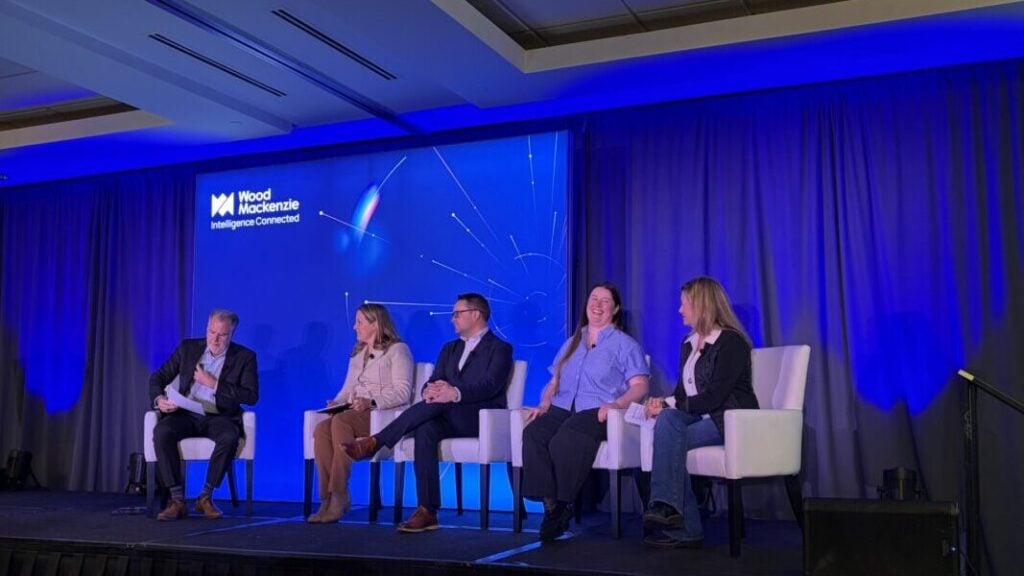
At a recent industry event hosted by market research firm Wood Mackenzie, energy storage experts discussed their approaches to public engagement, especially around addressing fire and other safety concerns.
The panel included Terri Schroeder from utility DTE Energy, Joel Vyduna from BESS developer Key Capture Energy, Emma Burke from owner-operator Pattern Energy, and Marci Palmstrom from IPP esVolta. Mark Stover, Executive Director of the trade association Texas Solar and Storage Association, moderated the discussion.
Early engagement
Vyduna emphasised the importance of thorough community outreach before filing permit applications. “If your goal is to send in a single developer, have them take a few conversations and run their use permit application through the process, I think those days are definitely over,” he said.
He recommends meeting with stakeholders individually before submitting applications. “Before you submit your application, ideally, you’ve spoken with all the stakeholders, all the neighbors, elected and appointed from both sides of the aisle, the Chamber of Commerce, the Lions Club, the Rotary—everybody that has an interest in that project.”
Try Premium for just $1
- Full premium access for the first month at only $1
- Converts to an annual rate after 30 days unless cancelled
- Cancel anytime during the trial period
Premium Benefits
- Expert industry analysis and interviews
- Digital access to PV Tech Power journal
- Exclusive event discounts
Or get the full Premium subscription right away
Or continue reading this article for free
This approach requires significant time investment. “You’re going to have to have 20 or 30 of these meetings with people, and put the time in. But then, if you do that up front, every one of them is going to become a well-educated little advocate for your project,” Vyduna explained.
Burke noted that Pattern Energy prioritises outreach to supporters. “Going to supporters first—the folks, the groups that you know will support your project, go to them first, get them informed. Definitely, the fire marshal, fire department is one of the first, if not the first, stakeholder that we’re reaching out to.”
Palmstrom agreed on timing: “As early as possible. Being at city council meetings, engaging with local public figures, getting feedback right away on what the community is, how they’re going to respond to this.”
The panelists reported hearing similar questions and concerns from community members across different projects and regions.
“Some of the things that we’re hearing in terms of opposition is it’s going to lower property values. It’s going to release toxins into the air, into the soil. It’s going to be this big, ugly site that everyone’s going to have to look at as they’re driving by,” Palmstrom said.
She also noted a newer concern, “There is strong opposition to some of these big data centres coming in, and so there is a sense that we’re finding that if the energy storage is built, there’s going to be a data centre coming along right away.”
Fire safety, however, remains the primary concern that developers must address with community members.
A growing number of BESS moratoriums highlight the fire safety concern. According to renewables service provider Carina Energy, in New York, there were approximately 100 active BESS moratoriums as of early March, making it a leader in the US.
The restrictions on these projects have persisted despite improvements in system safety, statistics showing incidents are becoming increasingly rare relative to deployment levels, and the phase-out of older designs implicated in high-profile fire incidents, such as the 2025 Moss Landing Energy Storage Facility fire.
Addressing fire safety
The availability of established fire safety standards, however, has made these conversations more straightforward than in previous years.
“A few years ago we didn’t have NFPA 855, UL 9540A, IFC Chapter 12, all these fire codes for batteries,” Vyduna said. “And now that reputable organisations like the National Fire Protection Association (NFPA) have adopted these codes and are teaching their members about it, I can go into really rural, full volunteer fire departments, and they’ve heard about this technology before.”
Burke emphasised sharing detailed test data rather than simply citing compliance. “What I like to dig into and what we can share is the information that those tests give us, the information a large-scale fire test (LSFT) gives us, the information that a cell burn test gives us, and that’s about knowing how the system burns, knowing how the fire can or shouldn’t propagate.”
This includes gas analysis and plume modelling. “We know what a worst-case scenario looks like, and what the impact on the community under that worst-case scenario looks like,” Burke said.
Palmstrom highlighted operational safety features: “Our sites are monitored 24/7, so it’s not like a fire would start, and the neighbour would need to call 911. There are automatic triggers that would bring the fire department. Our systems are also containerised, so if there does happen to be some sort of spark or fire within there, it’s not jumping from battery to battery to battery creating this huge fire.”
Schroeder also noted that fire department conversations have been easier than anticipated. “I came in expecting to have to educate the fire professionals in the communities, and those conversations have been a lot easier. They know the code, they know what to expect.”
Multiple panelists stressed the value of independent expert review.
“My experience is that the community doesn’t want to hear it from us,” Schroeder said. “They’re like, ‘We don’t care. We trust DTE, but we don’t care what you have to say about this. We want to know from someone professional.'”
To this point, Key Capture Energy routinely offers to fund independent advisors for municipalities. “We’ve already encouraged our community to hire their own advisors for anything that is questionable, and to the extent that it is allowed and legal, we will pay for that,” Vyduna said.
This approach looks to build credibility within the community over time. “After the 50th time that that third-party expert, working on behalf of the municipality agrees with what I say, at a certain point, they stop hiring third-party experts because they know that Key Capture Energy is not going to lie to them.”
Stover noted that Texas recently passed legislation incorporating developer-funded third-party validation requirements for battery storage projects.
Tailoring messages
The panelists then emphasised the importance of understanding what matters to each specific community.
Vyduna described different community priorities, such as economic development and tax revenue, grid reliability, and environmental benefits. “Understanding all the positives that batteries can provide, and leaning into what that community cares about, is a really important part of it.”
Schroeder noted that Michigan offers a grant programme that provides US$5,000-per-MW to communities that permit battery projects.
However, Vyduna said that reception to such programmes varies. “In some communities, they’ll say, ‘Absolutely, that’s great. Love the property taxes. Love this upfront incentive.’ There’s other times where the politicians say, ‘We really want that money. Please don’t mention it publicly.'”
Key Capture Energy has worked to develop a systematic approach to community questions.
“When you go into a community, they’ll say, ‘This community is really unique,’ which is true. Then they ask you the exact same 35 questions about battery safety, or really any topic related to battery development that every other community does,” Vyduna said.
The company maintains documentation of common questions covering “gases, smoke, fire code, sound, lights, fencing, setbacks, the fire water, or the potential of batteries leaking.”
“If in the moment that a question is asked, you can nod your head, acknowledge where the question is coming from, and then immediately have a succinct, accurate and appeasing answer, you can kill these issues before they fester,” Vyduna explained.
DTE Energy, meanwhile, benefits from an existing community relationship built over decades of operation.
“Most of the state is either an electric or gas customer of ours, and they’ve been a customer for 100 years,” Schroeder said. “Most of my BESS development is at either a retired coal plant, an operating nuclear or other plant, or co-located with wind and solar. So, in addition to being a DTE customer, we’ve been partners in their community on other assets for years.”
This allows DTE to approach community leaders directly, earlier in the process. “We’re going to the community leaders quickly and saying, ‘We would really love to add this battery project to your location. Do you see a path for us?'”
Developer expertise
Panel members also agreed that developers need to have broad technical knowledge when addressing community questions.
“The core developer needs to become a little bit of a firefighter and a little bit of a sound expert, a little bit of a light expert, because they’ve got to be able to understand how all these things piece together and be able to speak to them with a little bit of confidence,” Vyduna said.
Burke confirmed this from her experience at Pattern Energy, “Our developers lead that community engagement. They’re the ones that are working with the fire marshal, with the local authorities, local officials. My role, from a capital procurement perspective, is to provide a lot of that expertise and information and inform the developers so that they are going into these meetings informed.”
Developers encounter various forms of opposition, some also based on various types of misinformation.
Schroeder cited an asbestos comparison as a recurring, impactful comment by several oppositional community members, “’You told us asbestos was safe too.’ Not you, DTE, but ‘they told us asbestos was safe too. Now look at that.’”
Burke addressed toxicity concerns with context, “The smoke concentrations are really no different than that of a house fire. You don’t want to be near a house fire and breathing in the smoke, but it’s also not something that day-to-day you’re necessarily thinking and worrying about.”
Vyduna noted that developers must decide when to address criticism directly and when to let planning commissions evaluate claims themselves. “To a certain extent, the arguments can get so stupid you just don’t need to address them. Knowing when you need to go tit-for-tat with a community that’s trying to poke holes in your project, versus just letting it be said, or just recognising that the planning commission is smart enough to recognise when hyperbole exists—I think that that’s fine.”
This article has been amended from its original form to correct the spelling of Joel Vyduna from Key Capture Energy’s name.
