The government of New South Wales has signed a land lease agreement for a long-duration advanced compressed air energy storage (A-CAES) project.
A-CAES technology company and project developer Hydrostor said today (8 November) that a Crown Lands agreement has been signed with the Australian state’s government for its 200MW/1,600MWh (8-hour duration) Silver City project in the Broken Hill region of New South Wales (NSW).
The state’s energy minister, Penny Sharpe, said that once built and connected, the project would “prevent a repeat” of a recent emergency situation the Far West region of New South Wales was plunged into after severe storms on 17 October caused disruption to power supplies in Broken Hill and surrounding communities.
A Crown Lands agreement is a lease giving the holder exclusive permission to occupy and use state-owned land for a specific purpose and term under the NSW Crown Land Management Act 2016.
Try Premium for just $1
- Full premium access for the first month at only $1
- Converts to an annual rate after 30 days unless cancelled
- Cancel anytime during the trial period
Premium Benefits
- Expert industry analysis and interviews
- Digital access to PV Tech Power journal
- Exclusive event discounts
Or get the full Premium subscription right away
Or continue reading this article for free
The lease signed with the Crown Lands office at the Department of Planning, Housing and Infrastructure (DPHI) gives Hydrostor use of the site in Broken Hill for 65 years.
The long-duration energy storage (LDES) asset would play into the National Electricity Market (NEM), while a contract has already been signed with transmission system operator (TSO) Transgrid in 2022 for 250MWh of its capacity.
Transgrid selected the project through a competitive process to find a preferred option to back up the town’s electricity supply. Broken Hill is a historic mining region, and Hydrostor CEO Curtis VanWalleghem noted in an Energy-Storage.news interview that its baseload and peaking capacity is mostly supplied today by ageing diesel generators.
Claimed efficiency and environmental improvements
Hydrostor holds the IP for the proprietary A-CAES technology. VanWalleghem claimed that while conventional CAES projects run reliably, their drawbacks include a reliance on natural gas to heat air before its expansion as the systems discharge energy.
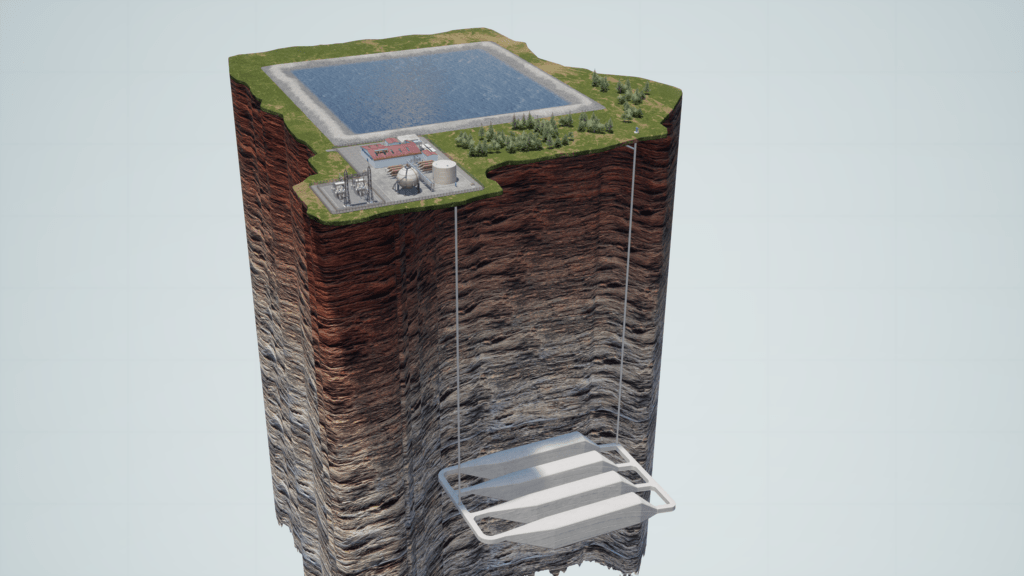
A-CAES uses a thermal management system which closes the loop of heating and cooling. Heat produced during compression is captured instead of vented and then stored in hot water, which is used to pre-heat the air before its expansion.
Another claimed innovation is that while CAES traditionally used salt caverns to store the compressed air, Hydrostor’s design allows the air to be stored in hard rock caverns. These caverns are typically used in the mining and hydrocarbon industries, and so existing mine sites, such as the Potosi mine at Silver City in NSW, can be repurposed.
Just over a year ago, the Canadian tech company signed a binding agreement with mining firm Perilya for the use of existing mine assets and infrastructure at Potosi.
State gunning for 28GWh long-duration storage by 2034
In mid-October, severe storm conditions destroyed seven of Transgrid’s transmission towers in Broken Hill and the Far West region of NSW, significantly disrupting the electricity supply in the town and its surrounding communities.
Backup generators kicked in, but planned and unplanned outages occurred to help keep it running, while a new 50MW/100MWh battery energy storage system (BESS) in Broken Hill owned by utility AGL was called into action by Transgrid.
“Recent events in the Far West region of NSW have demonstrated the need for long-duration storage to secure energy supply for Broken Hill and the Far West,” NSW energy minister Penny Sharpe said today of the deal with Hydrostor.
“This project will replace the older large-scale back-up diesel generator, preventing a repeat of the recent energy emergency in the Far West region of NSW,” Sharpe said, adding that the Silver City A-CAES system would “make Broken Hill a renewable energy leader,” putting more clean energy into the state’s energy mix and helping lower power prices.
In addition to some financial support through the NSW Emerging Energy Opportunities Program, Hydrostor’s project has also received funding support at federal level, from the Australian Renewable Energy Agency (ARENA). ARENA pledged AU$49 million (US$29 million) towards the projected total cost of AU$652 million in 2022.
Silver City also has a Long Term Energy Service Agreement (LTESA) contract for under a NSW state policy roadmap, awarded to Hydrostor by AEMO Services in late 2023.
CEO VanWalleghem described the contract to provide firming capacity to the grid as “a big vote of confidence in not only long-duration energy storage, but also our compressed air solution as a key technology pathway for decarbonisation and grid reliability across Australia.”
New South Wales energy minister Sharpe recently announced plans to legislate a 28GWh by 2034 long-duration energy storage target for the state. Its existing target is for 2GW of 8-hour duration storage (16GWh) by 2030, under the NSW Electricity Infrastructure Roadmap 20-year plan.
The first contract for LDES under a government biannual tender process as set out in the Roadmap was awarded in 2023 to RWE for a 50MW/400MWh lithium-ion (Li-ion) BESS project.
RWE has since made the Final Investment Decision (FID) to take that project into construction, while the state government has given Critical State Significant Infrastructure status to three long-duration pumped hydro energy storage (PHES) projects in development.