Sonnen has launched its first virtual power plant (VPP) in Canada with utility Epcor, electric retail provider Solartility, the University of Alberta and construction company Landmark Homes.
Residential energy storage system manufacturer and software provider Sonnen’s VPP will be deployed at Landmark’s Blatchford Lands community located in Edmonton, Alberta’s capital city.
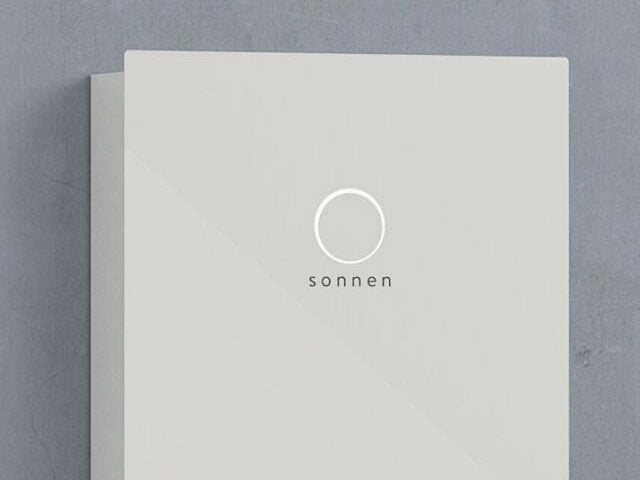
The Blatchford Lands VPP will see 100 Sonnen batteries deployed throughout the community, which the company says will represent nearly half a MW of power and over 2MWh of storage capacity.
Speaking with Energy-Storage.news Premium, Blake Richetta, chairman and CEO of Sonnen explained:
Try Premium for just $1
- Full premium access for the first month at only $1
- Converts to an annual rate after 30 days unless cancelled
- Cancel anytime during the trial period
Premium Benefits
- Expert industry analysis and interviews
- Digital access to PV Tech Power journal
- Exclusive event discounts
Or get the full Premium subscription right away
Or continue reading this article for free
“The Alberta model is quite unique and is a bit of a ‘hybrid’ of the American model in Utah and in Texas – involving both the direct dispatch of an investor-owned utility (IOU) plus the dispatch of a Retail Electric Provider.”
“Not to mention the super pioneering homebuilder, in Landmark Homes, similar to our ‘bellwether’ projects in America – with home builder/developers Mandalay Homes, Wasatch Group and Pearl Homes. And there are other exciting components to the Alberta model, including government innovation grants / awards, involvement from the University, etc.”
Blatchford Lands has received awards from Emissions Reduction Alberta (ERA), a government agency established by the Canadian province operating on the ‘polluter pays’ principle, where large industrial companies contribute financially based on their carbon emissions and environmental impact.
The neighbourhood uses renewable energy sources for heating and cooling in a location that was previously Edmonton’s municipal airport.
Also speaking with ESN, Geoff Ferrell, senior vice president of VPP business and field technical support at Sonnen, said of a typical installation for this programme:
“The battery, in the case of Landmark’s model, is located in the basement mechanical room. Our simple installation that utilises the home’s existing infrastructure and available space makes adding the battery to any home very easy and can be an upgrade to existing solar-only sites. The battery is also connected to the home’s internet, so we and the utility can monitor and control the systems remotely and achieve the goals set out in the project.”
After the initial deployment, Sonnen plans to launch VPPs throughout Alberta and other regions of Canada, claiming to potentially reach over 3,000 individual sites with more than 18MW of energy and 60MWh of grid support within the next three years.
The company aims to use this VPP project and others similar to it as a model for deploying more VPPs in communities throughout the US and Canada.
Richetta emphasised several grid services that the systems will deliver for Alberta: “Dispatched demand response (DR) / load shed during periods of grid congestion, dispatched DR to help mitigate peaking power plants, and potential non-wires alternatives (NWAs), or future distribution infrastructure investment deferral.”
He continued, “Firm dispatchable capacity planning [at the] system level, involving precise load shaping for grid-balancing and mitigating the Duck Curve effect. This includes potential reverse demand response through grid withdrawal or dispatchable load, and the possibility of dispatched energy injection. In the future, it may also encompass frequency response and Regulation Up for grid resiliency.”
Richetta also explained of the University of Alberta’s involvement, “The University will be a research partner. They will calculate the difference in energy use from a baseline home and one linked to the VPP to show the broader impact it could have.”
Ferrell added:
“U of A was tapped to provide the long-term study of these nodes as they relate to the local electrical infrastructure and to partner with the project team to model its full-scale effects. If these 100 homes were 10,000, what are the incremental or exponential benefits of all that flexible, dispatchable load on the grid, and what could parties like Solartility and EPCOR do with that?”
“They will be quantifying the monetary, greenhouse gas (GHG) and grid support aspects of this model to report on the attributes of an advanced BESS-based VPP as they benefit all the stakeholders in the value chain.”
That programme was an extension of the one launched in February, in which SOLRITE Energy and Sonnen combined SOLRITE solar panels with Sonnen batteries.
Sonnen has also launched VPPs at similar Utah, Florida and Arizona communities.