
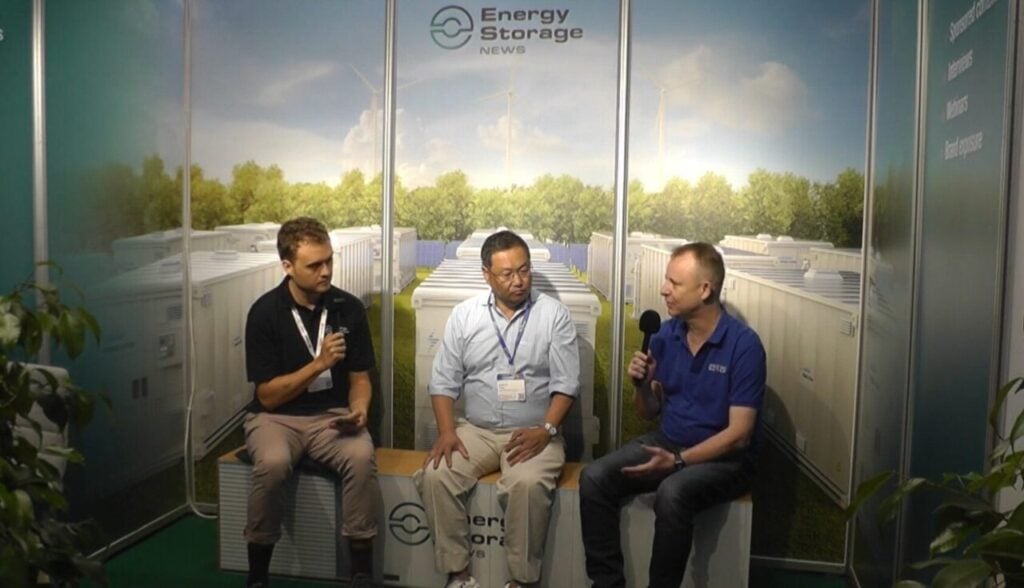
How do Chinese OEMs respond to evolving customer requirements and new risks that come with business outside their home market? We sat down with executives from Rept Battero at Intersolar Europe in June to discuss.
China-based lithium-ion and battery energy storage system (BESS) OEM Rept Battero is the fifth-largest supplier of cells for BESS globally, and by some counts the largest in the residential and C&I space. Now it is looking to translate that success into the grid-scale BESS market, says head of overseas business Andy Tang (formerly of system integrator Wartsila).
Tang was joined by global head of delivery Simon Wardell for a video interview with us at the Smarter E Europe trade show in Germany last month (often called Intersolar). In it, they discussed how Chinese companies need to evolve their offering to be successful outside their home market.
That includes how it responds to the EU’s ban on Chinese inverters in subsidised solar and BESS projects: see Tang’s comments on that in a separate piece published during the event.
Try Premium for just $1
- Full premium access for the first month at only $1
- Converts to an annual rate after 30 days unless cancelled
- Cancel anytime during the trial period
Premium Benefits
- Expert industry analysis and interviews
- Digital access to PV Tech Power journal
- Exclusive event discounts
Or get the full Premium subscription right away
Or continue reading this article for free
Evolution in offering
“There’s an evolution going in China among the battery OEMs and that is about moving away from just being a cell and module producer and seller, a process which starts and stops in China,” Tang explains.
“The performance warranties and guarantees in that business model are actually a reasonably small subset of what happens when you become an AC-DC block provider or system integrator.”
“So a lot of the challenges we have been working through are how do you bring the organisation forward and get them to the point of understanding the new risks. They’re fundamentally different risks along the integration line than what these companies have had to undertake.”
“It’s really about: how do you make sure that these projects come together? How do you make sure that the equipment shows up on site in a timely manner? How do you commission the system?”
Building out workforce
Wardell explains that the key to solving this challenge is hiring a best in-class workforce around these new expectations and risks, building up its offering in the more long-term areas of BESS project delivery, and ensuring a consistent service across regions.
“We’ve started really building out the team in both Europe and Australia and we’re also building out the systems, the processes and controls to make sure that, as a lot of our customers now are sort of global, that they see a one-way process no matter where they are.”
“That helps build accountability and shows we understand what is needed to be done all the way through the different commissioning steps, the grid connection process, and it really backs up the contract. We’re focused on building out that 20 year long-term service agreement (LTSA) to support those projects as well.”
Tang added to this with an issue which we’ve heard developers and IPPs cite as a major challenge when buying BESS from Chinese OEMs.
“If you look at my peers, my competitors in Europe, they have really pursued a model where they are sending people from China to do the commissioning on the systems. And that is a model that I think really has to shift and really has to change. At Rept we believe we really need locally based people that can speak the local language, are hands on, and can be that customer touchpoint. I think that’s really a critical issue.”
Wardell explained that the company is going for an approach that is 80% globally standardised and 20% local, dictated by things like grid connection standards and commissioning.
Full AC solution
The company is moving towards offering a full AC wrap solution, where it buys the power conversion system (PCS) equipment, provides the BESS, and puts the project together. But the responsibilities are obviously very different doing that versus just being a DC block supplier, Wardell says.
“I’ve done two very large AC wrap projects in the last few years that have had bumps along the way, and I’m bringing those learnings to Rept,” he adds.
While he didn’t name the projects, Wardell was VP projects in Australia for system integrator Powin from March 2023 to June 2025, when the company entered bankruptcy. (Its assets were then acquired by competitor FlexGen.) Wardell worked on the 850MW Waratah Super Battery, which Powin deployed for IPP Akaysha Energy in New South Wales during that period. In November it suffered a ‘catastrophic’ transformer failure, reducing its capacity before a later planned full shutdown. Last month it returned to 700MW capacity, 82% of its maximum.
Battery passport in Europe
Wardell explained that as part of that 80:20 approach, the firm is building up an IT and service solutions approach that can be globally applied, which Tang tied to the Battery Passport in Europe.
“The Battery Passport requires full traceability including on raw materials. But it relies on this IT backbone that Simon was talking about, that that helps store the information and to give you that level of traceability and transparency.”
“It’s one thing if you have a 20MWh site. It’s a completely different thing if you have a 1GWh site in terms of, for example, discovering a batch of batteries or a BMS that is defective. Without this backbone in place, your ability to go and figure out what to replace in the field is highly limited.”
DC vs AC solutions in Europe
We asked them what sort of demand they were seeing for full AC wrap solutions versus just DC block supply in Europe and how that’s evolved in the last few years.
Tang says that the Central and Eastern Europe (CEE) region has a lot of very entrepreneurial IPPs who are willing to take on the system integration themselves and therefore would just buy DC blocks from someone like Rept. In Western Europe on the other hand the need for fully wrapped solutions continues, he says.
This is borne out by many Chinese OEMs first projects in Europe being in the CEE region, including Rept’s.
He also sees an acceleration in the ‘splitting up’ of solutions into separate contracts for equipment supply and balance of plant (BOP) works in Western Europe.
Manufacturing locally?
We finished by asking Tang about the possibility of it setting up more local manufacturing for its overseas markets, potentially in Europe as some Chinese OEMs are doing. The firm manufactures in China and Indonesia currently. His answer was an interesting one.
“It’s a very challenging issue because it’s not really just a simple capital investment,” he explains.
“It’s actually a geopolitical decision and it has ramifications both in the host country wherever we would decide to build that facility, but also back in China. I would state that there is equal pressure in China about whether or not to allow the technology to leave China.”
