A “silver buckshot, not a silver bullet” has emerged as the rallying cry for Australia’s energy storage strategy, as Paul Hunyor, Co-CEO of Wollemi Capital, advocates for a comprehensive multi-scale approach that combines utility-scale projects with rapidly deployable distributed systems.
This philosophy reflects a pragmatic recognition that while “big utility-scale, storage and renewables projects are incredibly important,” the urgency of the transition requires leveraging every available pathway.
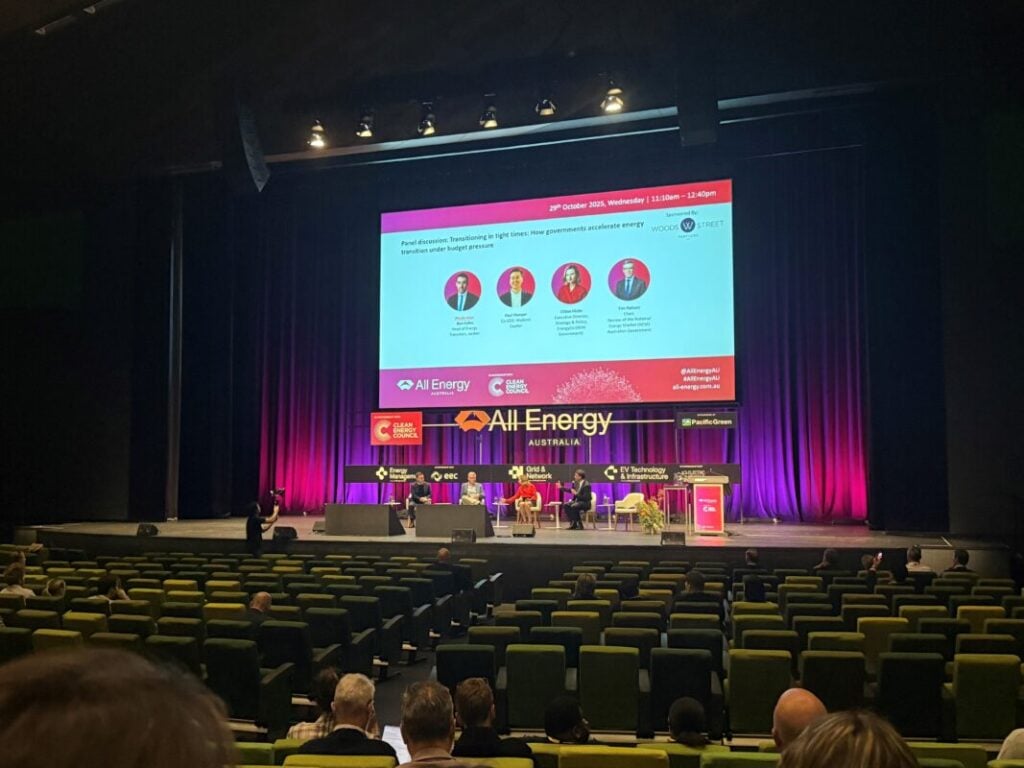
“It’s often said what’s required here is not a silver bullet, but a silver buckshot,” declared Hunyor, speaking at the All-Energy Australia 2025 conference session on ‘Transitioning in Tight Times’.
The session brought together several key figures shaping Australia’s energy storage landscape, including Hunyor; Tim Nelson, chair of the Review of the National Electricity Market (NEM); and Chloe Hicks, executive director of strategy and policy at EnergyCo (New South Wales).
Try Premium for just $1
- Full premium access for the first month at only $1
- Converts to an annual rate after 30 days unless cancelled
- Cancel anytime during the trial period
Premium Benefits
- Expert industry analysis and interviews
- Digital access to PV Tech Power journal
- Exclusive event discounts
Or get the full Premium subscription right away
Or continue reading this article for free
The global financing challenge
Hunyor outlined the global financing challenge, noting that while annual spending on energy transition has grown to “two and a bit trillion” globally, reaching climate targets requires an increase “upwards of seven to 10 trillion” by 2030-2050.
In the Australian context, private sector investment accounts for approximately 40-50% of the required capital, making government policies that encourage private investment essential for meeting storage deployment targets.
The cost dynamics of battery storage have created new opportunities for the distributed deployment of energy storage systems. Hunyor described the transformation in battery economics as “breathtaking,” citing “year on year, 40% declines on the equipment basis the last three years running.”
This cost reduction, driven by manufacturing capacity expansion from China, has made smaller-scale energy storage projects economically viable without the complex interconnection queues and social licence challenges that plague utility-scale developments.
Wollemi Capital’s recent acquisition of development team MPower demonstrates this strategic shift toward distributed storage. The team develops sub-5MW hybrid battery and storage sites, with Wollemi committing “a couple of 100 million dollars initially for the sort of next 18 months of rollout,” Hunyor said.
Hunyor explained the rationale: “If you’re looking for sort of billions at a time, and all the risks and complexity and timeline that goes with that, there is a good universal people to do that. We’re looking at sort of tens of millions that, in aggregate, add up to hundreds of millions.”
Tim Nelson discusses the Review of the NEM
One of the biggest discussion points on the panel, and across the two days of All-Energy Australia 2025, was undoubtedly the Review of the NEM by the independent expert panel led by Griffith University associate professor Tim Nelson, with the draft report having been released in early August. The report outlined key market reforms with implications for the energy storage sector.
Indeed, commenting on the publication, Nelson said the team identified revenue certainty as the primary barrier to storage investment.
“Every day they hear from a very clever analyst who tells them, well, electricity is going to get cheaper in the future because technology is getting better. But if you’re investing in heavy, fixed cost infrastructure that lives for a long time, you need some degree of revenue certainty,” Nelson explained.
The review’s proposed Energy Security and Investment Mechanism (ESIM) represent an evolution of existing reverse auction schemes, designed to provide revenue certainty while maintaining competitive price discovery.
Nelson emphasised the mechanism’s applicability to distributed storage through aggregation: “If I aggregate all of those batteries up… then all of a sudden the economics that I need to make those batteries work are the same real economics that exist for large-scale batteries.”
The policy framework acknowledges market signals favouring storage deployment. Nelson pointed to South Australia, where “70% of prices are negative” during midday periods, creating “a really good signal to install storage, not just large scale, but small scale.”
This price environment demonstrates how market fundamentals support storage investment independent of government subsidies.
EnergyCo on the 850MW Waratah Super Battery
EnergyCo’s approach to large-scale storage deployment demonstrates how government agencies can manage budget constraints while delivering critical infrastructure.
The Waratah Super Battery project, an 850MW/1,680MWh system, serves as both a transmission support mechanism and a commercial storage asset. The BESS, which is the “world’s most powerful battery” in terms of power output (850MW), was developed by Akaysha Energy and achieved its first full discharge to the NEM last month.
Hicks described it as “a fantastic buffer” for the Hunter transmission project, acting “like a shock absorber for the network by allowing us to run certain transmission lines higher by providing that redundancy” – not the first time the utility-scale BESS has been described this way.
The project’s financing structure demonstrates an innovative approach to risk allocation. Built on a former coal-fired power station site, the battery provides system integrity protection while allowing private operator Acacia to extract commercial value. This dual-purpose approach maximises public benefit while engaging private capital for operational efficiency.
EnergyCo’s Transmission Acceleration Facility represents another financing innovation addressing budget constraints. This revolving fund, capped at AU$2.4 billion (US$1.57 billion) but expected to cycle AU$6 billion through by 2030, enables early development work before regulatory approval or financial close.
Hicks explained: “What that allows us to do is keep recycling the funds through it,” enabling concurrent development activities that traditionally occurred sequentially.
The facility addresses a critical market failure in the storage and development of renewable energy. “Rather than previously, where you would have a network like TransGrid, they really need to know that they had regulatory certainty before they could commence. Now what we’re able to do is really accelerate all of that so that it can happen concurrently,” Hicks noted.
Setting the stage for strategic action
Industry participants identified specific policy priorities for accelerating storage deployment under budget constraints, with each panellist offering targeted recommendations that reflect their unique perspectives on overcoming the financing and deployment challenges facing Australia’s energy transition.
Nelson emphasised the untapped potential within urban environments, pointing to commercial and industrial rooftops where solar deployment remains limited due to “classic economic problems of principal-agent and split incentives” rather than pure cost barriers.
His focus on distributed energy reflects the reality that these projects don’t require substantial subsidies but instead need “innovative thinking and working with the private sector to create new business models.”
Hunyor highlighted systemic financial barriers, particularly the technical impediments within superannuation fund benchmarking that prevent Australia’s massive domestic capital pool from investing in land-based renewable energy systems.
He warned that without addressing these “quite technical sort of financial measurement and metric-driven policies,” Australia risks missing the opportunity to deploy its own capital in becoming a “renewable energy superpower.”
Meanwhile, Hicks advocated for comprehensive infrastructure coordination, stressing that successful large-scale deployment requires attention to every component of the supply chain – from port logistics to road upgrades for wind turbine transport.
Her approach centres on creating “fantastic legacy” outcomes where renewable energy infrastructure projects simultaneously address long-standing community needs, from telecommunications upgrades to social housing development.
You can find further coverage from All-Energy Australia 2025 on Energy-Storage.news.