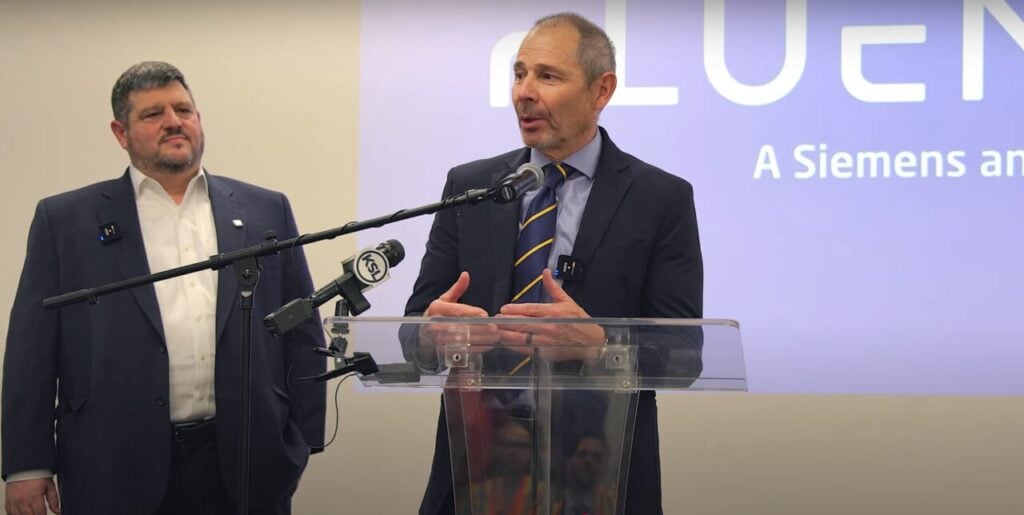
Energy tax credits “drive innovation, strengthen our economy, and create real opportunity”, according to US Republican Senator John Curtis.
Curtis, who has represented Utah in the Upper House of Congress since 2017, spoke yesterday during a visit to the recently opened battery module factory of battery energy storage system (BESS) integrator and technology provider Fluence in Utah’s Tooele County.
According to Fluence, the visit was made to highlight the company’s investment in US manufacturing and its efforts to build a domestic supply chain for its technologies.
“As energy demand continues to grow, we need an all-of-the-above approach that supports Utahns and provides the long-term certainty businesses need to invest and expand,” Senator Curtis said.
Try Premium for just $1
- Full premium access for the first month at only $1
- Converts to an annual rate after 30 days unless cancelled
- Cancel anytime during the trial period
Premium Benefits
- Expert industry analysis and interviews
- Digital access to PV Tech Power journal
- Exclusive event discounts
Or get the full Premium subscription right away
Or continue reading this article for free
“In Utah, we’ve seen firsthand how smart policies—like energy tax credits—can drive innovation, strengthen our economy, and create real opportunity.”
It comes at a time when the future of current tax credit schemes, both for manufacturing and deploying clean energy technologies, are under threat.
The budget reconciliation bill aka ‘One, Big, Beautiful Bill’, passed by the House of Representatives, the lower house of Congress on 22 May, seeks to eliminate production tax credits (PTCs) and investment tax credits (ITCs) for technologies including energy storage.
If passed in its present form by the Senate, the bill would limit the availability of tax credits to projects that begin construction within 60 days of US President Donald Trump signing it into law and enter commercial operation by the end of 2028.
They had been due to run until 2032, with the percentage of capex support phasing out gradually each year.
Bill would hand competitive advantage to China, industry groups say
Response to the bill has been fierce from industry sectors, including solar PV and energy storage.
Jason Grumet, CEO of the American Clean Power Association (ACP), which represents energy storage companies since its merger with the former national Energy Storage Association (ESA) in 2022, said the House had “voted to immediately end the clean energy tax incentives that provide economic growth, good-paying jobs, and low-cost electricity to millions of Americans”.
“By a margin of one vote [the bill passed by 215 votes to 214], the House voted to retreat in our competition with China for manufacturing jobs and to weaken our technology sector in the global race for digital dominance,” Grumet said.
“For the good of our country’s energy security and energy bills—this cannot stand.”
Many others spoke out, including fellow trade associations Solar Energy Industries Association (SEIA), American Council on Renewable Energy (ACORE) and the Business Council for Sustainable Energy (BCSE), which said in a statement that tax credits have enjoyed bipartisan support for decades, “and are key to driving America’s energy expansion as we face unprecedented energy demand.”
BCSE pointed out that tax credits have led to the creation of more than 400,000 jobs in energy, spurred more than 260 new manufacturing facilities and attracted US$133 billion of private sector investments to date.
‘US demand has skyrocketed while production moved overseas’
With the fate of tax credits—among many other things—now in the hands of the Upper House, the trade groups urged Senators to reject the approach laid out in the bill.
Fluence has long been vocal about its strategy of building up its domestic supply chain and manufacturing capabilities within the US.
It announced the Utah factory in 2022, and production there began last year, while earlier this month it opened a BESS enclosure assembly plant in Arizona. It also sources battery cells for about half of its projects in the country from a factory operated by AESC in Tennessee and buys other components from within the US.
However, the reality is that the energy storage industry remains largely dependent on imported materials, components and solutions from abroad, largely from China. The bill’s other provisions include prohibitions on relying on so-called foreign entities of concern (FEOC), and cutting off major supply chains without giving the US domestic industry enough runway to become mature could also be damaging to the fate of clean energy industries, along with the removal of tax credits.
Even the National Electrical Manufacturers Association (NEMA), which praised the legislation’s pro-US manufacturing provisions, cited the need for an “all-of-the-above tax code” that would “support an all-of-the-above electricity grid that can meet rising demand and maintain affordability for American families.”
“We are concerned that prematurely phasing out key energy tax credits will slow these essential infrastructure investments, stifle economic growth and job creation, and have a chilling effect on our shared objectives of growing domestic manufacturing, expanding energy dominance, and winning the AI race with China,” a NEMA statement last week read.
“When the industry first started putting battery storage onto the grid in 2008, the core equipment was sourced from facilities in the United States,” Fluence’s Americas president John Zahurancik said.
“Since then, production has largely shifted overseas, even though US domestic demand has skyrocketed,” Zahurancik said, claiming that facilities like Fluence’s in Utah are “helping to build the foundation for the United States to once again be a leader in battery manufacturing.”
Senator Curtis said his visit to the Tooele County facility allowed him to see the value of tax credit incentives in “meeting both our energy production and economic development goals”.
Fluence posted a short video recap of Curtis’ visit, including remarks from the Utah senator and John Zahurancik, which you can see below.