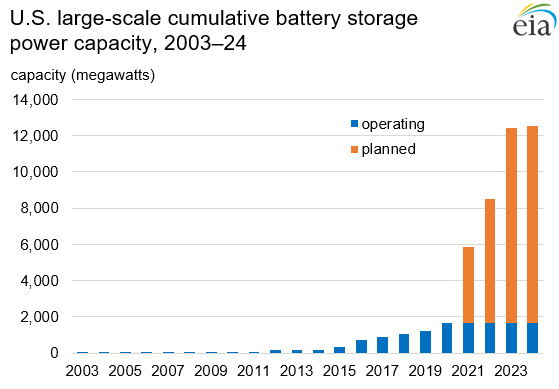
The US’ installed battery storage capacity reached 1,650MW by the end of 2020, but the country is on track to have nearly 10 times that amount by 2024, according to the national Energy Information Administration (EIA).
The stats are among findings in the most recent edition of the EIA’s Electricity Monthly Update and the Administration used the opportunity to paint the picture of an energy industry segment on a rapid upward trajectory. The first battery storage system that was reported to the EIA was installed in 2003 and from there it took until 2012 before cumulative installations reached the 100MW mark.
The growth of battery storage picked up pace significantly in 2015 when 153MW was added during that year, a 90% growth from the year before that before the 1GW market was surpassed in 2018. While the cumulative install figure for 2020 presented a decent jump of 35% from 1,222MW in 2019, this looks small compared to what lies ahead.
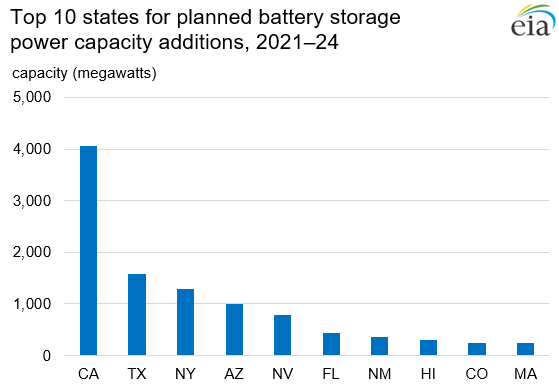
According to the EIA, between 2021 and 2024, about 10.9GW of battery storage power capacity additions is expected to come online, meaning there could be more than 12GW installed across the country by then.
Try Premium for just $1
- Full premium access for the first month at only $1
- Converts to an annual rate after 30 days unless cancelled
- Cancel anytime during the trial period
Premium Benefits
- Expert industry analysis and interviews
- Digital access to PV Tech Power journal
- Exclusive event discounts
Or get the full Premium subscription right away
Or continue reading this article for free
Batteries are being installed to perform a number of applications, from fast response ancillary services like frequency regulation, peak shaving and price arbitrage to renewable energy storage and balancing supply and demand on the grid. However, the single biggest contributor to the recent rapid increase is the installation of battery storage paired with solar PV.
One possible reason for this is that energy storage installed with solar is eligible for the investment tax credit, while as yet, standalone battery storage projects, are not. Recent studies by a team at Lawrence Berkeley National Laboratory (Berkeley Lab) looked in close detail at the different factors that determine whether standalone battery systems, or hybrid (renewable paired) offer the most benefit in any given location or grid interconnection point.
Action remains largely focused on key states with supportive policies and strong renewable energy markets
One trend the EIA has not yet reported figures on is the energy capacity, measured in megawatt-hours of battery storage installed: the most recent figures for that are for 2019, when 1,222MW of energy storage power capacity and 1,688MWh of energy capacity were recorded.
It will be interesting to see when the next figures emerge if the growth of relatively longer duration lithium-ion batteries, of up to four-hour durations, will mean there is a considerable leap in megawatt-hour figures across the US, or if this is limited broadly to the major regional markets such as California, where four-hour batteries are increasingly common.
Speaking of California, that state perhaps unsurprisingly to regular readers of Energy-Storage.news leads the US with 506MW installed as of the end of 2020 — and a significant amount expected to be reported for this year too. Elsewhere the top five states of California, Texas, Illinois, Massachusetts and Hawaii accounted for more than 70% of installed capacity. EIA said that what all of these states have in common are that they have passed legislation favourable to the deployment of storage, either through requirements or incentives.
From now until the end of 2024, the expected 10.9GW of new battery capacity will be spread across 22 different states, although California, Texas, Arizona and New York between them will deploy about 70% of it. California leads once again, with more than 4GW of power capacity planned.