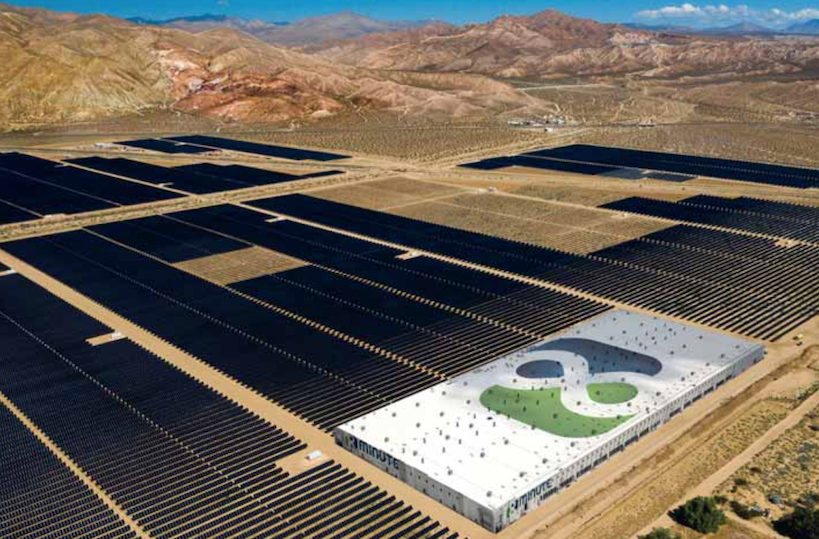
Standalone battery energy storage can potentially offer better value to the US electricity system than pairing batteries directly with solar or wind generation, but the pros and cons of each approach vary greatly from project to project.
This is largely because siting the resources separately means the optimum location where batteries in particular offer most value to the electricity network can be chosen, according to a new study from Lawrence Berkely National Laboratory (Berkeley Lab).
Battery storage is useful for mitigating the volatility that increased renewable energy penetration brings to electricity networks, but it does not necessarily need to be interconnected to the grid at the same point in order to do so. Batteries can also mitigate other problems that the grid experiences, such as transmission congestion, where demand for electricity is growing greater than the network infrastructure that can deliver it.
Adding four hours of battery storage sized at half the nameplate capacity of a renewable power plant adds, on average, US$10/MWh of electricity market value across the service territories of the US’ seven main independent system operators (ISOs). On the other hand, independently siting renewable power and battery storage can enable each to be located at the grid node where it offers most locational value, adding an estimated US$12.5/MWh of value.
Try Premium for just $1
- Full premium access for the first month at only $1
- Converts to an annual rate after 30 days unless cancelled
- Cancel anytime during the trial period
Premium Benefits
- Expert industry analysis and interviews
- Digital access to PV Tech Power journal
- Exclusive event discounts
Or get the full Premium subscription right away
Or continue reading this article for free
There is a growing appetite for hybrid resources from renewable developers, the study notes. In the West of the US, around 70% to 90% of proposed new solar plants at the end of 2020 would be paired with energy storage, with a national average of about 34% of solar and 6% of wind project proposals including co-located batteries.
There are many reasons for this trend to have emerged, especially in California, where 89% of large-scale solar waiting in network operator CAISO’s interconnection queues is hybridised with storage. One of the factors is that interconnection to the grid is an expensive process which can take a lot of time, while available interconnection capacity is limited. Connecting generation and storage to the grid at the same point can therefore significantly lower the cost of a battery project.
Another factor is that there is currently an investment tax credit (ITC) in the US which offers a reduction on the tax burden for building renewable energy projects and for batteries if paired with renewable energy. That can be worth as much as US$10/MWh, the study finds. There currently isn’t an ITC for standalone energy storage and the authors noted that while the federal ITC is an economic driver for hybridisation, it does not reflect “true system-level economic advantages”.
The study’s authors acknowledged that the question of whether to build standalone storage or hybrid resources is a complex one and the optimal siting choice can vary greatly from location to location. For instance, in areas with high renewable penetration, coupling with batteries can reduce the amount of “value deflation” that occurs when more and more renewables come on stream.
It is worth noting that while the value of storage and renewables can go up if separate locations are chosen, the increase in value could be outweighed by the increase in costs. Different states also have different policies which could favour one or the other choice.
The Berkeley Lab analysts that wrote the report from the lab’s Electricity Markets and Policy Department concluded that both separate and hybrid projects can be of benefit to the electricity system, but the relative benefits vary from market to market and through a variety of other factors.
A journal article and briefing on the team’s work is available at Berkeley Lab’s site here.