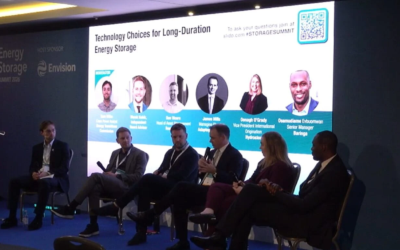
The MP for Waveney said there is a need to put regulations in place to move energy storage forward to its full potential in the UK at an APPG for energy storage event in Westminster, London. Credit: Tom Kenning
The Brexit referendum has provided an opportunity for the UK to look outwards and become a pioneer for an energy storage revolution, according to Peter Aldous, UK Member of Parliament and chair of the All-Party Parliamentary Group (APPG) on Energy Storage.
The MP for Waveney said there is a need to put regulations in place to move energy storage forward to its full potential in the UK, while speaking at a Westminster event, ‘The Cutting Edge: developing a world-class energy storage industry in the UK’, organised by the Renewable Energy Association (REA).
However, Nina Skorupska, chief executive of the REA said that for the UK to remain competitive after Brexit, the forthcoming call for evidence on energy storage, which had been touted to take place this Autumn, must be accelerated. She said the industry is “desperately waiting’ for this consultation.
But in response to questions on when the call for evidence on energy storage will take place, Aldous told Energy storage News: “The Government is still finding their feet.”
Try Premium for just $1
- Full premium access for the first month at only $1
- Converts to an annual rate after 30 days unless cancelled
- Cancel anytime during the trial period
Premium Benefits
- Expert industry analysis and interviews
- Digital access to PV Tech Power journal
- Exclusive event discounts
Or get the full Premium subscription right away
Or continue reading this article for free
“
“We are not asking for a subsidy. We usually go out with a begging bowl; not this time”
Also referring to Brexit, Skorupska said: “This is a business opportunity, whatever you might be thinking about remaining or leaving, we need business as usual to happen.”
The REA will be lobbying the new government for flexibility for smart energy integration and the realisation that energy storage can deliver alternative future energy security for the UK.
Skorupska said: “We are not asking for a subsidy. We usually go out with a begging bowl; not this time. […] With the market services that are required, energy storage in all the different scales will play their part over the next three to four years. Some are commercially viable now as we’ve seen with the EFR experience.”
EFR
In August, battery storage dominated the outcome of the UK National Grid’s 200MW Enhanced Frequency Response (EFR) tender, with the technology to be used for balancing services at grid scale for the first time in the UK.
Bridgit Hartland-Johnson, head of energy storage, Siemens, said: “The market does not wait. The EFR smashed expectations.”
She added that EFR had seen costs at about one third of the original expectations. Meanwhile the emergence of developers only for energy storage is beginning to give some strong signals that this is the next generation financial opportunity. Indeed, the market has started to see more decentralized generation and is expecting around 30GW of thermal power generation capacity to come off the grid by 2025.
She added: “We feel that with or without Europe, the UK market will be big anyway.”
However, Hartland-Johnson also said that for Siemens particularly, some of their project bids for the EFR tender would have required more than 50% of their costs on batteries, yet most of their batteries are sourced from Korea or Japan. Therefore, the UK would benefit from more domestic battery manufacturing that can compete with costs from foreign markets. She noted two strong UK-based manufacturers including Oxis Energy, which is producing bulletproof batteries for military personnel use.
Residential
Stephanie Ordan, Energy Storage business unit manager for EMEA, Eaton, said that the UK is expected to become the EU’s second biggest market for residential energy storage behind Germany, with Italy in third position.
Ordan said Germany will be the biggest market as it has the most renewables deployed – adding: “The main driver for energy storage is renewables.”
She also said that energy storage is the biggest emerging market space in a decade.
Meanwhile, Skorupska said the REA is trying to make the case for alternative solutions to the Hinkley Point C nuclear reactor, which is still being held up by the prime minister. However reports today suggest that Theresa May will finally allow the controversial nuclear plant to go ahead. Energy Storage News recently detailed how the storage sector could replace the need for Hinkley.
In June, Energy Storage News also gathered industry reaction immediately following the result of the Brexit referendum.
credit: Tom Kenning