Legislation to create an incentive programme for behind-the-meter (BTM) energy storage in New Jersey has been advanced by the US state’s Senate Environment and Energy Committee.
New Jersey Democrat Senators Bob Smith and Linda Greenstein are the sponsors of Bill S-631, which would create incentives worth up to 40% of the cost of energy storage projects that meet performance requirements set by the regulatory Board of Public Utilities (BPU).
Announced this week (8 June) as having been advanced by the Senate Committee, the legislation can now go to floor votes in the New Jersey Senate and then the General Assembly before final approval by state Governor Mikie Sherrill.
“This programme will ideally offset the costs of building energy storage systems and encourage others to take on this initiative. Not only will this save current and potential owners money, but the overall increase in storage will also lower energy costs for all consumers over time,” Smith, who represents the 17th District (Middlesex and Somerset), said.
Try Premium for just $1
- Full premium access for the first month at only $1
- Converts to an annual rate after 30 days unless cancelled
- Cancel anytime during the trial period
Premium Benefits
- Expert industry analysis and interviews
- Digital access to PV Tech Power journal
- Exclusive event discounts
Or get the full Premium subscription right away
Or continue reading this article for free
S-631 includes provisions to reserve at least 25% of the programme’s funding for low-income and disadvantaged customers.
The bill states, “Energy storage systems, located throughout the electric grid, can facilitate greater energy independence and energy security for the State’s electric customers by providing increased stability of the power supply, smoother integration of renewable energy sources, a reduction in the peak demand placed on centralised power plants, and cost savings.”
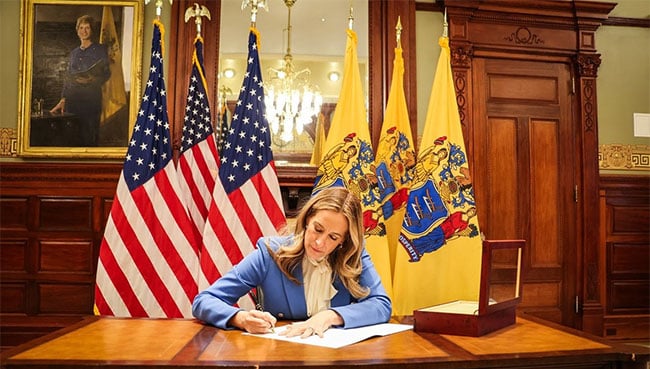
The development follows Governor Sherrill’s moves to support the deployment of energy storage from her first day in office, in March, approving 355MW of utility-scale battery energy storage system (BESS) projects and procurement scheme for a further 645MW. Sherrill signed those, alongside moves to expand a state community solar programme to 3GW. New Jersey’s 2,000MW energy storage target has also seen the state create a scheme to support utility-scale BESS facilities, the Garden State Energy Storage Programme (GSESP), which is already underway.
There has also been growing industry interest in leveraging distributed energy resources (DERs) to ease the financial strain that large power consumers place on everyday ratepayers.
Earlier this month, Virtual power plant (VPP) operator and DER platform Voltus and tech giant Google signed a three-year agreement for the PJM region, which sees Voltus aggregating up to 100MW of DERs each year from local businesses and homes into a Google-funded VPP. Voltus will then pay customers who participate in the programme.
On 16 April, developer-operator Lightshift Energy announced a five-project portfolio, with similar goals to S-631, though located across Virgina. Instead of pursuing 200MW-500MW transmission-scale projects that would require years of PJM interconnection studies and millions in upgrade costs, Lightshift is installing smaller batteries, 20MW or less, at existing distribution substations to minimise costs for regular energy consumers.
ESN Premium recently discussed the trend in California, with Arnab Pal, executive director at Deploy Action, a nonprofit trying to accelerate decarbonisation efforts in the state.
The NJBPU also in March, selected developer and IPP Elevate Renewables’ 600MWh BESS for development in Ridgefield, as part of the Garden State Energy Storage Programme (GSESP), phase one of which was approved in June 2025.
The GSESP aims to deploy 2,000MW of energy storage by 2030, following a mandate established by the Clean Energy Act of 2018.
Additional reporting by April Bonner.