
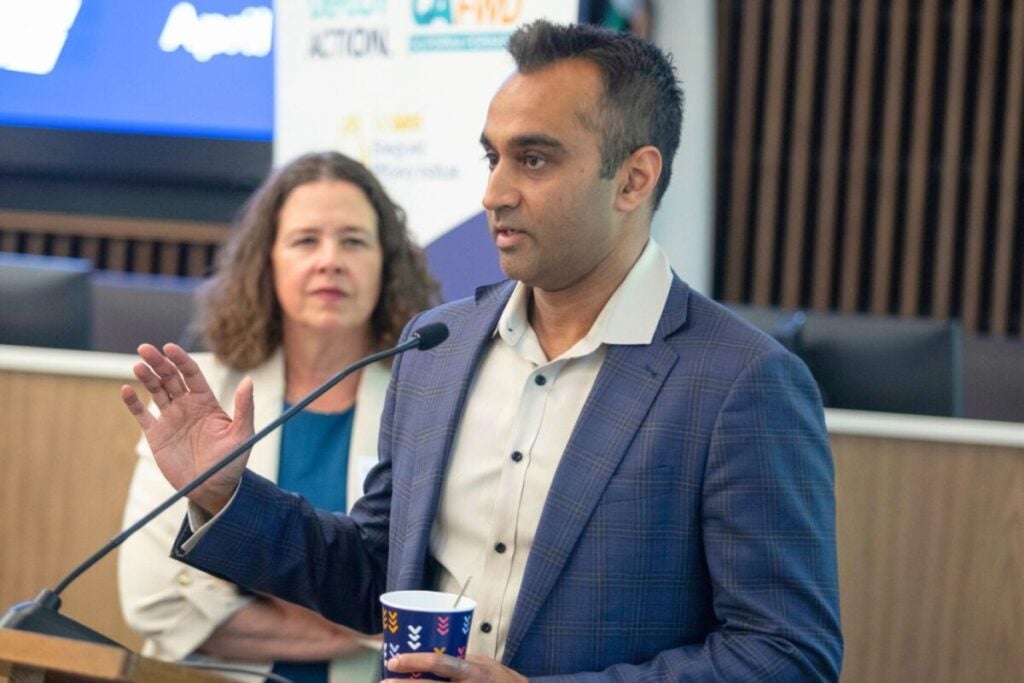
Energy-Storage.news Premium speaks with Arnab Pal, executive director at nonprofit Deploy Action, about the company’s recent California polling results.
A recent poll conducted by Deploy Action, a nonprofit focused on accelerating decarbonisation efforts in California, led by former US Department of Energy advisor Pal, and featuring founding advisory chair Jigar Shah, former head of the DOE Loan Programs Office (LPO), shows that California voters broadly support policies that would allow renewables and demand response programmes to compete more directly with traditional utility infrastructure.
According to the survey, approximately 80% to 85% of California voters support allowing these distributed energy resources (DERs) to compete with utilities, with roughly 80% of Republicans expressing support alongside Democratic voters.
According to Pal, Deploy Action commissioned the polling to determine whether public sentiment aligns with policy priorities being pursued in the state legislature, particularly around grid utilisation.
Try Premium for just $1
- Full premium access for the first month at only $1
- Converts to an annual rate after 30 days unless cancelled
- Cancel anytime during the trial period
Premium Benefits
- Expert industry analysis and interviews
- Digital access to PV Tech Power journal
- Exclusive event discounts
Or get the full Premium subscription right away
Or continue reading this article for free
“Our sense has been a lot of the activity that happens in legislatures and with the governors and with elected officials doesn’t always line up with where people are at in terms of what their thinking is and what their opinions are. We wanted to see if that’s the case,” Pal says.
The results indicated strong voter support for using existing grid resources more efficiently as a way to manage electricity costs. “From a technical standpoint, it’s super interesting because I think the first way to bring down costs is to use more of your existing resources,” Pal says.
“We just wanted to see: ‘Does everyone agree with us?’ And the answer, overwhelmingly, is yes.”
Deploy Action’s approach includes both improved grid utilisation and strategic load growth. Pal describes this as a “two-part equation.”
“Part one is we make sure the utilities change the way they plan, and that their priority is to maximise their asset utilisation to bring down costs. Then we couple that with increases in demand, meaning being able to connect electric vehicles (EVs), and certain data centres—not necessarily all of them,” Pal says.
The strategy includes creating frameworks where large energy users like data centres could access power continuously except during the most expensive hours of the year, when they would rely on demand-side resources like battery energy storage systems (BESS) and demand response.
“What that would do is make infrastructure cheaper per person, and you’re adding more people to the rate base, and then each person ends up paying less,” Pal explains. “But you have to do both of those things. Additionally, virtual power plants (VPPs) are like a tool to achieve what we’re trying to do.”
Current regulatory structure
Pal identifies several barriers that currently prevent battery storage and other DERs from competing more effectively with traditional utility investments.
The main issue, he said, is that utilities operate within a rate-basing structure that makes it straightforward to get approval for traditional infrastructure investments like new transmission lines, while DERs are typically categorised as “programmes” rather than investments.
“These aren’t really considered investments, these are more considered quote-unquote programmes, so they’re not really incentivised, both structurally and financially, to pursue these opportunities, which is part of the reason why they get held up and they get stuck in sort of program land,” he highlights.
At the same time, utilities are increasingly interested in flexible resources that can be deployed quickly, particularly in areas expecting significant load growth. “Their whole thing is speed to power and load flexibility, and demand response and batteries are all speed-to-power plays, and you can bring on capacity, both distribution generation capacity, quickly,” Pal says. “You can’t do that when you build a new set of lines.”
Deploy Action’s position is that utilities should pursue both traditional infrastructure and DERs. “We’re saying do this fast stuff that’s easier first. And I truly believe that there is no incentive structure in place for them to do that. And on the Public Utility Commission (PUC) side, there isn’t a clean regulatory structure for them to procure those resources, and we’re trying to fix that.”
Last month, ESN Premium spoke with Pat Wood III, co-chair at Pew Charitable Trusts, about the non-profit’s DER Policy Playbook, which covered some of the same pathways to incentivising DERs in the US, as Deploy Action notes.
To reduce barriers to entry, for example, Pew is calling for an automated permitting process for residential installations and to streamline interconnection procedures for commercial providers. These administrative improvements are aimed at reducing costs and delays that slow deployment.
For implementation, the report emphasised the need to aggregate DERs into VPPs. This would allow individual residential and commercial systems to be pooled together and managed as a single resource that can respond to grid needs.
Legislative efforts
Deploy Action is supporting several bills aimed at addressing these issues, including California’s SB 1295.
SB 1295 would create a third-party procurement programme at the distribution level, allowing BESS to be deployed as an alternative to distribution line upgrades in certain situations. The bill would establish mechanisms for utilities to procure BESS from third parties while receiving compensation through shared savings models.
“We need to create a mechanism so they can actually select procuring those batteries from third parties over building another line,” Pal says. “We’re not going to fix it all with this one bill, but that’s what we’re starting to try to do here.”
The legislation also addresses utility ownership of batteries at substations, where utilities control the land. “My whole thing is, if they can build those batteries for cheaper than building a new line, then we should let them build those batteries. Are they going to profit off it? Sure, but that’s a different conversation—figuring out what their rate of return should be, should we be changing that, should they be using more debt, etc.,” Pal notes.
Shortly after Pal’s conversation with ESN, SB 1295 passed the California Senate, along with SB 905, a bill holding utilities accountable for making the grid “smarter and more efficient”.
Of course, implementation is only part of the battle. Further issues can arise afterward. For instance, California’s Demand Side Grid Support (DSGS) distributed storage programme helped lower the net load on the state’s grid during a 29 July 2025 test.
DSGS was introduced in 2022 by the California Energy Commission (CEC). It compensates customers for discharging stored energy from residential and commercial BESS during peak demand or grid stress.
In 2025, the DSGS programme faced cuts to its budget that would significantly reduce its operating time.
California Governor Gavin Newsom then proposed using funds from a different expiring programme to keep DSGS operating until the end of 2026. Participants will be shifted to the California PUC’s Emergency Load Reduction Programme (ELRP), “a 5-year pilot programme designed to pay electricity consumers for reducing energy consumption or increasing electricity supply during periods of electrical grid emergencies”
Deploy Action opposes the move, arguing that the programme has been effective at the California Energy Commission (CEC), and that transferring it would create unnecessary delays.
“DSGS is not meant to be a permanent solution. It’s an inelegant but effective way of being able to pull these demand-side resources in situations where otherwise there might be blackouts. We need a bridge for the next two to three years, and this program has worked really well at the CEC. Why would we change something that’s working really well?,” Pal asks.
Pal also notes concerns about implementation timelines at the PUC. “The PUC, for all of its strengths, speed is not one of them,” he says. “So, our whole thing is let’s keep it here for two or three years, and then let’s develop the appropriate marketplace so these resources can be used most cost-efficiently.”
Comparisons to other states
When asked about models California could learn from, Pal mentions Texas, which has a more competitive electricity market and has integrated significant renewables and BESS capacity.
“I think people don’t want to hear it in California, but I do think there’s some lessons to draw from Texas, which is a heavy renewable state, a more competitive market, easier to put storage in,” he says. “I’m not saying California should operate exactly like Texas, but I do think there’s stuff that they do with their retail choice that I think California can learn from.”
Pal also notes that California’s electricity costs are often mischaracterised. While the state’s per-kWh rates are high, total bills remain comparable to other states due to efficiency standards that reduce overall consumption.
“Everyone looks at the cents per kWh of the cost of electricity, if you look at the overall bill in California, and I think people forget that California has all these efficiency standards, so the cost per kWh may be higher, but everyone uses fewer kilowatt-hours, so the total bills are still sort of middle-of-the-pack in California,” he states.
Pal adds that grid utilisation and strategic load growth are relevant beyond California. “This is a national problem that we’re trying to fix. We’re just picking a few states to work in,” he says. “We’ve got to do this in the Northeast, we’ve got to do this in the South.”
Voter sentiment on utilities
The polling also measures voter attitudes toward utilities and regulators. California utility Pacifc Gas & Electric (PG&E) received low approval ratings, while the CPUC had an approval rating of 11%. Notably, half of survey respondents were unfamiliar with the CPUC.
“The overall approval rating of the PUC was 11%—that’s lower than Donald Trump’s in California,” Pal says. “It’s really bad.”
Pal believes the numbers suggest a need for different approaches. “I think it’s not their fault per se, but I think anytime that’s your perception, I think you ought to consider doing different things. We’re not here to blame them or shame them, we’re here to tell them that when only 11% of the state approves of what you’re doing, you need to start thinking differently.”
The polling also indicated that some voter frustration may be directed at factors that aren’t the primary drivers of rate increases.
The polling results suggest that California policymakers have public support for policies that would increase competition in energy markets and prioritise grid utilisation. Deploy Action is working with legislators and utilities to develop regulatory frameworks that would enable these changes.
“This should have already been done, and it hasn’t,” Pal says.
