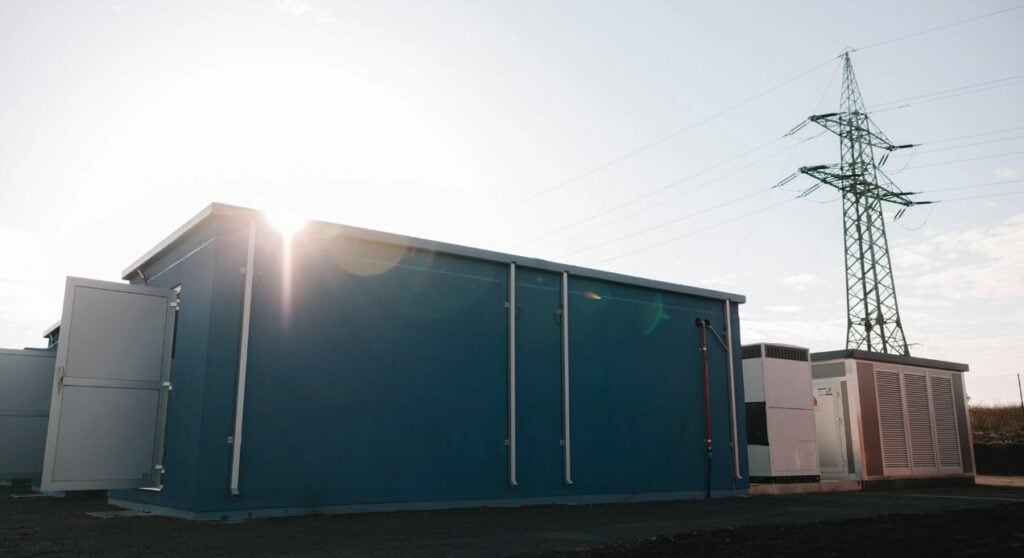
Developer Kyon Energy, investor Obton and system integrator ECO STOR have commissioned 27.6MW/32.4MWh of battery storage across two sites in Germany.
The two projects were built in Bad Düben and Elsteraue, both in the eastern state of Saxony. Kyon said the projects would provide ‘control power’ to help stabilise the German grid as it moves towards 80% renewable energy by 2030.
“Already today, local overloads of the grid infrastructure occur on sunny or windy days. In addition, volatile generation leads to high price fluctuations. These developments will intensify with the further expansion of renewable energies. Our projects contribute to a sustainable and independent energy transition by counteracting volatility and grid congestion,” said Florian Antwerpen, CEO of Kyon Energy.
The Bad Düben unit is a 13.8MW/16MW system according to ECO STOR’s own energy storage monitor and, although the Elsteraue isn’t accounted for, the total deployment indicates it is nearly identical in size.
Try Premium for just $1
- Full premium access for the first month at only $1
- Converts to an annual rate after 30 days unless cancelled
- Cancel anytime during the trial period
Premium Benefits
- Expert industry analysis and interviews
- Digital access to PV Tech Power journal
- Exclusive event discounts
Or get the full Premium subscription right away
Or continue reading this article for free
The projects were financed by Obton, developed by Kyon Energy and built by ECO STOR, both of which Energy-Storage.news has interviewed this year. They are Obton’s first battery storage projects in Germany, and ECO STOR says it is the main owner and operator of the Bad Düben system, through Obton Storage GmbH.
“We support the energy transition away from fossil fuels and see battery storage as a key component of this green transformation, bringing more renewable energy to the grid. With this investment, we hope to gain valuable insights that can benefit some of our existing and future solar installations by combining them with battery storage,” said Rune Holmgaard-Poulsen, senior specialist at Obton.
ECO STOR’s monitor pegs Germany’s utility-scale battery energy storage online today at around 700MW. Well over 200MW of that has come online in 2022, just based on projects that Energy-Storage.news has reported on – see all coverage of the German market here.
Like most markets, BESS projects are in the long-term moving to trading more energy on electricity markets and away from solely providing grid frequency response services. However, we haven’t yet seen a significant move up in hourly durations in the German market, whereas the US, UK, Italy and to a lesser extent the rest of Western Europe are doing so to different degrees.
Even projects in hundreds of MW range announced very recently like Fluence’s 250MW/250MWh grid booster for transmission system operator Transnet and RWE’s 140MW and 80MW projects have made no indication of designing systems for durations substantially over an hour.
ECO STOR has developed the 3.5MW/4MWh “ES-3450” battery storage product and deployed it in seven projects with cumulative deployments of 108MWh in 2022. It is scaling its project sizes and expects to commission a 100MW/200MWh system in 2024.
Energy-Storage.news’ publisher Solar Media will host the eighth annual Energy Storage Summit EU in London, 22-23 February 2023. This year it is moving to a larger venue, bringing together Europe’s leading investors, policymakers, developers, utilities, energy buyers and service providers all in one place. Visit the official site for more info.