
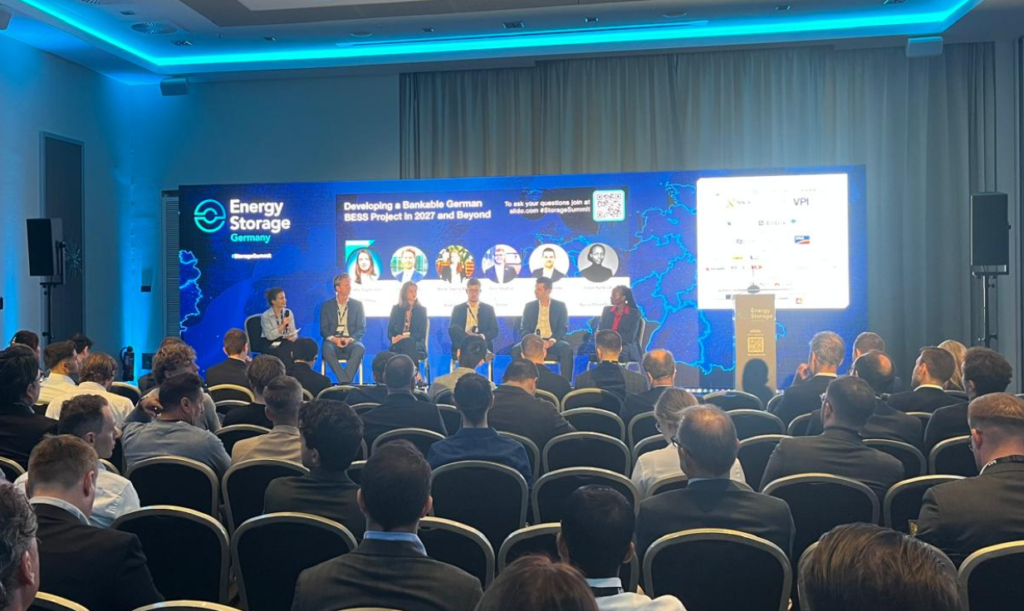
BESS project owners, lenders and optimisers kicked off the Energy Storage Summit Germany 2026 today in Berlin with a discussion on developing a bankable project.
The ‘Developing a Bankable German BESS Project in 2027 and Beyond’ panel brought together executives from developer-operators Kyon Energy and Aquila Clean Energy EMEA, optimiser Entrix, market intelligence provider Modo Energy and banks NORD/LB and Rabobank.
Marcus Starke, senior director, energy origination & structured finance, at NORD/LB said there are three key risks the bank looks at when considering financing a project.
“The first is timeline. Timelines are always very progressive so we always try to push for as much buffer as possible. It’s not just about grid connection, it’s also about putting all the components together. The second is on grid restrictions and FCA (flexible connection agreement) discussions. If someone claims they have no grid restrictions, you need to ask if they are 100% sure,” Starke said.
Try Premium for just $1
- Full premium access for the first month at only $1
- Converts to an annual rate after 30 days unless cancelled
- Cancel anytime during the trial period
Premium Benefits
- Expert industry analysis and interviews
- Digital access to PV Tech Power journal
- Exclusive event discounts
Or get the full Premium subscription right away
Or continue reading this article for free
“You also need a very good due diligence package. Standardised DD packages exist in wind, for example, but not in BESS. We need more standardised contracts and DD packages.”
Kyon’s head of markets & regulatory affairs Marie-Sophie Braun said that as a project owner the first thing to assess for a project is how much risk you can and are willing to take, as this can also affect design parameters like duration.
How tolls and contracted revenues come into this was obviously a key topic on the panel. Rabobank’s energy transition specialist Coen Hutters said that within Continental Europe, Germany is leading the way on this, with other regions like the Nordics now starting to follow.
There was agreement that hybrid approaches combining some level of contracted revenues with room for merchant exposure were where the market is heading.
Felix Stephan, offtake origin manager, said that capturing more upside meant a higher internal rate of return (IRR), and that lenders liked project owners having some skin in the game too (rather than outsourcing all that risk via a 100% toll).
Discussing merchant-only financings, Aquila’s deputy head of investment Grace Kankindi explained what it took to make these work. It’s a topic she’s previously spoken to Energy-Storage.news about, with the firm claiming the first fully merchant project financed BESS in Germany this year.
“It really depends on the lender being able to understand and price the risk. You need to look at asset fundamentals, a diversified revenue stack and choose the right optimiser, ideally someone with a track record. It doesn’t need to be a big player. We’re hoping what we’ve done sets a precedent for other fully merchant projects,” she said.
Responding to the point on fully merchant financings, NORD/LB’s Marcus Starke said that liquidity from lenders is much higher if there are some contracted revenues.
“I don’t want to say fully merchant is not a good idea, it depends on the structure. Depends on how you run sensitivities and modelling etc,” he said.
He also said that a mix of approaches in the market is good but pointed out why so much time, effort and attention is given to project financing.
“We need smaller projects financed by other parties than us. But ultimately we need to make sure there are no defaults, as that wont help anybody.”
Kyon Energy’s Marie-Sophie Braun, meanwhile, said that portfolio financing has numerous benefits, including a mix of offtake providers and offtake structures, and the creation of benchmarks within the portfolio, which banks like.
Even combining different routes-to-market (RTM) in one offtake agreement is possible, but Grace Kankindi said that it needs to remain bankable, and there hasn’t been much of this in Germany.
The panel was moderated by Cosima Sagmeister, market analyst Germany for Modo Energy.
