
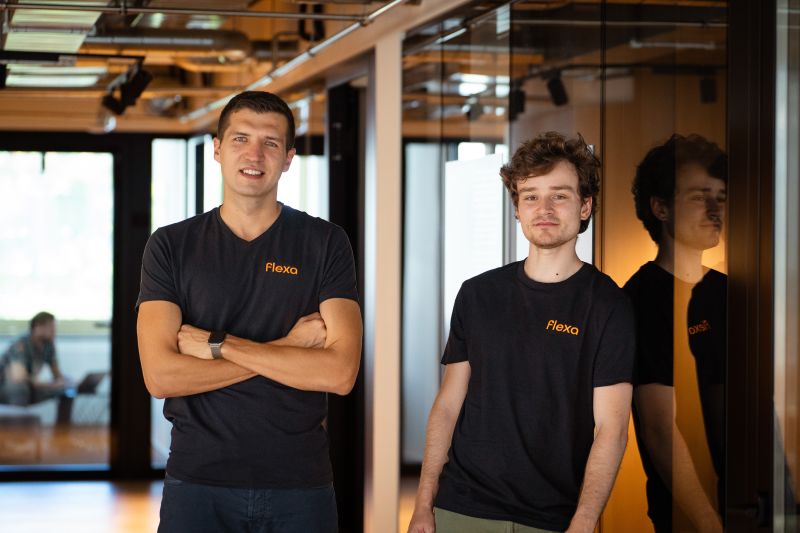
A regulatory change is opening Germany’s energy markets to 23GWh of home batteries. We chat to the co-CEO of virtual power plant (VPP) platform Flexa about why, how it will happen and what it could mean for the market.
Flexa co-CEO Fabian Fürst first pointed us in the direction of the new rules which mean that, from 1 October, small-scale battery storage systems in Germany will be able to play into the same energy markets as large-scale projects.
In this interview, Fürst explains what exactly is changing and how it could impact the market, considering that the combined capacity of Germany’s small-scale batteries is about twice that of its grid-scale ones.
Our discussion took place in the lead-up to the Energy Storage Summit Germany 2026, which kicked off today and runs until tomorrow (15-16 September 2026) in Berlin. Executives from large-scale battery storage optimiser Entrix, one of the two founding parent companies of Flexa, will be speaking at the event.
Try Premium for just $1
- Full premium access for the first month at only $1
- Converts to an annual rate after 30 days unless cancelled
- Cancel anytime during the trial period
Premium Benefits
- Expert industry analysis and interviews
- Digital access to PV Tech Power journal
- Exclusive event discounts
Or get the full Premium subscription right away
Or continue reading this article for free
Energy-Storage.news: Flexa was founded in 2024 by AI-based battery optimiser Entrix and renewable energy services provider Enpal. Can you talk me through the founding of the company, your background, and how you came to be co-CEO?
Fabian Fürst: It was a mix between Entrix and Enpal recognising an opportunity for decentralised assets. Entrix does grid-scale optimisation, and they saw that the German market is actually much more decentralised than grid-scale. They wanted to tap into that market. Enpal, at that time, had the biggest homogeneous asset base in terms of decentralised assets—it’s an installer for rooftop solar, home storage, heat pumps, etc. For each of its assets, it already had its HEMS (home energy management system) installed, so all these assets are connected and fairly easily accessible.
If you want to build a company in this space, you need initial scale to prove your technology works rather than going from pilot to pilot. That’s what Enpal gave us.
I was working at McKinsey at the time, purely on energy. I’d started a few companies before and wanted to focus on energy because I see it as a civilizational problem that can actually be solved in the next couple of decades. At McKinsey, I worked on these problems for clients globally. I saw batteries go from being irrelevant in terms of IRR to suddenly becoming relevant. I saw the rooftop solar trend happening and worked for grid companies struggling with it—rooftop solar is difficult to plan for and disrupts the system. Then EVs came along, which complicated things even more.
I was talking with people about how we could turn this around and make it usable for grid operators, but they never had the speed or innovation capability to do it themselves. That put the idea in my mind that the system is broken—not optimal for the future state where everyone drives an EV and more rooftop heat pumps are rolled out.
I started talking with people in the industry and accidentally met my co-founders, Bas and Vjeko, who were already working on it. They’re both technical—I’m a commercial guy. I studied finance, know models and how to sell, but I can’t write sophisticated algorithms. Bas led the team that built Autobidder at Tesla, which handles their optimisation in the US, and then became CTO of Entrix. My other co-founder led the team that built the VPP at gridX, a German startup that was sold to E.ON.
I realised these guys really knew their stuff. I knew there was a problem and wanted to work on it, so I joined about two and a half years ago when they were just starting out. Bas brought the trading expertise from Entrix, my other co-founder knew the decentralised asset side from gridX, and I brought the commercial and financing knowledge, understanding customers and energy players in the market.
Is it a joint venture between Entrix and Enpal?
Yes, it was set up as a JV with a simple split between them plus a pool for us and our employees. There’s no external funding.
In simple terms, what do you do at Flexa?
We optimise to lower the energy costs of our customers as much as possible across all assets, markets, and other factors. My grandma could get a few hundred euros in savings without investing anything, which is nice. We started at the household level and now also do commercial and industrial (C&I) clients, but household is still our biggest business.
To do this, you have different parts: forecasting—you forecast each individual site’s production and load, and you forecast market prices. Then you run an optimisation first individually for each site, then pool it with all other sites for aggregate optimisation. You trade it on the market and dispatch it to these sites. The optimisation brings in local signals like grid fee schedules—there are 900 different DSOs in Germany with 900 different grid fee schedules—plus load constraints, peak shaving, whatever is relevant. Then you connect it with market opportunities.
Right now we do wholesale markets and intraday continuous. We’re bringing sites into ancillary markets as well—that takes time with the TSOs, but we should have that roughly next year.
Is there a certain size at which you stop? A maximum-sized project you work with? Obviously, Entrix does grid-scale batteries.
We see ourselves as unlocking sites that wouldn’t be optimised otherwise—any site you need to pool to create value. That’s typically below one megawatt. We have some sites of 800kW, for example. You wouldn’t normally do a 5MW site unless there’s a very strong case for it, because there’s so little flexibility to trade.
Let’s move to what’s changing in the market from 1 October 2026. I know basically what the EEG (Renewable Energy Sources Act) is—a subsidy for solar and storage projects, but it meant they could not charge from the grid, and that’s now changing, unlocking new markets for these batteries. Is that the long and short of it?
In a nutshell, yes. Two things are going on. One, the government doesn’t want to pay billions anymore in EEG subsidies because they say there’s enough already—they don’t want to subsidise as heavily. On the other hand, individual sites that are non-market-integrated actually pose problems for the grid because they have no incentive to respond to market signals.
For example, customers get roughly €80 (US$92.27) per MWh no matter when they feed in. So, many customers feed in at very negative prices—that’s what you saw in April this year when Germany hit minus €499.9 per MWh, the maximum minimum price. That’s because so many sites feed in anyway with no incentive to curtail. It’s getting costly for the government and becoming a problem for the system.
Now they’re incentivising customers to become part of the system in two ways. For new customers, they’re requiring them to market their electricity on the market—anyone installing new PV from 2027. For existing customers, they’re removing the constraint that you cannot charge the battery from the grid or discharge into the grid without losing your EEG subsidy. You can participate in the market while still getting some subsidy.
How it works: you get the subsidy value paid out anyway—basically the solar capture price, so your EEG minus your solar capture price. Whatever you actually capture is yours. So if we come in and market these batteries, they could get much more than the EEG before.
We’re already doing this with Enpal customers and others where the system makes sense—we can already earn more than the subsidy. But for many we couldn’t do it—if the battery is very small, there’s not much to shift, not much value to create. From 1 October, you can suddenly target all 2.5 million customers, and they have a good incentive because without investing anything more, they can get three to four hundred Euros upside per year.
This change applies to all EEG projects—small, large, grid-scale?
Yes, it applies to all in general, though there are different implementation methods based on segment. For home storage it’s simpler—there are pragmatic rules so you don’t need two meters to measure what is PV and what isn’t. For a typical C&I site with a few hundred kilowatts of PV-plus-battery, you just have two meters, but that’s fairly cheap at that size.
What’s also happening: I talked about 2.5 million home storage batteries participating in the market. But it also unlocks the whole C&I storage market where they were only doing peak shaving with batteries. Suddenly, you get peak shaving plus market, which is nice. The C&I batteries in our portfolio right now are all front-of-meter because of that problem. Everyone is talking about how to do peak shaving, plus behind-the-meter optimisation, plus market, for C&I assets. There should be quite some growth there.
You mentioned earlier that for some projects you’ve been able to get around this already and participate in the market?
For some projects we just forfeited the subsidy because we said we get more value out anyway. We do it fully merchant, forfeit the subsidy, [when] it’s worth it for these customers specifically. That’s what we do with our Enpal customers—they’re sized in a certain way in terms of kilowatt-hours and battery performance, so it’s worth it. For most customers in the market, it wouldn’t be worth it today. We wouldn’t do full optimisation—you could only do load shifting, which isn’t that much.
There’s a grid fee exemption for grid-scale batteries right now. If you discharge and charge, you don’t pay grid fees. This regulation unlocks for everything behind-the-meter as well. For arbitrage volumes, you’re also not going to pay grid fees. Suddenly, you can do many more arbitrage cycles with these batteries, which you couldn’t before. With grid fees in Germany averaging €160 per MWh, you need quite some spreads to run an arbitrage cycle—that’s a hurdle you already need to overcome. You don’t have that anymore, so there’s more value just from that.
The grid battery grid fee exemption goes until August 2029. Have home batteries been wrapped into that same exemption period?
More or less, yes. It applies to systems commissioned before August 2029 and then runs for 20 years from commissioning. It’s the grid fee only, though, not levies or electricity tax, and the Bundesnetzagentur (federal network regulator) can still change the rule.
So, what would be the impact of 23GWh of batteries entering the market in a way they couldn’t before?
There are a few things that will happen, depending on where the batteries participate and how fast. It’s a lot of volume, so depending on where they participate, they’ll make an impact.
First, because a lot of uncurtailed PV capacity today is co-located with these batteries—it’s 10kWp on average times 2.5 million, so 25GW—these 25GW are suddenly not feeding in anymore at negative prices if they all participate. That will make a huge difference in terms of negative prices initially.
Second, you’ll see some impact on the wholesale market, specifically on intraday continuous. I don’t think it will make a huge impact on day-ahead because it’s too deep. But some of the spikes on intraday are fairly small in terms of liquidity, so they can be smoothed out a lot. For example, a week ago you had a spike because of a sabotage attack on a substation that took off 3GW of lignite, which spiked intraday. If you have 23GWh of additional storage that can react to that, that spike won’t be as big.
I don’t think a significant part of these batteries will go into ancillary service markets in the near term. Each individual battery is less reliable than a grid-scale asset, but as a pool they can be just as reliable, if not more so. The work is prequalifying these new pooled concepts—that’s what we’re doing now, and it will scale up over time. If they were all in, 23GWh would make a difference, but ancillary service markets are also not as deep.
I think this will impact the business cases of some developers looking into the market. On the other hand, if a lot of customers see they can make good money by participating in the market, you might see even more pickup in home storage. Roughly 60% of PV in Germany has storage right now. There might be retrofits of the 40%, new storage rolling out—even battery-only storage that you can add to trade and load shift.
We’re also seeing batteries tend to be a lot bigger when these incentives are part of the offer. In our portfolio, the newer customers we’re onboarding now have, on average, 21kWh. In the beginning, it was more like 12kWh. Customers feel they can get more money with it, and salespeople see that as well. You can see a trend in battery sizes going up for home storage. That might be the same for C&I—right now you size the battery for peak shaving, but if you want to do market trading and you still have grid connection capacity on your site, you might want to max it out and not only do peak shaving.
Overall, it should drive general deployment of battery capacity.
It’ll be interesting to see how much impact it has, and if it potentially reduces revenues that grid-scale projects were banking on. If you have all these new assets entering the market, reducing spikes, maybe that will accelerate saturation of ancillary services.
It’s definitely interesting to watch. It’s hard to say how fast or how many of them participate. If all of them participated at once, it would definitely have a strong impact on the markets. But it will be more gradual—more and more will participate over time. All the new ones by default because they need to, but of the old ones, I don’t see every homeowner in Germany suddenly signing a contract overnight.
Why would the new ones have to?
For new PV customers building from 2027—at least what’s in the cabinet version from the end of July, which hasn’t been through the Bundestag yet—they need to direct market themselves after a three-year grace period. But the three-year grace period has a much lower EEG than you would have today. Right now, it’s roughly €80, exactly €78 for new ones. It will be €52, and they don’t get any money at negative prices—zero for that. Effectively, their capture price will be around €35, which is not a lot anymore compared to the old ones. It’s less than half.
So they fade out anyway, and they need to direct market themselves after three years. The benefit without direct marketing is so low that it might not make sense from the start.
