
Flexible Connection Agreements (FCAs) must not be used simply to exclude BESS from connecting to the grid, but the industry will have to make do with them and all their imperfections for the foreseeable.
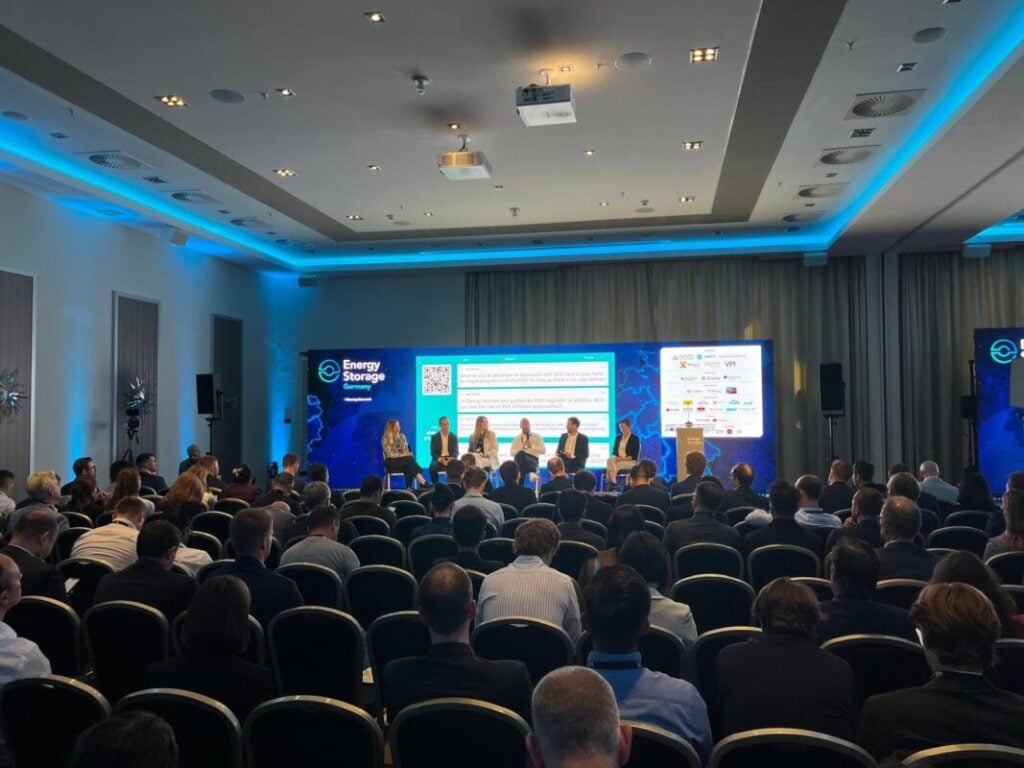
These were some of the key points made by speakers on the ‘From Bottlenecks to Breakthrough: The Future of Flexible Connection Agreements (FCAs)’ panel discussion at today’s Energy Storage Summit Germany 2026.
The event kicked off earlier today with opening remarks and a panel on project bankability, and runs for two days (15-16 September) in Berlin.
Stricter legal definition needed?
Moderator Nina Schmüser, regulatory affairs manager for independent power producer (IPP) Grenergy, asked whether the FCA session panellists believed FCAs should be more strictly defined in law. To that question, there was a general feeling that the answer is no.
Try Premium for just $1
- Full premium access for the first month at only $1
- Converts to an annual rate after 30 days unless cancelled
- Cancel anytime during the trial period
Premium Benefits
- Expert industry analysis and interviews
- Digital access to PV Tech Power journal
- Exclusive event discounts
Or get the full Premium subscription right away
Or continue reading this article for free
Nele Maas, senior research consultant at FfE, said: “While Germany’s implementation has a few flaws compared to the European directive, I wouldn’t put more into the legal definition.”
Georg Gallmetzer, managing director at BESS owner-operator Eco Stor, agreed, saying that the most important thing is for large-scale projects to get built in time.
Coming up with a country-wide legal definition risks spending a lot of time and energy for an outcome that pleases no one and risks delaying deployments, he said, and that it’s better to continue ahead with an imperfect system that still gets projects online.
Time to market is key, and FCAs enable that
“Time to market is the prevailing argument here. I don’t want the regulator or government to interfere in the currently high dynamics of the industry and high willingness of grid operators. All grid operators eventually come to finance-able FCA terms,” he said.
The company’s Bollingstedt BESS project, which was just sold to Swiss power firm Alpiq, was used as a pilot project by transmission system operator (TSO) E.ON to set FCA standards in its network (as Gallmetzer explained in a recent Q&A with us). However, the FCA terms meant a steep reduction in the project’s revenues, and others may blame Eco Stor’s project for such reductions in their own.
“Our Bollingstedt project was a -20% cut on revenues. But we demonstrated the full development cycle (with the sale to Alpiq) despite, or because, of an FCA,” Gallmetzer said. “We brought long-term stability into a contract. And it’s still attractive enough for an investor.”
Lack of clarity
Of course, while not directly disagreeing with this, the other developer-operators on the panel lamented the process of FCAs, particularly at the DSO (distribution system operator) level.
Leandra Boes, commercial asset management director for Green Flexibility said: “We do wish there were clearer guidelines. Some solutions hit the industry really hard. Some solutions would have achieved same thing for DSO but not hurt us as much.”
Meanwhile. Stefan Tait, executive director Germany for Harmony Energy, said: “We see the TSOs are trying to align and have a similar framework, but there is still lack of clarity, particularly while everyone is trying to get to final investment decision (FID) by end of this year (because of the grid fees).”
FCAs cannot be used to block BESS
Thankfully, there was a TSO representative on the panel, Wilhelm Kiewitt, head of energy economics for 50Hertz Transmission, one of Germany’s big four. He spoke unequivocally to what many in the industry have accused German DSOs of doing: using FCAs to essentially block BESS projects from connecting.
“I sometimes have the feeling that FCAs are being misused to manage connection queues at the DSO-level. Requirements for limiting ancillary service participation are sometimes used to reduce the attractiveness of a project. This misuse cannot be tolerated,” he said.
“Frequency stability is TSO’s job and we require both TSO and DSO projects for it. I highly doubt that BESS projects creating problems at DSO level is a general phenomenon. In some extreme cases that might be happening.”
“DSOs have a desire to reduce complexity. But there is higher interest of society for as many batteries as possible to provide ancillaries. Grid users benefit from more batteries in grid services.”
“That ancillary service restriction needs to be standardised via a discussion between the storage industry and grid operators. Otherwise it makes the system even more complex for TSOs (which procure ancillary services) to manage,” said Maas.
DSOs lagging behind
Speaking to the differences between DSOs and TSOs and how these relate to the topic of FCAs, Gallmetzer pointed out that BESS are actually showing the inefficiences of some DSOs, but that ultimately this is a reality the industry needs to live with for some time.
“DSOs have a lot of blind flight in operations, they don’t have the superpower of TSOs. BESS uncover inefficiencies of DSOs in managing their networks. I believe BESS are in reality a highly active piece of grid, not just a market asset. So some DSOs try to find a way out to enable a fraction of BESS to connect. We as industry can’t come in and ask for 500GW and think it’s possible and it will go quickly. Either we wait for DSOs to build a perfect digitalisation of operating the grid, or we deploy now,” he said.
On that topic, Schmüser asked the panel how they deal with a local grid operator that is not digitalised. Boes said that, like some other owner-operators, Green Flexibility began forecasting grid congestion itself, echoing some of what Gallmetzer said. “We will be discussing a dynamic FCA with an operator this year. We’ve come up with the proposals on our end, which takes a lot of work and resource for us. But we have to do it, it’s the world we live in.”
