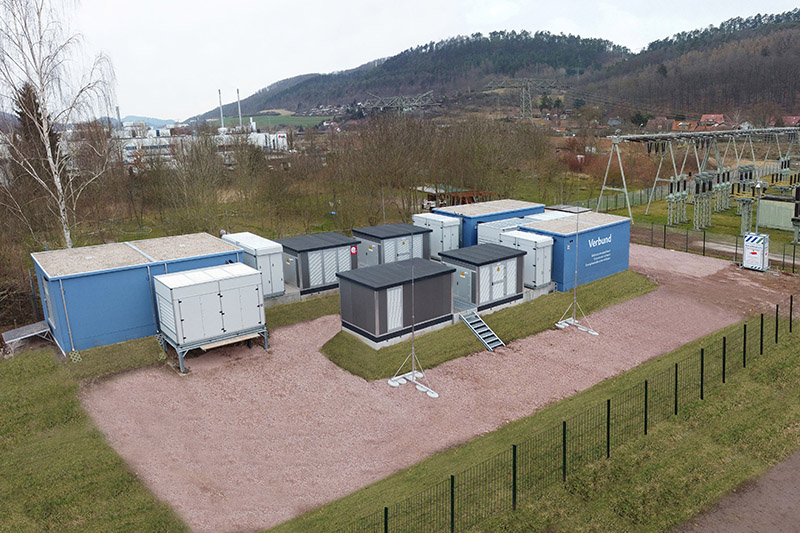
The German utility-scale storage revenue stack for new projects has been totally reshaped by recent events and regulatory changes as the market moves to 100MW-plus ticket sizes, local developer ECO STOR told Energy-Storage.news.
This year, German utility-scale energy storage projects will garner about half of their revenue from peak shaving with the rest made up of a mix of auxiliary (ancillary) grid services and intraday trading. That is according to Georg Gallmetzer, managing director of ECO STOR, a company which designs battery energy storage system (BESS) projects before selling when shovel-ready.
Peak shaving is a service where generators inject power during distribution system operators’ (DSO) peak quarter-hour demand loads, over the course of the year for which they are paid €50-100,000 (US$53-106,000) per MW/year. But the revenue stream will not be available for new energy storage projects commissioned after December 2022, Gallmetzer said.
“So value stacking for new projects from now on relies only on auxiliary services and short term trading, but the energy world has changed, fortunately. The prices on the auxiliary markets have increased and the spreads in short-term trading have multiplied. So the business model is now stronger, even including the increased material prices which have grown by about 30% in relation to last year.”
Try Premium for just $1
- Full premium access for the first month at only $1
- Converts to an annual rate after 30 days unless cancelled
- Cancel anytime during the trial period
Premium Benefits
- Expert industry analysis and interviews
- Digital access to PV Tech Power journal
- Exclusive event discounts
Or get the full Premium subscription right away
Or continue reading this article for free
He added that investment decisions for ECO STOR’s current projects were made before Russia’s invasion of Ukraine and recent commodity price increases, but that the profit opportunities of those projects have ‘increased dramatically’.
It is noteworthy that this is all happening as some of the early movers in the UK market, Europe’s largest, like Gore Street Capital and Anesco have recently entered or made concrete plans to enter the German utility-scale storage market.
When asked to comment on these moves, Gallmetzer identified “pressure on land and grid access in their home market” as key drivers for the expansion.
“I think the UK is the wild west of land grabbing which has led to a situation of extremely high prices for project rights. It’s in the £100k (US$126k) per megawatt project right range which is enormously high, which is actually a little inhibitor for growth in the UK.”
Though not all UK projects trade at this price. Just today, Bluefield Solar announced a £56,000/MW project rights deal two months after a £75,000/MW one, covered in a separate Energy-Storage.news piece.
Part of the increased interest in German utility scale is also likely to be down to an increase in the size of new projects. The market has until now been dominated by smaller projects with the average utility scale BESS commissioned in 2021 standing at just 2.9MWh according to a recent study reported on by Energy-Storage.news.
That is starting to change. Essen-headquartered power generation company RWE expects a 72MW project, one of two totalling 117MW/128MWh, to come online in late 2022. Siemens and Fluence have announced a 100MW/200MWh project although an exact delivery date is not clear, while ECO STOR expects to commission a 100W/200MWh BESS in 2024.
“It will be the biggest in Germany but only for a short time, because many market players have similar plans,” Gallmetzer added.
“Large investors have been trying with small ticket sizes of investments and getting experience before scaling. Those ticket sizes are on the market and the experience with them is very positive.”
ECO STOR has a project pipeline under construction for delivery by the end of this year totalling 100MWh. The company is owned by Norway-based investment firms Agder Energi Venture and Klaveness Marine Holdings, Delph 25 and IGE (holding companies controlled by the founders of Covalis Capital), and company management.