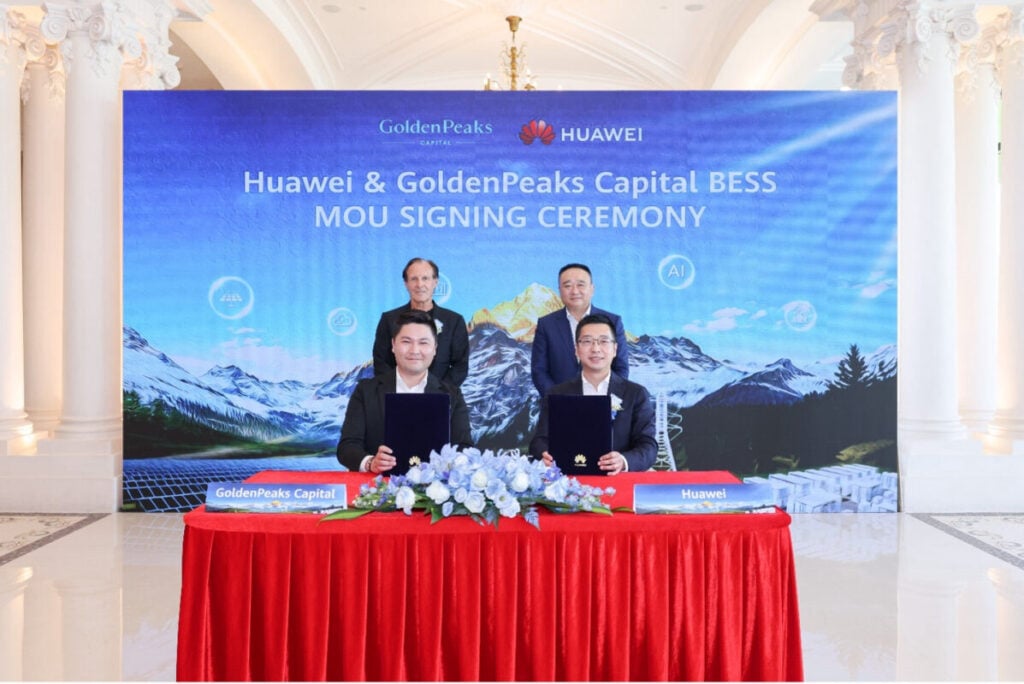
GoldenPeaks Capital (GPC) and Huawei Polska have signed a Memorandum of Understanding (MoU) on a Battery Energy Storage System (BESS) cooperation focusing on 500MWh grid-forming BESS in Europe.
Under the MoU, Huawei says it will provide its All-Scenario Grid-Forming energy storage platform, with its safety standards.
GPC says it will further leverage its expertise and growth strategy in the Central and Eastern European markets, driving technology deployment and commercial operation and supporting the region’s ongoing energy transition.
The companies highlight that this collaboration comes during a “significant moment of global transition from classic energy structures accelerating into their transition to renewable energy.”
Try Premium for just $1
- Full premium access for the first month at only $1
- Converts to an annual rate after 30 days unless cancelled
- Cancel anytime during the trial period
Premium Benefits
- Expert industry analysis and interviews
- Digital access to PV Tech Power journal
- Exclusive event discounts
Or get the full Premium subscription right away
Or continue reading this article for free
The partnership aims to address grid stability issues caused by the rising share of renewable energy and its integration into the grid.
GPC will leverage the cooperation to offer technical support as part of its strategy to expand its presence in Poland, Hungary, and other countries.
In 2024, the company advanced its “2024 1GW Asset Target” by acquiring an additional 283MW of solar projects under construction.
In June 2025, it added another 54MW/216MWh BESS into its overall renewable portfolio, bringing the total RtB BESS portfolio to 392MW/1.6GWh.
All of these projects have obtained 17-year revenue guarantees through Poland’s capacity market auctions.
Grid-forming capabilities have been an emerging trend in European BESS projects.
In 2024, Germany-headquartered utility and independent power producer (IPP) RWE announced it would build a 7.5MW/11MWh BESS with grid-forming inertia capabilities in the Netherlands.
This year, RWE commissioned a 35MW/41MWh grid-forming BESS in the Netherlands.
In July, developer Merus Power commissioned a 38MW/43MWh grid-forming BESS in Lappeenranta, Finland.
Huawei’s Grid-Forming ESS solution has already been deployed at the Red Sea destination in the Middle East. It combines 400MW of PV capacity with 1.3GWh of energy storage, making it the world’s largest 100% renewable PV-plus-ESS microgrid, the company has claimed.
The system has also been implemented in Germany, Bulgaria, the Philippines, and China, supporting the company’s global deployment of its products and services.
Huawei has been banned from 11 5G networks in the EU, and the company’s products have been largely banned in the US since 2019.
Huawei’s newly announced MoU with GPC is also notable because part of a grid-forming BESS is the inverters in the system. There has been discussion of the company’s inverters also being banned in Europe.
Nathan Zhao, Director of Huawei Poland Digital Power, said of the MoU:
“Huawei Digital Power will support GPC’s energy storage strategy in Europe with All-Scenario Grid Forming capabilities and end-to-end high-quality standards covering R&D, production, and services, to jointly respond to the EU’s carbon neutrality goals.”