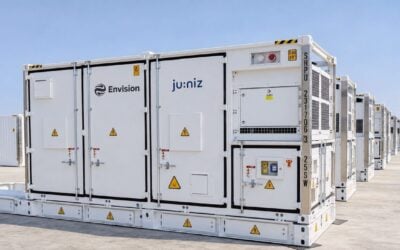
EnergyAustralia has paid AU$750,000 (US$519,300) in penalties after the Australian Energy Regulator (AER) alleged that four battery energy storage systems (BESS) it manages failed to deliver frequency services offered into the market.
The AER said on Wednesday (11 November) that it had issued 10 infringement notices to the generator-retailer over alleged breaches at the four systems in New South Wales and Victoria on multiple occasions during 2023 and 2024.
The regulator alleged that EnergyAustralia failed to ensure the BESS could fulfil the frequency control ancillary services (FCAS) offers it submitted to the Australian Energy Market Operator (AEMO), or that it failed to ensure they complied with AEMO’s FCAS dispatch instructions.
FCAS keep the grid’s frequency close to 50 hertz by rapidly adjusting supply or demand when the power system becomes unbalanced. Participants who offer services must comply with the National Electricity Rules (NER) and be able to deliver on their promises. The AER did not name the four sites.
Try Premium for just $1
- Full premium access for the first month at only $1
- Converts to an annual rate after 30 days unless cancelled
- Cancel anytime during the trial period
Premium Benefits
- Expert industry analysis and interviews
- Digital access to PV Tech Power journal
- Exclusive event discounts
Or get the full Premium subscription right away
Or continue reading this article for free
The alleged breaches came to light after AEMO asked market participants for frequency control data following the storms that hit Victoria in February 2024. EnergyAustralia then self-reported the alleged breaches, worked with the AER throughout its investigation and repaid AEMO the money it received for the services, the regulator said.
Paying an infringement notice is not an admission that the NER were breached. The AER can issue one when it has reasonable grounds to believe a company has contravened a civil penalty provision.
“Frequency control ancillary services are a crucial part of the safety net that keeps the power system stable and secure, preventing blackouts and protecting electrical equipment from damage,” said Justin Oliver, AER deputy chair.
Oliver said that as BESS take on a larger role in the power system, operators “must understand their operating limits, make accurate offers and comply with AEMO’s dispatch instructions”, and should regularly monitor their assets to make sure they are working correctly.
“Providers of frequency control ancillary services must be ready and able to deliver these services and meet their obligations when called upon, or face enforcement action,” he added.
The AER said this was its fourth FCAS enforcement outcome since 2019, and the first involving EnergyAustralia. The most comparable case came in 2022, when the Federal Court ordered Neoen’s Hornsdale Power Reserve in South Australia to pay AU$900,000 for failing to deliver contingency services it had been paid for in 2019. Neoen linked that failure to a defective firmware upgrade.
The other two cases involved thermal generators. In October 2023, two AGL subsidiaries were ordered to pay AU$6 million over FCAS offered from the Bayswater and Loy Yang power stations, and in 2021 CS Energy paid AU$200,000 in infringement notices.
Western Australia, which sits outside the National Electricity Market (NEM), has seen a similar case. The state’s Economic Regulation Authority recently fined state-owned utility Synergy AU$1.2 million after a software error led its Kwinana BESS to submit inflated offers into the state’s wholesale market.
EnergyAustralia’s BESS pipeline and the NEM frequency market
EnergyAustralia is building its own large-scale BESS. In July, Wärtsilä completed delivery of all 1,038 Quantum units to the 350MW/1,400MWh Wooreen BESS in Victoria’s Latrobe Valley, which is targeting commercial operation in 2027. EnergyAustralia sold a 50% stake in the project to Thailand’s Banpu in July 2025.
In South Australia, the company has taken delivery of the final units for its 50MW/250MWh Hallett BESS, which is being built next to its gas-fired Hallett Power Station and is expected to begin operating by mid-2027.
New BESS continue to enter the NEM, with 554MW of battery storage recently entering AEMO’s market management system.
Frequency services were once the main revenue stream for grid-scale BESS in the NEM. By the first quarter of 2022, AEMO data showed that BESS had become the largest provider of frequency regulation, with a 31% share across the NEM’s eight FCAS markets.
At the time, Cornwall Insight Australia said grid-scale BESS typically earned 80-90% of their revenue from FCAS, and forecast that ancillary services prices would fall as more BESS entered the market.
That shift has since taken place. The AER’s latest wholesale market performance report found that energy markets made up about 80% of BESS spot revenue in 2025, while FCAS costs fell to their lowest level since 2016. BESS output capacity in the NEM rose from 261MW at the start of 2021 to 6.1GW by the end of 2025, according to the report.
The AER said supporting power system security and an efficient wholesale market is one of its compliance and enforcement priorities for 2026-27, and that it will continue to monitor whether market participants are meeting their obligations.
Never miss an Australian energy storage story. Sign up for our Australia newsletter and get the latest project announcements, policy updates and market analysis delivered directly to you.