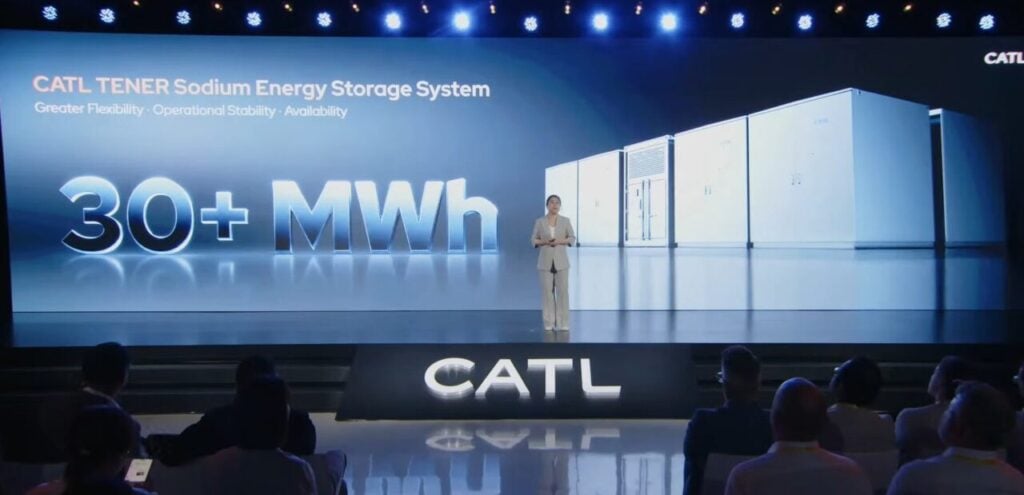
CATL held the global launch of its large-scale sodium-ion battery energy storage system (BESS) yesterday, unveiling a 30MWh+ module which it will ship outside China from next year.
Contemporary Amperex Technology Limited (CATL) hosted the official launch event yesterday for the sodium-ion (Na-ion) version of its TENER BESS solution in Munich, Germany. The livestreamed launch took place on the sidelines of the Smarter E expo and conference, which includes the Intersolar Europe and ees Europe solar PV and energy storage events.
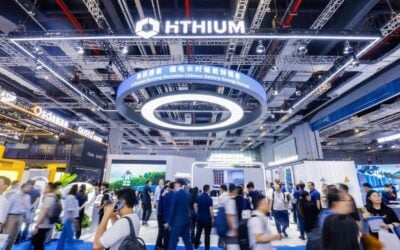
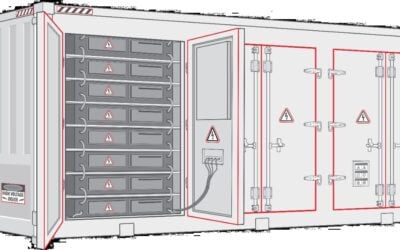
While the company had previewed some technical specifications for a 20-foot ISO containerised Na-ion BESS with 3MWh capacity per enclosure at the recent SNEC 2026 expo in Shanghai, the product showcased in Europe is a 42-ton solution that enables a 1GWh project to be built using just 34 connected ‘modules’.
William Xu, director of CATL’s energy storage system (ESS) technical centre, said that the company has shipped more than 300GWh of lithium-ion (Li-ion) systems to date, making it a leader in the global industry.
Try Premium for just $1
- Full premium access for the first month at only $1
- Converts to an annual rate after 30 days unless cancelled
- Cancel anytime during the trial period
Premium Benefits
- Expert industry analysis and interviews
- Digital access to PV Tech Power journal
- Exclusive event discounts
Or get the full Premium subscription right away
Or continue reading this article for free
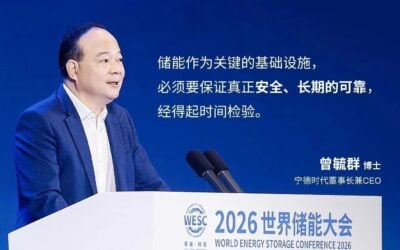
“However, our customers are still facing some uncertainties in the return of energy storage investment, so as the pioneer again, we would like to introduce the next generation of energy storage battery, the sodium-ion battery,” William Xu said.
Supply chain, operational performance and lifecycle issues addressed
The three “key uncertainties,” according to the company, are around the supply chain and the global reliance on lithium; the differences in technical requirements for operation in different parts of the world with varying environmental and climate conditions; and cycle life and safety.
With sodium an abundant raw material, Na-ion batteries’ capability to operate at a wider range of temperatures than lithium and CATL’s design of the full solution, including DC block, power conversion system (PCS) compatibility and energy management system (EMS), the Chinese OEM claims it can mitigate customers’ concerns.
CATL believes sodium will be alongside lithium as a building block of large-scale BESS solutions, Xu said.
The company has already manufactured 300,000 Na-ion cells for validation and its “dedicated sodium-ion battery factory will be put into service shortly,” according to the ESS centre technical director.
“At the supply chain level, we have worked closely with our partners to build scalable manufacturing capacity. We have the ability to deliver tens of thousands of tonnes of anode and cathode materials at the solution level,” William Xu said.
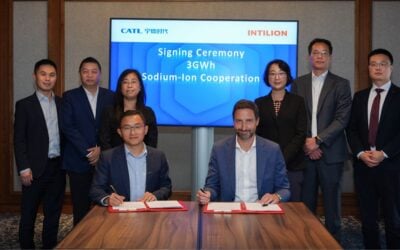
Initial shipments will begin this September in China under the company’s 60GWh supply agreement with system integrator HyperStrong, aiming to reach 1GWh in shipped units by the end of 2026.
Global shipments will begin in June next year, according to CATL energy storage CTO and European ESS business president Amanda Xu, who took the stage after William Xu to give a detailed introduction to the product.
Na-ion TENER combines flexible configuration with reliability and long service life, CTO says
According to Amanda Xu, CATL “redesigned the system around three priorities that matter most to asset owners and operators: flexibility, operational stability, and availability.”
The system’s 30MWh+ scale enables “simple project deployment,” and the decoupled energy and power block design supports a range of durations from 1-hour to 8-hour discharge at full rated power. Faulty modules can be isolated and replaced while the rest of the system remains in operation.
A dedicated bidirectional voltage regulation system solves the “industry-wide challenge” for PCS posed by Na-ion’s wide voltage range, Amanda Xu claimed, while TENER is compatible with “all major PCS brands.” The CATL EMS, meanwhile, enables “more accurate real-time estimation of cell condition,” including state of charge (SoC).
Amanda Xu talked up various other features and capabilities of the technology, including sodium-ion’s higher SoC overcharge tolerance versus Li-ion, CATL’s predictive maintenance algorithms and wide operating temperature range. As revealed at SNEC earlier this month, CATL claims the batteries can achieve up to 15,000 cycles at 25°C and over 10,000 cycles at 45°C.
It also has a higher level of “intrinsic safety” in abuse conditions. However, despite all the claims and technical development progress, customers will still rightly ask fundamental questions about whether sodium-ion can scale and whether the systems can reliably operate over lifetimes of 20 years or more.
“Those are exactly the right questions to ask. Our industry has never lacked impressive laboratory results. The real test is whether our technology can perform consistently under demanding real-world operating conditions year after year,” Amanda Xu said.
“After more than a decade of focused development, CATL has brought sodium-ion technology to commercial maturity. That maturity rests on three fundamental, very, very basic efforts: supply chain readiness, manufacturing readiness, and real-world validation.”
Watch the launch event below:
Read the related ESN Premium articles:
HyperStrong CEO on sodium-ion BESS product potential and challenges