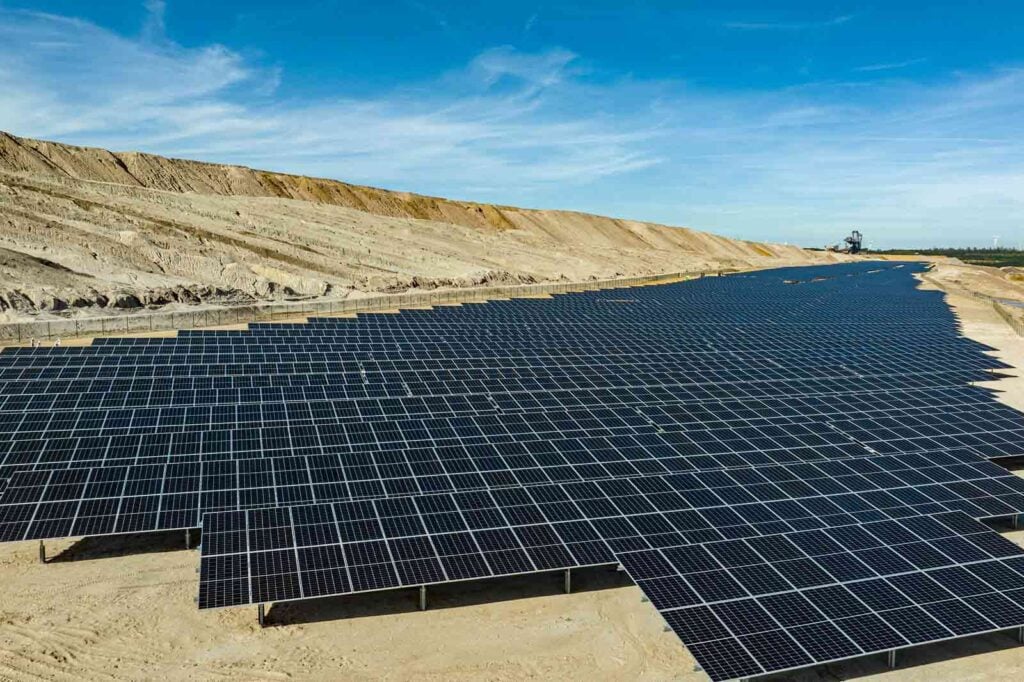
Germany: Federal Network Agency picks 490MW of solar-plus-storage from oversubscribed tender

LinkedIn
Twitter
Reddit
Facebook
Email

Germany has awarded contracts to 490MW of solar-plus-storage projects in its latest “innovation” auction for co-located renewables.

The Bundesnetzagentur (German Federal Network Agency) said the auction was more than four times oversubscribed, having received 163 bids for over 2,182MW of proposed capacity. The original auction offered contracts for 486MW of new capacity.

The successful projects were awarded at prices ranging from 4.79 cents/kWh to 5.59 cents/kWh, with a volume-weighted average of 5.31 cents/kWh. Bavaria was awarded the most capacity of any state (11 projects with 122MW of combined capacity), followed by Schleswig-Holstein and Brandenburg with around 50MW each.

The average price was “considerably lower” than the previous innovation tender auction, which closed at 6.15 cents/kWh and was also around four times oversubscribed, the Bundesnetzagentur said.

This article requires Premium SubscriptionBasic (FREE) Subscription

Try Premium for just $1

  • Full premium access for the first month at only $1
  • Converts to an annual rate after 30 days unless cancelled
  • Cancel anytime during the trial period

Premium Benefits

  • Expert industry analysis and interviews
  • Digital access to PV Tech Power journal
  • Exclusive event discounts

Or get the full Premium subscription right away

Or continue reading this article for free

The last three innovation auctions have seen substantial price drops; the October 2024 round settled at an average of 7.45 cents/kWh, which then fell to 6.15 cents in July and 5.31 cents in this most recent iteration.

The last auction, in July, also set a record as the first time bids exceeded 2GW in cumulative capacity, Bundesnetzagentur president Klaus Müller said at the time. That record was exceeded this time around.  

The falling prices, fierce competition and high demand speak to the economics of renewable energy in Germany. While the auction was issued for any co-located renewable energy or energy storage projects, all of the successful bids were for solar-plus-storage.

To read the full version of this story, visit PV Tech.
3 November 2026
Málaga, Spain
Understanding technology and supplier selection for Europe’s utility-scale PV market in 2027. PV ModuleTech Europe 2026 is a two-day conference that tackles these challenges directly, with an agenda that addresses all aspects of PV module, inverter and battery supplier selection; product availability, technology offerings, supply chain traceability, quality assurance, factory auditing, system reliability, and supplier bankability.
2 December 2026
Italy
Battery Asset Management Summit Europe is the annual meeting for owners, operators, investors, and optimisation specialists working with operational BESS assets across the continent. The Summit focuses on how to maximise performance and revenue, manage degradation, integrate advanced optimisation software, navigate evolving market and regulatory frameworks, and plan for repowering or end-of-life strategies. With insights from Europe’s most active storage markets, it equips attendees with practical guidance to run resilient, profitable battery portfolios as the sector scales.

Read Next

September 30, 2026
Gotion High-Tech has been named as the BESS supplier for three projects totalling 6GWh awarded to an ACWA Power consortium in Saudi Arabia.
September 29, 2026
Inverter manufacturer SMA Solar Technology has become the first to be certified as capable of providing inertia to the German grid.
September 29, 2026
In this news roundup, Metlen inaugurates a 75MWh BESS in Italy, PNE and Enercon develop a wind and storage project in Germany, and Mirova invests €65 million in Nordic BESS from Ingrid Capacity.
September 29, 2026
Gamuda Australia and Yanara have signed the EPC contract for Stage 1 of the Mortlake Energy Hub (MEH-1) in western Victoria.
Premium
September 24, 2026
We recently caught up with Georg Gallmetzer, managing director of German BESS platform Eco Stor, about the firm’s role in formulating flexible connection agreements (FCAs) and how this was intimately tied to the debate on grid fees.