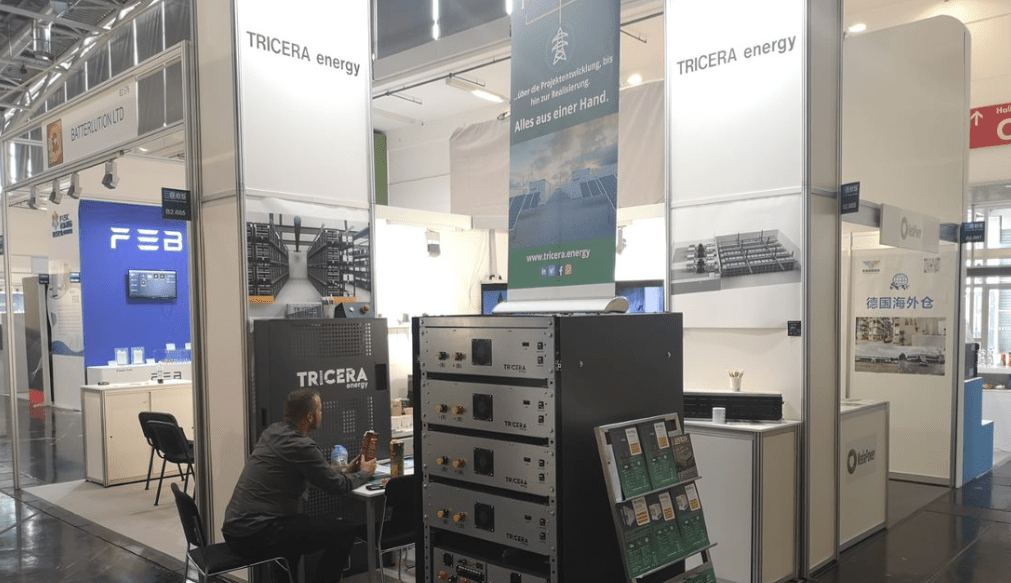
German battery energy storage system (BESS) project developer Tricera Energy has been able to build its business thanks to ‘second use’ battery modules from the country’s automotive sector, its COO told Energy-Storage.news.
The Dresden-headquartered company has a 120MWh pipeline of projects for delivery by the end of 2023 but had to come up with an alternative to sourcing batteries the traditional way, as COO Lars Fallant explained:
“We don’t order batteries from China because we are too small for them to be interested in working with us, or the price is too high, which is why we use second use batteries from the automotive sector.”
The company repackages battery modules into BESS units starting from 100kWh in size, which it sources from the country’s EV industry, one of the largest in the world. ‘Second use’ means unused batteries, as distinct to ‘second life,’ which means repurposing of used vehicle batteries.
Try Premium for just $1
- Full premium access for the first month at only $1
- Converts to an annual rate after 30 days unless cancelled
- Cancel anytime during the trial period
Premium Benefits
- Expert industry analysis and interviews
- Digital access to PV Tech Power journal
- Exclusive event discounts
Or get the full Premium subscription right away
Or continue reading this article for free
Fallant explained how it is able to procure unused battery modules in the scale required to do its BESS projects:
“Sometimes a production line will cease and there will be leftover battery modules we can use. Or, the automotive player makes more batteries than they need because of warranty agreements which were not exercised, and they don’t want to use ‘old’ batteries in their new lines. Right now there is also a chip shortage which has meant a relative overproduction of batteries in some cases,” he said.
“In all these cases, they sell to us for a good price and these are our core supply of batteries. We also have a small supply of batteries from our shareholder, which is a forklift company that builds its own battery modules. A third supply source which is small for now, but which we want to grow, is second life or recycled batteries from the automotive sector. Again, we’ve started here with our shareholder.”
The main challenges with second use battery modules – module disassembly into the constituent cells would be too costly – are two-fold according to Fallant. First, you need to design your own battery management system (BMS). Tricera’s shareholder had an existing basic one that Tricera was able to build on.
The other challenge is the variability in the size and charge type of the modules being used, meaning the mechanical structure of the rack needs to be built flexibly enough to accommodate this.
Energy-Storage.news has reported on several moves from EV industry players to repurpose vehicle batteries this year.
In April, Mercedes-Benz tied up with Swedish startup BatteryLoop to provide both new and second life batteries for the latter’s energy storage system (ESS) solutions. A month earlier, Jaguar Land Rover launched an off-grid ESS unit using only battery cells from prototype and engineering test vehicles of its first electric SUV, Jaguar I-PACE.
In March, energy group Enel started operating a 4MW backup power storage system at a plant in a Spain-held North African territory using repurposed Nissan electric vehicle (EV) batteries. Audi supplied used batteries from its e-tron EV to a 4.5MWh BESS project which launched in Herdecke, Germany, in January.