
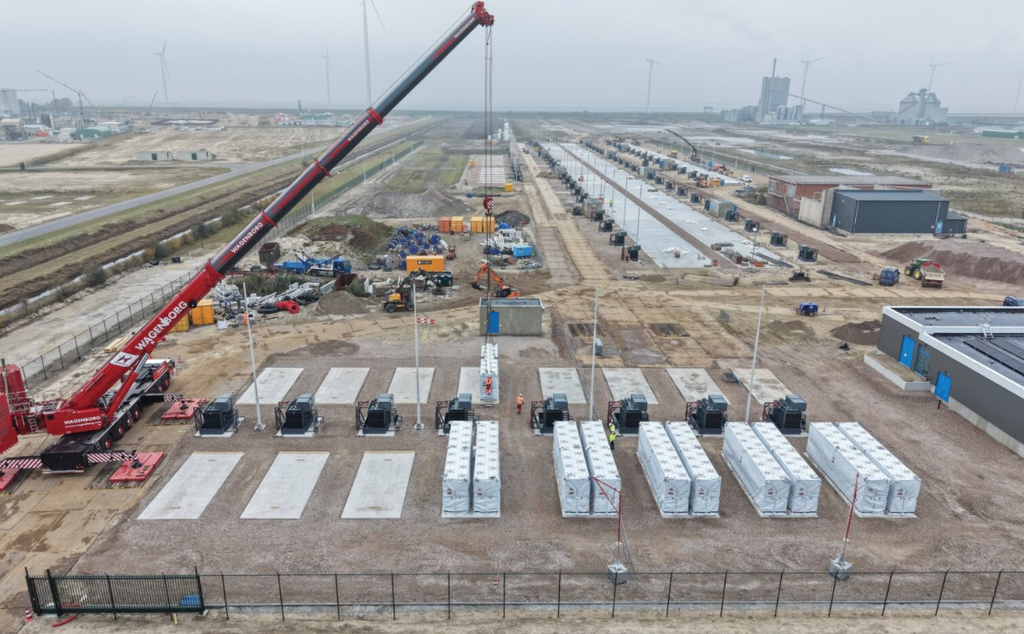
We hear from the head of market strategy & public affairs for Netherlands-based BESS platform Giga Storage, on the key trends and challenges in European asset management today.
Kathleen Dingenen will be one of dozens of industry experts on stage at the Battery Asset Management Summit Europe 2026 in Rome which is now right around the corner, running on 2-3 December. Use our discount code ESN20 for a 20% discount on tickets.
Dingenen will be on the ‘Flexible Connections, Queue Reform and the New Grid Services Stack‘ panel discussion on Day One.
Read on for her views on how running large-scale battery energy storage system (BESS) portfolios is changing, optimisation and offtake strategies, challenges and solutions around degradation and state of charge (SOC), how warranties are evolving, and more.
Try Premium for just $1
- Full premium access for the first month at only $1
- Converts to an annual rate after 30 days unless cancelled
- Cancel anytime during the trial period
Premium Benefits
- Expert industry analysis and interviews
- Digital access to PV Tech Power journal
- Exclusive event discounts
Or get the full Premium subscription right away
Or continue reading this article for free
Industry is bigger and more complex, but fundamentals haven’t changed
Energy-Storage.news: How has BESS asset management best practice in Europe evolved in the past three years?
Kathleen Dingenen: Three years ago most European BESS were small, 1- or 2-hour assets living almost entirely off frequency services, and “asset management” largely meant keeping availability high for FCR. That model has run out: FCR and aFRR are saturating in our markets, so the value has moved to wholesale trading (day-ahead, intraday and imbalance) stacked with whatever ancillary and capacity revenues remain.
The biggest change, in my view, is scale. Assets are now 2–4 hours and grid-scale (our GIGA Leopard in the Netherlands is 300MW/1.2GWh, GIGA Green Turtle in Belgium 700MW/2.8 GWh), and at that size a battery is no longer a price-taker at the edge of the system but a significant grid asset in its own right. That works both ways. The value we can offer the grid is much larger: balancing, congestion relief, voltage support and, increasingly, grid-forming capabilities. But so is the risk: how a 700MW asset ramps, trips or reacts to a fault directly affects system stability. Managing that interaction with the grid, together with the TSO, has become a core part of asset management.
The second change is complexity. Combining several system services on top of arbitrage means managing prequalification, reserving capacity and state of charge for each product, overlapping obligations and penalty regimes—all on the same asset at the same time. Revenue stacking is now done dynamically rather than by fixed allocation, and warranties have moved from daily cycle limits to annual throughput allowances. Contracting has evolved as well: we have gone from fully merchant (for small projects) to a mix of tolls, capacity contracts (needed for project finance) and merchant exposure, which turns asset management into portfolio management.
At the same time, some fundamentals haven’t changed. Availability remains key, even in this new market: on a large asset, every hour of downtime is a significant revenue loss, so we keep improving our asset management practices to avoid long outages. Asset management is always a balance between impact and cost, and at GIGA we are professionalising our asset management environment towards a fully data-driven approach.
What are the key policy, regulation and market design changes you need to keep track of when it comes to formulating your BESS asset management strategy?
I see three layers of rules that shape how we manage our assets day to day:
- Technical and safety rules—first and foremost the revision of the EU’s Network Code on Requirements for Generators (RfG 2.0). It brings storage explicitly into scope and it is set to make grid-forming capability mandatory for new storage above 1MW. That has a direct impact on asset management: it affects inverter specifications, the headroom we need to keep for grid support, our warranties and how we operate the plant. It also raises the question of how that capability will be remunerated, because grid-forming is a valuable system service, not just a connection condition. Next to RfG 2.0 come fire-safety standards and permit conditions, and the EU Battery Regulation, e.g. the introduction of the battery passport from February 2027, which strengthens our position towards suppliers on degradation and warranty claims.
- Operating obligations—in particular Flexible Connection Agreements (FCAs), which determine when and how much we can charge or discharge, but also the rules on real-time balancing obligations.
- The economic frame—grid tariffs and market design: 15-minute products, the European balancing platforms, and in Germany the metering and market-role rules for several optimisers behind one connection point. These don’t change the hardware, but they change the optimal dispatch, and with it how many cycles we run and how fast the battery degrades. Tariffs are a good example: a tariff that charges storage for both offtake and injection quickly makes a cycle uneconomic.
What is your current approach to maximising returns from your BESS, and what key performance indicators drive your operational decisions?
Our philosophy is to earn on as many markets as possible that offer real system value, rather than chasing the single highest price on a given day. In practice that means a layered revenue stack: a contracted base (a tolling agreement on part of the capacity, and capacity remuneration where available) combined with merchant exposure to wholesale and balancing markets.

The KPIs that drive operational decisions are availability (technical and commercial), realised revenue per megawatt versus a market benchmark, revenue per equivalent full cycle (which captures what we are paying in degradation for each euro earned), round-trip efficiency, and compliance with contractual and grid obligations—connection limits, CRM availability and toll performance terms. A strong revenue number that consumes warranty headroom or breaches a connection limit is not a good result
What are your views on the upcoming MACSE auction and what impact it will have on the market?
We are not active in Italy, so I look at MACSE as an observer. The first auction procured 10GWh at prices around a third of the cap, with roughly half going to a single large utility. To me that mainly shows how much scale matters in a long-term, low-margin contract: cost of capital, purchasing power and the ability to absorb risk across a portfolio all become decisive. That is not a criticism of the winners—they played the rules well—but it is a lesson for scheme design. If you want a diverse market with real competition, independent developers need a route to the same advantages, for example through tolling partners and long-term infrastructure capital, which is exactly how we work at GIGA. For our markets my message is: markets first, and where you do intervene, design it so that it creates a level playing field across companies and technologies.
Technical asset management: degradation, SOC and warranties
How do you balance profitable market participation with preserving battery cell health, and what role do optimisation technologies play in this decision-making process?
Every cycle has a price in terms of warranty headroom and future capacity, so the question is always whether the spread or service we are capturing is worth more than the degradation it causes. On high-value days we will cycle harder; on flat days, sitting idle is often the right decision. We work with a yearly throughput volume (MWh) rather than daily cycle limits, so the offtaker can do two cycles one day and none the next. That flexibility has come with liquid-cooled battery modules; older air-cooled modules are much more limited in how hard they can cycle.
Optimisers work within the throughput and SOC-window limits from the warranty and co-optimise across markets in near real time. Our role as owner is to set those parameters, make sure they reflect the actual warranty and contract terms, and keep checking that the optimiser’s choices make sense over the life of the asset—not just this month’s P&L.
As the industry matures, how is the approach to managing degradation evolving?
It is moving from “protect the battery” to “spend the battery wisely”. Early projects used conservative cycle caps and wide SOC buffers because there was little field data. Today, with LFP chemistry, liquid cooling and years of field data, suppliers can model degradation per operating condition—depth of discharge, C-rate, temperature, time at high state of charge—and on that basis offer much stronger guarantees. That allows us to use the battery much closer to its maximum capability. Owners, however, often don’t have access to that detailed data, so optimisers cannot yet optimise on degradation directly. That is why the next shift is independence: owners increasingly build capacity testing and data-access rights into their contracts, so they don’t rely solely on the supplier’s view of the asset’s health.
How are performance warranties evolving to keep up with the pace of industry development and give operators the flexibility to maximise returns?
Warranties are becoming more flexible, but they still lag behind how assets are actually used. The traditional model—a fixed number of cycles per day within strict operating windows—fits poorly with merchant trading, where you may cycle twice one day and not at all the next. We now see warranties based on cumulative energy throughput, annual rather than daily cycle allowances, and wider SOC and C-rate windows. At GIGA we currently build under a full EPC model with a tier-one integrator, so the warranty and long-term service package is a central part of procurement, not an afterthought. What we keep pushing for is sufficient data access in order to continuously assess the system’s state of health, and terms that remain valid when the asset is operated under a toll or by several optimisers at once.
How big a challenge is accurate state-of-charge (SOC) measurement, and how are operators solving this / mitigating the risks?
Accurate SOC measurement is a real challenge. LFP’s very flat open-circuit voltage curve, capacity degradation, temperature, cell and rack imbalance, PCS/BMS efficiency assumptions and a limited number of full cycles can all cause estimation errors, and even sudden SOC jumps. An apparently comfortable 20% SOC may in reality represent materially less usable energy, particularly at rack level. The result can be premature inverter or BMS limits, or the inability to deliver the energy that the EMS or trader thought was available. So the biggest practical danger is not operating the battery unsafely—the OEM BMS still provides its protection layers—but believing you have energy that the plant cannot deliver, with a direct impact on revenue.
Operators use several approaches, some more effective than others:
- Periodic SOC calibration: the battery is periodically taken from 100% to 0% and back to 100% SOC, which resets the error that builds up from counting small deltas. The downside is that calibration consumes cycles and time—and therefore trading opportunities.
- Independent SOC estimation: based on many more input variables and detailed modelling of the battery.
- Moving from SOC to available energy with an uncertainty interval (X MWh ± Y MWh), and only making X available to offtakers, which significantly reduces the risk.
- Operable SOC buffers: instead of making 0–100% tradable, defining for example 5–95% as the operable range, with a dynamic operating reserve based on confidence in the SOC estimate.
Whatever the approach, continuous monitoring of SOC deviations is essential.
Is there an emerging consensus on the augment-or-overbuild choice?
There is no single answer yet. Augmentation typically becomes relevant once the BESS has reached a certain age, whereas overbuild is foreseen from the start to avoid capacity shortfalls in the early years. Overbuilding is expensive, but it can have a positive effect on overall degradation and potential other services that a BESS can offer.
Optimisation and offtake
How much of a challenge is it to assess optimiser performance, and how is this developing?
It is challenging, because there is no single neutral benchmark. An optimiser’s result depends on the asset’s specifications, its connection limits, the risk appetite agreed with the owner and the contract structure, so comparing a headline “€/MW/year” across portfolios says little.
What is improving is transparency: independent indices and benchmarks from analytics providers, more granular reporting by optimisers, and contracts that make the comparison explicit (for example revenue-share structures). As an owner we want full data access, a clearly defined counterfactual, and reporting that separates market conditions from the optimiser’s own decisions.
How do you view the current state of risk-sharing between parties in Continental Europe/your markets’ BESS sector, and how will this evolve over time?
Risk-sharing depends very much on the market. In the most mature markets, such as Great Britain and increasingly Germany and the Netherlands, there is a deep pool of offtakers, optimisers and lenders with years of operational data, so the full range of structures is available: tolls, profit-and-loss sharing, floors, and lenders who accept a significant merchant component. In earlier-stage markets, contracted revenue is a precondition, and it often comes from state-backed schemes such as capacity mechanisms or MACSE-type auctions. Maturity is not the only factor, though: some markets—and some counterparties—are simply more conservative than others, depending on their track record with storage and how stable the regulatory framework is.
Across all markets, revenue risk is increasingly shared. Tolls and P&L sharing structures both share risk, just from a different angle: a toll transfers price risk to the offtaker, while P&L sharing aligns owner and optimiser around the same upside and downside.
Where risk-sharing is still lacking everywhere is regulatory and grid risk. Grid tariffs, connection conditions and market rules change frequently and often unpredictably, and that risk sits almost entirely with the developer. In contracts with offtakers, such changes are typically treated as change of law, which means they end up back with the asset owner. That is a cost for the whole sector: more stable and predictable rules—or at least transitional arrangements for existing assets—would lower the cost of capital, and ultimately the cost of flexibility for consumers.
What type of revenue contract structures are currently dominating, and which will we see in the market going forward (floors, tolls, swaps etc)?
For projects of our size, lenders require a substantial share of contracted revenues. Today that is mostly tolling, but we see the market evolving towards a wider range of structures: floors with upside sharing, swaps and other financial products that separate the hedge from physical operation. To keep exposure to the upside, we split our projects into blocks and keep part of the capacity fully merchant. I expect that hybrid model—a contracted base for financing, a merchant share for upside—to become the standard for large-scale BESS.