
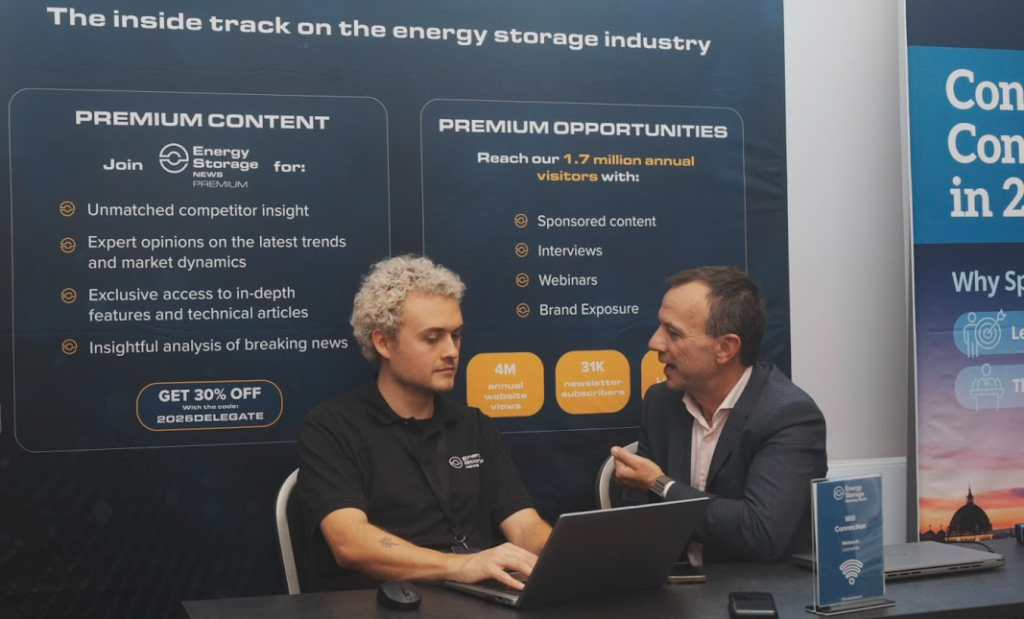
We recently caught up with Georg Gallmetzer, managing director of German BESS platform Eco Stor, about the firm’s role in formulating flexible connection agreements (FCAs) and how this was intimately tied to the debate on grid fees.
Our conversation took place at the Energy Storage Summit Germany in Berlin last week (pictured above), where FCAs were the talk of the town, with more-or-less every battery energy storage system (BESS) project in development having to contend with them.
There was a clear sense of frustration amongst investors and owner-operators at FCAs, and perhaps by extension at Eco Stor, whose Bollingstedt project was used by transmission system operator (TSO) E.ON to formulate a broader FCA framework.
In a very candid chat, Gallmetzer explains why he understands the industry’s frustration with FCAs, but argues why they are needed and how they have helped to mitigate a much more existential threat to Germany’s grid-scale BESS industry.
Try Premium for just $1
- Full premium access for the first month at only $1
- Converts to an annual rate after 30 days unless cancelled
- Cancel anytime during the trial period
Premium Benefits
- Expert industry analysis and interviews
- Digital access to PV Tech Power journal
- Exclusive event discounts
Or get the full Premium subscription right away
Or continue reading this article for free
Bollingstedt project
The firm’s 103MW/238MWh Bollingstedt BESS in Germany, now sold to power firm Alpiq, is still the largest online in the country. In May, Gallmetzer explained to us how it was used by E.ON for a ‘lighthouse project’ to experiment with FCA terms like ramp rates, ancillary caps, feed-in and charge restrictions) over a full year of operation.
“We had the challenge of being the first to be restricted by an FCA for the size of an asset like Bollingstedt, and to be confronted with what it means to operate large-scale BESS on the high voltage grid, which is substantially different to an unrestricted/non-FCA BESS,” Gallmetzer explains.
“We had the choice of either stopping asset operation or finding a solution with a grid operator that is willing to let us operate.”
Gallmetzer said E.ON concluded from Bollingstedt that its hundreds of gigawatts of BESS in the grid queue required FCAs to come online, forcing developers to choose between restricted assets or no projects—Eco Stor chose restrictions after identifying investable returns within the FCA conditions.
It was a learning experience for both sides, and the initial FCA terms were then later softened by E.ON, he adds.
“That solution in the first place was worse than what it eventually ended up at, because the grid operator learned from Eco Stor about certain things like privately financing energy infrastructure, and actually how BESS is flexible enough to accommodate the grid requirements. So the eventual grid restrictions were made more mild, and I was not shy as to be very transparent to tell everything firsthand to the industry publicly,” he says.
Other operators in Germany may come to the same conclusion
He describes Eco Stor’s process of ‘analysis, reflection, really debating with grid operators and engaging with them’ as something that explains why it has made its peace with FCAs in a way that some other players in the market might not yet have done in Germany.
“Some have done a bit of this, some have been entering the debates, but the objection to our conclusion is absolutely natural because it involves a process of analysis, a process of frustration, re-doing the economics of a project, and then a process of reconciliation and identifying ground for future investments. That is mostly yet lacking in the industry,” he says.
“But systematically I’m convinced that many players in the market may come to a similar conclusion and identify investable ground, including FCAs, and it may be on next level FCA terms, as FCA terms at E.ON are not yet fully defined. There’s still a definition phase going on. And every input that helps us to get FCA terms proved is, of course, welcome, and I invite every industry player to try and do the same exercise.”
“But eventually, it will be an exercise that some investors don’t find investable ground in, some may think it kills the business case. This happens in the context of a grid queue that is probably 10 to 20 times the size of the market. Where evidently sooner or later, a consolidation has to take place. The FCA debate is essentially anticipating this, and actually the grid operators intended to use FCAs as an instrument for consolidation and clearing the grid. That is also very clear.”
Sharing the financial benefits of BESS across society
Part of people’s frustration with regulators in Germany and generally doing business there may also be cultural. Gallmetzer explains that what much of the regulation of BESS boils down to is ensuring that the financial benefits are shared between society and that one segment does not over-profit.
“The big debate in the industry is essentially about how the financial benefits of BESS, which is new to the system, should be shared between the project’s investors, the grid operator and the consumer. The grid operator is obliged to keep costs low for the benefit of the consumer, that is in the public interest,” he explains.
“I believe this is fair, and at the same time, I believe it is right that the investor’s interest in an investable business also shall be protected, with some of the financial benefits being externalised to the public consumer. That is okay for me. This philosophy of public welfare being integrated into the system in this way is not common thinking among all the players in the market.”
“Nevertheless we have learned in the past 25 years of the energy transition in Germany that whenever there is one segment overly profiting from the transition, the regulator or the government has found ways to socialise the excessive profits.”
The relationship between the grid fee and FCA debates
On top of the FCA challenge, there was the debate around grid fees for charging and discharging. In early 2026, it looked like the proposal to bring them back in for BESS at €120/kW/year (US$136.43/kW/year), and commentators said that would kill the business case. Then, a huge reduction to €4-7/kW/year was agreed, with dynamic grid fees to be introduced in 2030-33.
Gallmetzer says the FCA debate and the grid fees debate in Germany were closely related.
“The debate on the grid fee scheme is intimately related to the FCA debate. BNetzA (Bundesnetzagentur, the federal network regulator) started the process for the new grid fee scheme with the intention of socialising profits from all grid users in order to lower grid costs, and they started with the intent to look into everyone’s business plans to see what their capability was to pay for grid access while still having a viable business plan,” he explains.
“At the start of those discussions, there was the view that BESS business is a gold mine and so a €120 per kW per year grid fee was assumed to be a fair share, that was the starting position. That would have effectively killed the business case by far.”
“Through the AgNes consultation debates, showing the transparency of BESS’ real commercial performance, including typical investor return requirements, we showed that under FCAs BESS is not a gold mine at all, and that if full grid fees were put on top of it, it would completely kill the business case.”
“So then the choice was either FCAs or high grid fees, but you FCAs can’t be dismissed, in order to mitigate the operational risk of grid failure unrestricted BESS operation bears, so the only other choice was to set FCAs as a given instrument and lower grid fees to make sure BESS was still investable.”
He says he was deeply involved in the debates via industry associations and through a process of revenue and IRR forecasts with and without FCAs and new grid fee suggestions, the regulator moved toward something agreeable.
“And it is seldom that the regulator changes its opinion, but in this case it changed opinion, deciding that it couldn’t charge the BESS industry with a full capacity price grid fee. Remember the biggest threat to the industry was not the FCA. The biggest threat was an unreflected grid fee reform.”
“FCA was the credible argument to convince the regulators to give the industry a bearable grid fee in the future. So the industry with this decision of BNetzA, will survive.”
“So in all the market risks that the industry faced, the grid fee risk was the highest, and that has been successfully mitigated with the help of the necessity and credibility of FCA impact on investible business cases.”
“The Bollingstedt experience in this way, eventually helped the industry.”
