
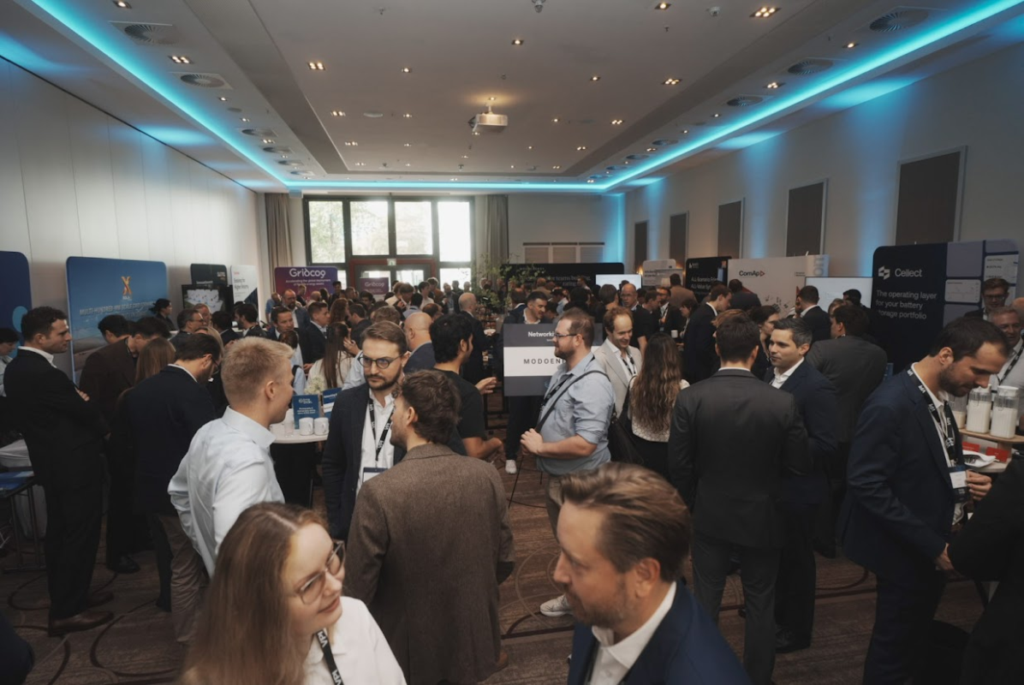
A roundup of some of our key takeaways from the Energy Storage Summit Germany this week, including around FCAs, inertia, the capacity market (CM), EU restrictions on China, and the future of one very notable system integrator.
Energy-Storage.news was on site to cover the event, which ran over 15-16 September in Berlin. Here are a few thoughts and nuggets of info we heard both on- and off-stage. Look out for more detailed articles on some of this in the coming weeks!
Flexible connection agreements (FCA) the talk of the town
The ‘event about flexible connection agreements (FCAs)’ is how one delegate described it. Maybe an exaggeration, but it came up on every panel and in most conversations, with nearly every new BESS grid connection coming with some form of restriction. The second panel of the event focused on it (see our write-up here), and we will publish another in-depth piece on it from off-stage chats soon.
Inertia is a bright spot
Numerous delegates said that inertia services opening up is a bright spot for BESS in Germany at a time when business plans look increasingly squeezed and challenged. Right now all BESS suppliers are waiting on guidance from regulators on certification, but the technology is ready to go and big operators at the event said they were likely to include capabilities in future projects.
Try Premium for just $1
- Full premium access for the first month at only $1
- Converts to an annual rate after 30 days unless cancelled
- Cancel anytime during the trial period
Premium Benefits
- Expert industry analysis and interviews
- Digital access to PV Tech Power journal
- Exclusive event discounts
Or get the full Premium subscription right away
Or continue reading this article for free
But the capacity market (CM) is more disappointing
However, panellists and delegates were much more disappointed by the country’s upcoming capacity market (CM). Climate groups have slammed it as ‘pro-gas’, a sentiment shared by everyone we spoke to about it.
In the lead-up to the event, speakers told Energy-Storage.news that while it was true the upcoming two tenders totalling 9GW of capacity will be virtually impossible for energy storage to participate in, a 2GW one next year would be much more accessible to the technology.
However, delegates at the event said that even the 2GW had various rules and requirements that meant it would be very challenging for energy storage to be successful in.
The biggest one of these is that the de-rating factors will only be published seven weeks in advance of the tender date.
“How can you secure land, permits, supply deals and a business plan in that period of time?”, one delegate, from a technology supplier, lamented.
EPC wrap is a big opportunity for suppliers
We heard both on- and off-stage that the EPC ‘wrap’ is the more common approach to deploying BESS in Germany, as opposed to ‘multi-contracting’ or ‘split scope’ in the UK. That is partially down to the maturity of the market. It means having a local team is even more key.
More restrictions on Chinese inverters are probably coming
Numerous delegates said they expected more wide-reaching bans on inverters from ‘high-risk’ countries, which basically means China. This would most likely come from the EU’s upcoming cybersecurity legislation, CSA2.
The EU this year banned them for solar and BESS projects which have received EU grant funding, or whose shareholders are backed by EU bodies like the European Investment Bank (EIB).
But that only covers about 12% of storage deployments through 2030, Wood Mackenzie estimates.
A more wide-reaching protocol would be a boon for big EU-based power conversion system (PCS) manufacturers like SMA and Power Electronics.
“Big European PCS manufacturers will be sold out for the next 10 years if a wider ban happens,” one delegate said.
There would not be enough local capacity currently to fill all EU demand for inverters, they said, but building more local manufacturing capacity in time would be possible.
Wärtsilä
We were also told at the event to expect announcements from system integrator Wärtsilä Energy Storage which will signal renewed, stronger ambitions in the sector.
The company has gone a bit quiet the last few years following a strategic review and then eventual carve-out by its parent companyWärtsilä into a 50:50 entity with Germany-based RCT Solutions.
Now, as an independent entity, it might be less restricted than when it was under a company primarily focused on gas and marine power solutions (which are more profitable than storage).
It’s never been a particularly big player in the German market, but now with a Germany-based CEO in RCT founder Peter Fath, could that change?
Market is moving to partial tolls
Like in most places, the grid-scale BESS market in Germany is increasingly moving to contracted revenue structures as a way to hedge risk and unlock more financing options. In Germany, it looks like a move to only partial tolls covering a portion of capacity. Part of that is because FCAs make 100% project tolls more difficult, but also because in-house optimisation teams still want part of the project to play with, one delegate said.
