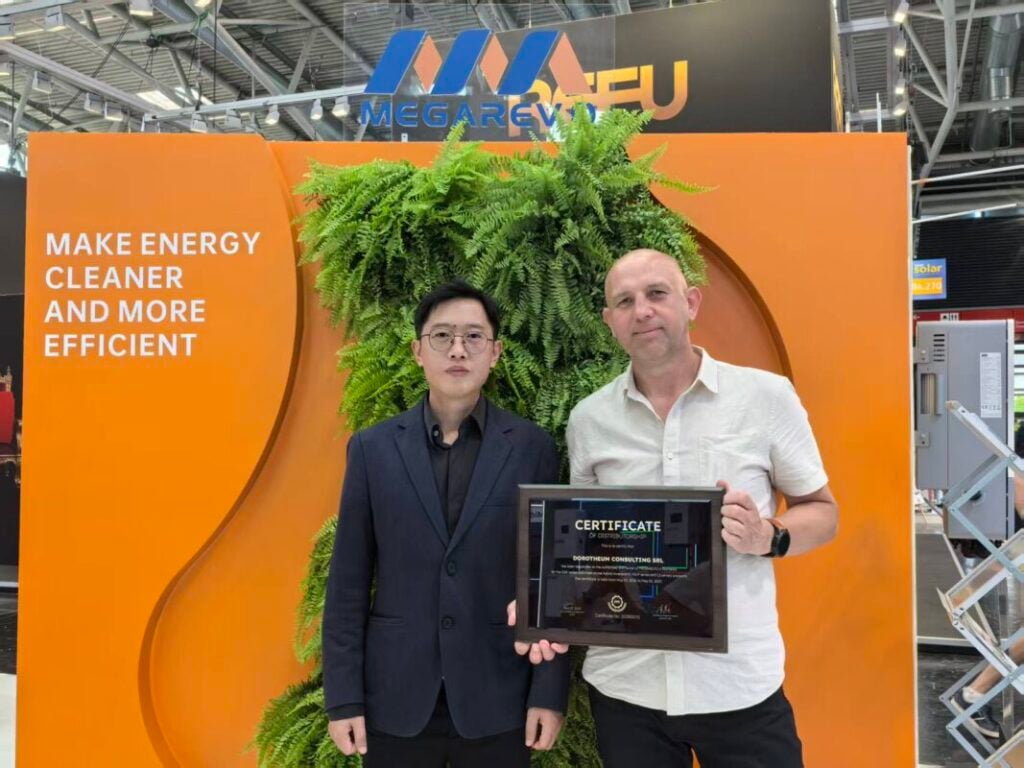
Founded eight years ago, China-headquartered Megarevo is expanding its presence in Europe with a focus on localisation, technical training, and tailored microgrid solutions.
The business produces inverters for residential, commercial and industrial applications, and has also begun manufacturing battery packs and systems. These are available globally, and Megarevo’s expertise in this area lends itself to the new focus on microgrid solutions.
Megarevo founder Brian Yaw discussed the company’s approach to commercial and industrial (C&I) energy storage, its competitive strategy, and plans for the European market with Energy-Storage.news at Intersolar Europe 2026 in Munich, Germany.
Energy-Storage.news: Can you share more about your product portfolio and how it evolved?
Try Premium for just $1
- Full premium access for the first month at only $1
- Converts to an annual rate after 30 days unless cancelled
- Cancel anytime during the trial period
Premium Benefits
- Expert industry analysis and interviews
- Digital access to PV Tech Power journal
- Exclusive event discounts
Or get the full Premium subscription right away
Or continue reading this article for free
Brian Yaw: We are particularly strong in the commercial and industrial range, from 30kWh up to 5MW. When we started out, there were no other players at all in this scenario. We worked one-by-one, project-by-project, with all kinds of customers from different countries to establish our knowledge and know-how. That’s how we became experts in this space, not only in C&I but also in microgrids. We followed the process, we learned from the customers, and we learned from the scenarios.
Across that range, what makes your modular approach particularly suited to commercial and industrial applications?
Nowadays, we offer both a modular system and a standalone system, which we separate into two types of product—I would say it’s an industrial solution and a commercial solution.
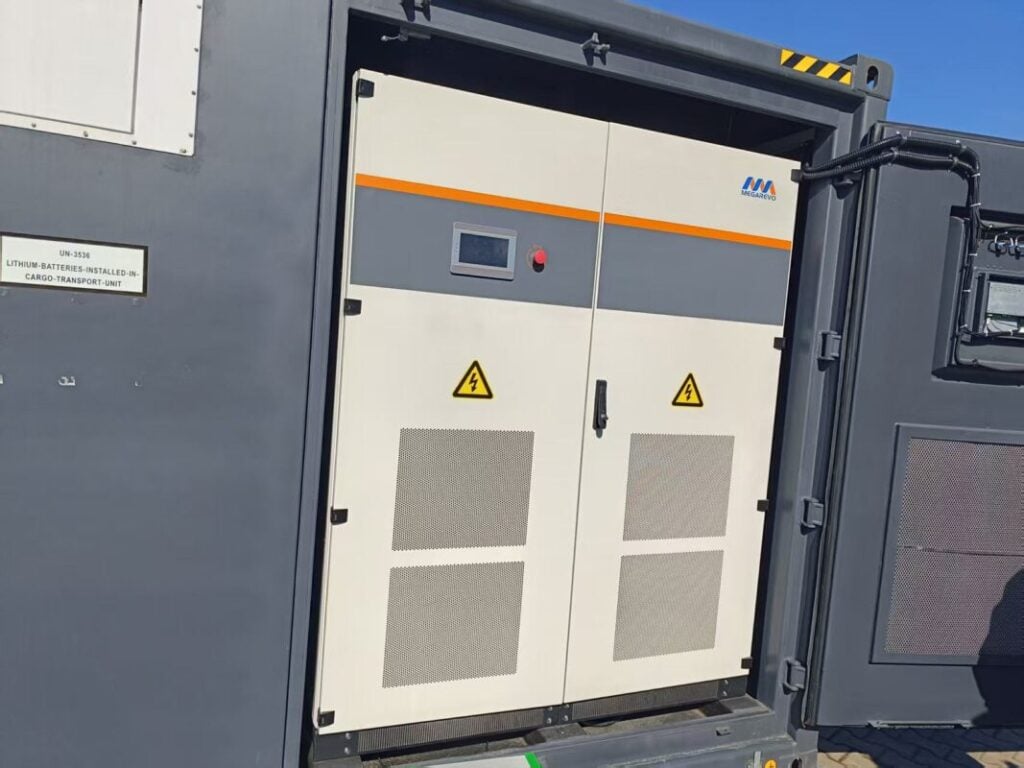
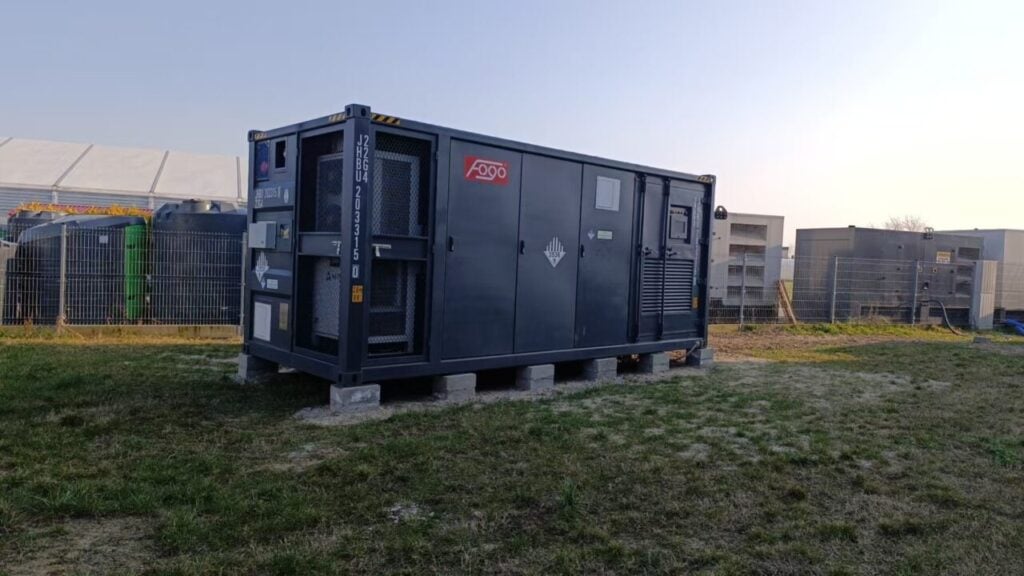
The industrial solution is like a very strong, robust, heavy machine. For example, we have delivered lots of projects in Eastern Europe recently, for all kinds of industrial customers, at factories, and for manufacturing. There are lots of motors, compressors, and inductive loads, for which our industrial products are perfect.
Meanwhile, the commercial products, like our 500kW hybrid inverter, are becoming smaller, modular, and lighter. For scenarios like offices, commercial converters are enough. When we implement projects, we will talk to the customers and recommend which product will be suitable for their needs.
What customer needs are you responding to, and how can your solutions help them reduce grid reliance and deliver cost savings?
What the customer needs from us is not only a product. We are working with them to provide tailored solutions.
This gives us a distinct competitive advantage over other domestic competitors: we consistently provide deeply customised solutions, ensuring that the final delivered products have a high degree of adaptability to real-world application scenarios. However, in actual service delivery, we often encounter clients who lack a clear understanding of industry standards and technological boundaries. They often make demands that go beyond conventional technical logic or are even impractical for implementation.
In these situations, we don’t simply reject them outright. Instead, we first break down their needs from the perspective of their actual business objectives, helping them clarify the difference between their “desired effect” and “feasible solution” in a clear and understandable way. Then, based on our past implementation experience, we provide more reliable and cost-effective alternative paths, thus maintaining the product’s delivery standards while truly helping clients solve their core pain points.
Across Europe, the issues faced vary, although the solutions are similar. In some countries, the electricity price is too high, so businesses are looking for a lower cost way of powering their operations. In others, the electricity supply is not stable enough to support operations.
So, where the cost of electricity is high, our mission is to decrease cost, usually through solar plus energy storage. In the countries where the utilities are weak, we can help customers access very stable energy supply. The configuration between these two scenarios is similar, but not exactly the same.
Can you explain a bit about what the two situations require? What are the key differences?
In a country with a strong utility, we can configure a hybrid inverter and battery energy storage system (BESS) with an energy management system (EMS) to charge when electricity prices are low, and discharge when they are high. It isn’t so complicated as in countries where a weak utility means we have to take care of the load 24/7.
In that scenario, you have to manage all the power from the grid, from the solar PV and sometimes from a generator, and match all of this power. Sometimes the utility will drop out completely, sometimes voltage will drop significantly, but you have to be able to make use of all these different power sources. This control algorithm is very complicated, but the load is there; you make sure the load gets power with no interruption.
What are the technical features of your product that make it so effective in microgrid applications?
In our inverter power electronics devices, we make use of the latest topology, the latest components and the latest control algorithm.
We have a big, well-educated team that is very experienced in power engineering, and with so many global customers, the experience of the design process is important. So is the scenario. With this in-house knowledge, we can deliver what the customer asks of us.
In trying to create a standardisable microgrid, we provide a building block to create the system based on customer needs. A microgrid is not a standard product, but this business is critical. So, our modular system can expand—for example, our MPS module starts at 100kW and can be built on up to 500kW. Our power conversion system (PCS) option starts at 125kW or 150kW.
Once we have installed a system, we stay available onsite for months to ensure that it meets the needs of the customer. I believe nobody can be successful without doing so. And because it’s such a complicated area, there are not many competitors yet. I’m happy to be able to say we are recognised as a global expert in microgrids.
What presence do you have in Europe at the moment? And what is your roadmap to expand that presence?
Our roadmap for Europe is focused on localisation. We already have a warehouse in the Netherlands and service centres in Germany and Bulgaria, and we are trying to build another two or three service centres in Ukraine or Italy, Poland or Hungary. These will be big hubs for us.
Our sales model in the European continent is that we have our own team, but we sell through our distributor. While we are sending experienced service engineers to Europe, we are hiring local people as well.
We want to establish local sales, local warehouses and a local service team, and through all of these, we are helping our distributors expand their business.
My people here are to offer technical and marketing services. We don’t sell directly to the customer; we sell to our distributors. We also help them give installers installation training, but we are available to help solve possible problems on site.
The Megarevo brand is gradually being more recognised across Europe, and we are being approached by distributors in lots of different countries. We will keep investing in the future.
How will you stand out from other companies that may have been in Europe longer?
If you look back across history, the most well-known companies or brands were not always so famous or strong, and the brands that were biggest before are not strong now, or have disappeared completely.
There will always be new problems to address—everybody, even the big names that have operated in Europe for many years, has to develop new products, hardware and firmware, for the future. And I believe there will be a big change to win.
My strategy is to focus on our roadmap, to listen and work with our customers. That’s always the way to win against the giants, who might be well-known but are very far away from their customers. We work so closely with our customers, some of whom are here because they aren’t being taken care of by those big names. If you can stay with the customer, listen to them and make use of that knowledge to develop products using the latest technology, you can win.
To learn more, visit the Megarevo website.