The inertia market could be a significant contributor to the German energy mix, but it would be short-sighted to assume that inertia can account for the entirety of a BESS operator’s revenue stack.
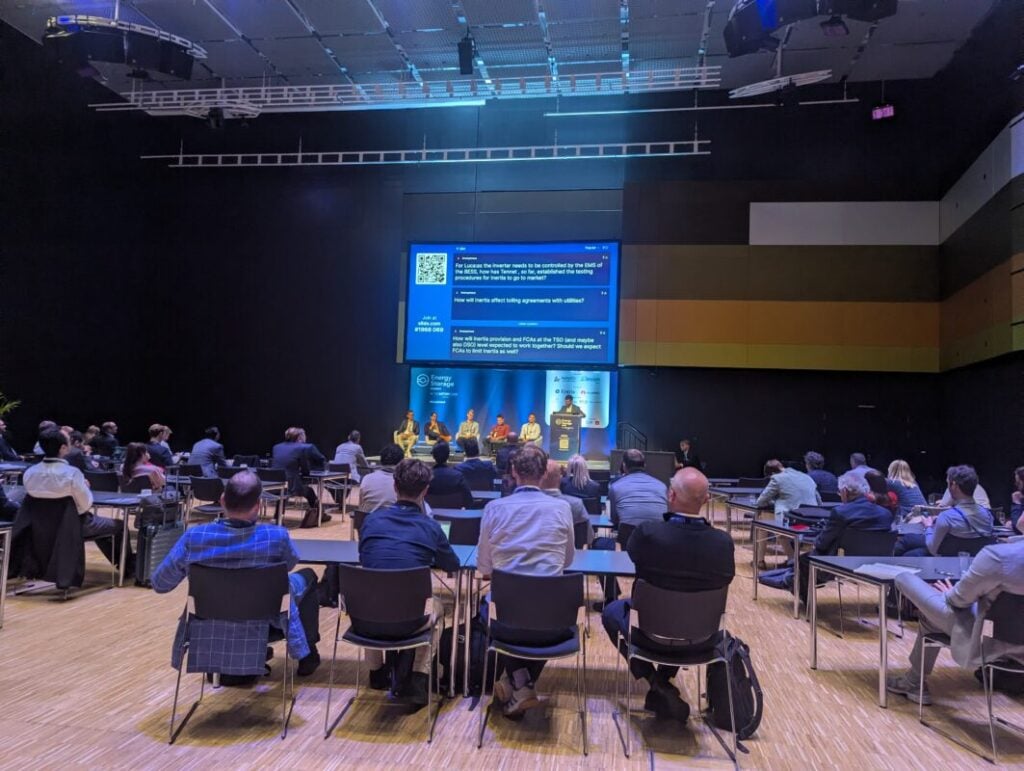
This was an opinion expressed by Till Stehr, market analyst at Modo Energy, who spoke on a panel on the second day of the Energy Storage Summit at the Battery Show Europe, hosted by Energy-Storage.news publisher Solar Media and co-located with parent company Informa’s The Battery Show Europe, and said that the German inertia market is best thought of as “a long-term contract”.
“If you lock in a ten-year contract now, the relative importance of FCA will decline over time and grid prices will decline, based on saturation,” he said, referring to some of the financial uncertainty in the German battery energy storage system (BESS) market that occupied much of the first day of the panel. “As a part of your revenue stack, inertia will only go up.”
“The other thing about this revenue stacking is that it’s important to think about doing inertia not instead of other markets, [and] that’s something that project developers will agree on,” warned Stehr. “It wouldn’t make sense to reserve 1MW of your battery capacity to only provide inertia with it.”
Try Premium for just $1
- Full premium access for the first month at only $1
- Converts to an annual rate after 30 days unless cancelled
- Cancel anytime during the trial period
Premium Benefits
- Expert industry analysis and interviews
- Digital access to PV Tech Power journal
- Exclusive event discounts
Or get the full Premium subscription right away
Or continue reading this article for free
Other panellists also pointed out the fact that inertia, for all its potential, is a relatively new phenomenon, and a greater degree of maturity and comfort with the process will be necessary for inertia to become more widespread.
“It’s quite a new product,” said Luca Sternecker, project lead for the inertia market at TSO Tennet. “For the TSO side it emerged maybe three years ago.” Meanwhile Alexander Koehler, head of revenue management at Vattenfall, said that inertia is mostly “considered as an upside”, pointing to its relatively early-stage phase of development.
Improving technical understanding
Volker Schöller, CTO at solar solutions firm Schoenergie, went on to describe some of the technical challenges associated with the growth of inertia, beginning with DSOs, many of which are coming to inertia for the first time.
“What we see at the moment is that there are not many DSOs that have knowledge of the inertia market because we’re talking about 800 DSOs in Germany,” said Schöller. “For many of them the inertia market is completely new.
“In the past, TSOs like Tennet were the only grid operators that had to have a look at the inertia market, so now we, as an installer, are coming to the DSO and they tell us ‘oh my god what will you do in my grid?’”
Sternecker went on to discuss some of the broader limitations of the German grid, and how inertia may well be just one example of a new process or product in place on the grid in the coming years.
“At the moment grid forming is not in place yet,” he said. “It is a new development, and projects are in the pipeline, but none of them are built yet. I know from our grid, the first BESS with grid forming will come online next year, so it’s not that long to go.”
“We are not allowed to take any power out of the grid and into the battery, [not] even 1KW out of the grid into the batteries” added Schöller. “It’s a design failure for now.”
Though he may well be referring to one type of configuration of BESS project, for example Innovation Tender solar-plus-storage projects, which cannot charge from the grid.
Stehr brought the conversation back to inertia at the end of the panel, stressing that, while inertia is one part of a changing German grid picture, it would be unhelpful to lump inertia and other flexibility components, like grid forming, into the same bucket.
“I think there’s definitely some movements going at the EU level to make some sort of grid forming mandatory in the future,” said Stehr. “But inertia is one of these interesting things where grid forming isn’t grid forming!”
“In Australia we have revenue uplift from grid forming but that includes very little from inertia provision, so now everyone builds batteries that can help the grid in many ways but can do very little inertia,” he said. “The inertia market can remain an inertia market.”