Electrifying low-temperature industrial heat and steam processes with renewables could reduce European Union natural gas consumption by 35 billion cubic metres-per-year, according to a report from the International Energy Agency (IEA).
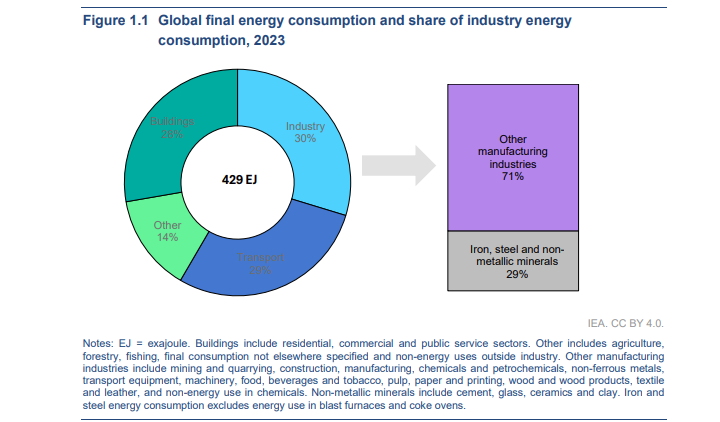
The report, released late last year and revised earlier this year, is titled Renewables for Industry: Electrification of low-temperature heat and steam. It highlights that industries dependent on low-temperature heat and steam—spanning food and beverages, textiles, chemicals, transport equipment, wood products and paper—represent roughly 70% of global industrial energy consumption.
In 2023, these sectors emitted nearly 3 gigatonnes of direct energy-related CO₂, accounting for half of all direct industrial emissions.
The IEA found that electrification of industrial processes through heat pumps and electric boilers has the technical potential to reduce the EU’s industrial fossil fuel use by almost 3,000 petajoules.
Try Premium for just $1
- Full premium access for the first month at only $1
- Converts to an annual rate after 30 days unless cancelled
- Cancel anytime during the trial period
Premium Benefits
- Expert industry analysis and interviews
- Digital access to PV Tech Power journal
- Exclusive event discounts
Or get the full Premium subscription right away
Or continue reading this article for free
However, substituting natural gas and other fossil fuels with electricity at this scale would require around 600TWh per-year of additional electricity demand—comparable to the combined annual electricity consumption of Germany and the Netherlands.
Thermal energy storage key to industrial electrification
IEA identifies thermal energy storage (TES) as the critical technology linking low-cost variable renewable electricity supply with continuous industrial heat demand.
TES systems can be constructed from inexpensive, readily available materials such as sand, cement and bricks, and can store heat up to 1,000°C. At approximately US$15-20 per-kWh, they are significantly cheaper than chemical batteries and do not rely on global supply chains for critical minerals.
Industrial heat pumps and electric boilers represent commercially available technologies for heat electrification, though deployment has remained limited due to unfavourable electricity-to-gas price ratios, lengthy grid connection lead times and the absence of clear policy frameworks.
Large-scale industrial heat pumps are well established for delivering heat up to 150°C, whilst electric boilers can generate steam up to 350°C at pressures of around 70 bar.
Regional economics
The IEA found that industrial heat pumps are economically attractive compared to existing gas boilers in several EU member states, though costs range widely from €41-74 per-MWh (US$46-US$83 per-MWh), reflecting differences in electricity prices and approaches to energy taxation and network cost allocation.
Electric boilers remain more expensive due to lower efficiency, although they are increasingly finding markets in Northern Europe thanks to the region’s low electricity-to-gas price ratios and taxation favouring electrification.
Adding TES would enhance the cost competitiveness of electric boilers by reducing exposure to peak power prices whilst improving operational flexibility and overall energy efficiency, according to the report.
China’s coordinated policy
China is advancing industrial heat electrification through a range of policies, with the technical potential to reduce the country’s industrial fossil fuel use by almost 9,000 petajoules. Direct natural gas use could be reduced by 48 bcm, reducing China’s import dependence.
Realising this technical potential would increase electricity demand by 1,700TWh—comparable to the forecast growth in China’s solar PV electricity generation between today and 2030.
The IEA highlighted that direct use of solar PV and wind coupled with TES creates new opportunities for heat electrification in China. Connecting industrial consumers directly to captive renewable power generators could almost halve heat electrification costs for steam from US$70-100/MWh for grid-connected systems to around US$50/MWh in examined provinces.
Grid-connected industrial heat pumps are attractive compared to natural gas boilers, but struggle to compete whilst cheap domestic coal remains available as a heat source.
China’s 14th Five-Year Plan, sectoral energy efficiency plans, heat pump and electric boiler action plans, financial support programmes and grid reforms provide strong support for deployment. However, the IEA noted that many targeted policies still focus on energy-intensive industries, leaving an opportunity to expand their scope to all industrial sectors.
ASEAN industrial parks
Industrial parks play a central role in the Association of Southeast Asian Nations (ASEAN) industry landscape and could become drivers of heat electrification in the region, according to the report.
Regional visions and plans support renewables, energy efficiency and green industrial hubs, yet still focus on energy-intensive sectors. Capital costs, grid constraints and limited access to finance hinder deployment, particularly in manufacturing hubs such as Indonesia, Malaysia, Thailand and Vietnam.
The IEA suggested that expanding policy and financial support to all industrial sectors, alongside targeted demonstration projects and electricity market reform, could accelerate deployment of heat pumps, electric boilers and TES.
Electricity demand for industrial heat accelerating globally
Over the past decade, global use of electricity for industrial heat has accelerated, with China, India and ASEAN recording the largest increases. Despite differing industrial structures, all major economies have converged towards similar electricity shares for industrial heat of around 4-5%.
Increased uptake is being driven by improving cost competitiveness, expanding technology availability and stronger policy signals, alongside the benefits of reducing exposure to volatile fossil fuel prices.
The IEA emphasised that renewables are rapidly transforming power systems worldwide, leading to a higher share of renewables in the industrial mix via heat electrification. This linkage between industrial electricity demand and growing renewable generation is becoming an important driver of decarbonisation across industrial sectors.
The report stressed that improving energy efficiency is the foundational step in preparing for electrification of low-temperature heat and steam. Energy efficiency measures lower overall heat demand, reduce losses and thereby enable smaller, more cost-effective electrification solutions.
In many industrial facilities, basic optimisation such as recovering and effectively using waste heat, improving insulation, enhancing process control and plant-level thermal optimisation can deliver immediate reductions in fuel consumption at comparatively low cost.
Six priority policy actions
Whilst several drivers exist, the IEA noted that global policy momentum is increasing but remains in early stages. To accelerate the electrification of industrial low-temperature heat and steam, the agency recommended six priority actions.
- First, elevate heat electrification into the policy agenda and integrate it into industrial roadmaps and targets within broader energy goals, whilst maintaining a technology-open approach fostering a wide portfolio of possible pathways.
- Second, anticipate heat electrification in long-term grid planning and prioritise connection requests with demand-side flexibility to prevent capacity shortages and reduce project delays.
- Third, reform electricity taxes and levies to level the playing field with fossil fuels and reward flexible industrial demand, possibly through lower network tariffs.
- Fourth, provide targeted early support for capital and operational costs and enable innovative business models to accelerate the roll-out of heat electrification technologies.
- Fifth, enhance skills and workforce development by expanding education and training programmes and certification schemes to meet the growing demand for industrial electrification expertise.
- Sixth, promote international collaboration on technical standard frameworks to facilitate equipment interoperability, broader adoption of standards and achieve economies of scale.
The IEA concluded that supportive policies are only now gaining momentum, but stronger signals are still needed to overcome structural barriers and unlock the full potential of industrial heat electrification.
The full report can be accessed and downloaded from IEA’s website.