Africa’s energy storage market has seen a boom since 2017, having risen from just 31MWh to 1,600MWh in 2024, according to trade body AFSIA Solar’s latest report.
The Solar Africa Solar Outlook 2025 details that energy storage has become a critical complement to variable renewable energy (VRE) generation such as solar PV, with the trade body indicating that developers are increasingly looking to co-locate battery energy storage systems (BESS) with renewable energy power plants.
This has resulted in an increase in energy storage levels in recent years. In 2022, the continent had around 50MWh of energy storage capacity installed. Since then, energy storage capacity tripled in 2023 and then experienced another 10-fold increase in 2024.
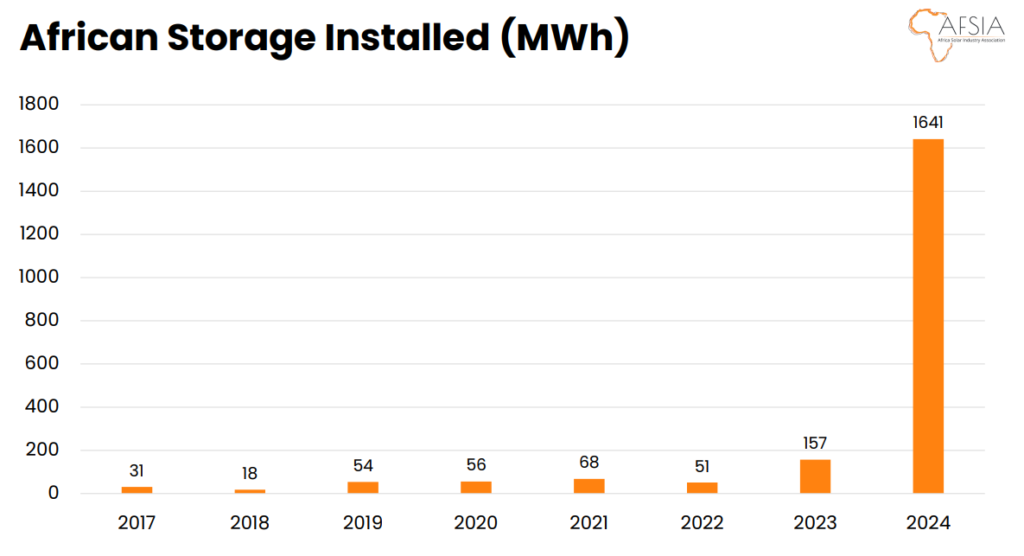
According to AFSIA Solar, this upward trajectory is not expected to slow down in the near future either. The trade body has identified a development pipeline exceeding 18GWh across Africa.
Try Premium for just $1
- Full premium access for the first month at only $1
- Converts to an annual rate after 30 days unless cancelled
- Cancel anytime during the trial period
Premium Benefits
- Expert industry analysis and interviews
- Digital access to PV Tech Power journal
- Exclusive event discounts
Or get the full Premium subscription right away
Or continue reading this article for free
The rise in interest surrounding BESS in Africa arose from the introduction of lithium batteries, which enabled greater flexibility as opposed to gel and lead batteries. This is not just limited to large-scale BESS units but has also seen a rise in electric vehicle (BESS) batteries. As such, the costs associated with batteries have decreased, making them much more accessible.
Indeed, since 2022, the cost of battery packs and cells has decreased year-on-year, with 2023 registering a 13% decrease and 2024 trumping this with a 20% reduction.
Co-location becoming the new norm for utility-scale projects
As previously noted, the co-location of BESS units alongside variable renewable energy generation is a method for optimising a power plant. Due to this, it is no surprise that solar-plus-storage is becoming the new norm for utility-scale projects across the African continent.
Solar PV, which, as reported by our colleagues at PV Tech in their write-up of the AFSIA report, reached 19.2GW in 2024, increasing by 2.5GW on 2023 levels, is becoming the focal energy generation resource for Africa.
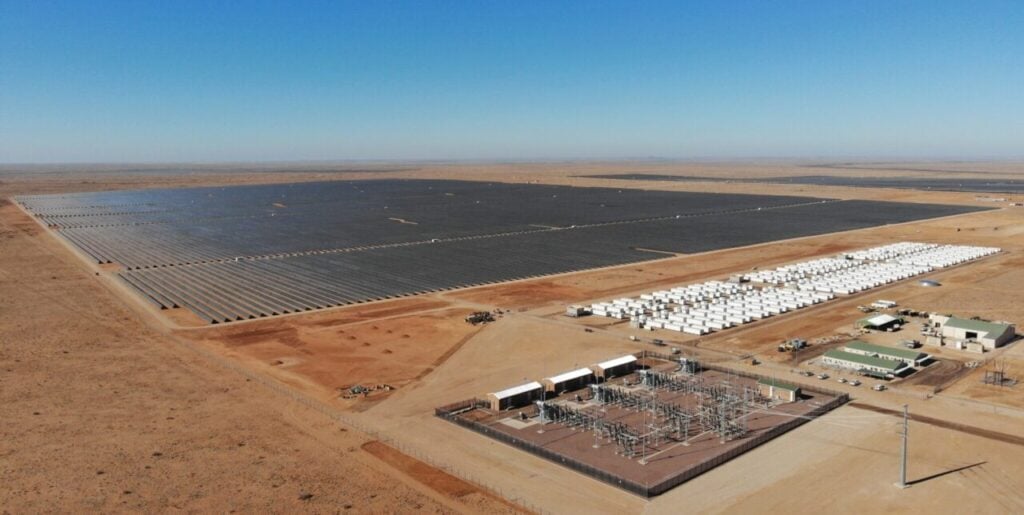
As noted by AFSIA Solar, one of the most notable solar-plus-storage developments in Africa is Norway-based independent power producer (IPP) Scatec’s 225MW/1,140MWh Kenhardt project in South Africa. The site started operation in late 2023 (pictured above).
The project was awarded under the Risk Mitigation Independent Power Producer Procurement Programme (RMIPPPP). The report notes this initiative, which is described as a means to fill the short-term supply gap, alleviate the electricity supply constraints, and reduce the extensive utilisation of diesel-based peaking electrical generators.
Several initiatives and drivers for energy storage have also been introduced to African countries. One such mechanism is South Africa’s Battery Energy Storage Independent Power Producers Procurement Programme (BESIPPPP). The scheme is already on its third bid window with successful projects in the first stage currently in the construction phase. The total of successful BESS projects amounted to 513MW/2,052MWh.