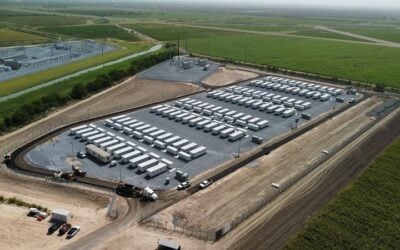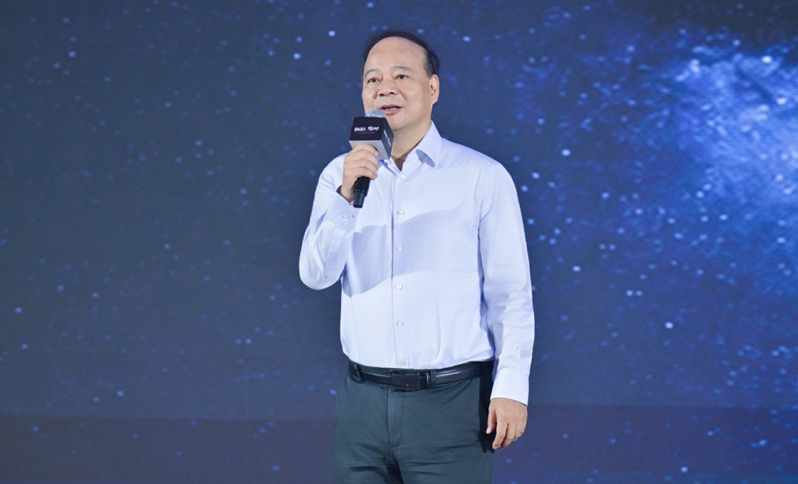
CATL’s Core Operation Carbon Neutrality Launch Event was held in Ningde, Fujian Province, China, on 17 August.
The company announced that it had achieved its core operation carbon neutrality target by the end of 2025, making it the world’s only battery manufacturer to reach this milestone while shipping at a terawatt-hour scale. The company also unveiled its action roadmap toward full value-chain carbon neutrality by 2035.
Against overlapping climate and energy pressures, global energy use is shifting rapidly toward electrification. China’s 15th Five-Year Plan targets lifting the electrification rate from the existing 30% to 35% by 2030. The European Union (EU) plans to double its rate by 2040, and Turkey, holder of the incoming COP31 presidency, is advocating for a global electrification rate of 35% by 2035.
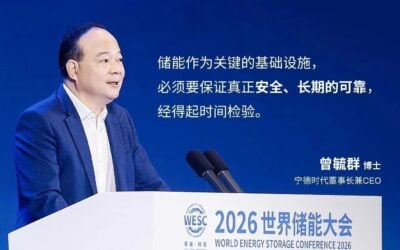
Robin Zeng, CATL’s Chairman and CEO, said at the event that widespread electrification of energy consumption hinges on cost-competitive clean energy.
Try Premium for just $1
- Full premium access for the first month at only $1
- Converts to an annual rate after 30 days unless cancelled
- Cancel anytime during the trial period
Premium Benefits
- Expert industry analysis and interviews
- Digital access to PV Tech Power journal
- Exclusive event discounts
Or get the full Premium subscription right away
Or continue reading this article for free
As a zero-carbon technology enterprise, CATL is bringing zero-carbon electricity to diverse industries. For CATL, zero-carbon represents not merely a mission, but a real-world proven capability—and a major growth opportunity, Zeng said.
CATL to focus on supply chain emissions following factories’ attainment of core operation carbon neutrality status
CATL first announced its zero-carbon strategy in 2023, setting targets for core operation neutrality by 2025 and full value chain neutrality by 2035. By the end of 2025, all 20 of its battery factories achieved ISO 14068-1 certification as zero-carbon facilities, powered entirely by zero-carbon electricity.
CATL revealed in financial filings that it produced 748GWh of batteries in 2025, with lithium-ion battery sales surging 2.3-fold since 2022 to maintain its position as the world’s top-ranked battery supplier by market share.
Benchmark Mineral Intelligence ranked CATL as the top global supplier of cells for battery energy storage system (BESS) applications and fourth among battery storage system integrators last year. Meanwhile, the battery manufacturer said in its most recent financial results release in July that the stationary energy storage market accounted for just under 20% of its total revenues in the first half of 2026.
“Non-zero-carbon batteries will eventually be phased out by the market,” said Robin Zeng. He emphasised that the company is committed to advancing the global green transition through scalable zero-carbon solutions.
In June, CATL established CATL Zero-carbon Technology (Xiamen) Co., Ltd., with a registered capital of RMB 10 billion (US$1.48 billion). The entity will serve as the company’s global hub for coordinating zero-carbon technologies and commercial deployment.
According to documents Energy-Storage.news has seen, CATL’s zero-carbon roadmap unfolds in two phases: first, decarbonising its own operations; and second, driving carbon neutrality across its entire supply chain.
The first phase is now complete. CATL unveiled its zero carbon strategy in 2023, setting a target for core operation carbon neutrality by 2025. By the end of 2025, all 20 of its battery plants achieved ISO 14068-1 zero-carbon certification, with core operation powered entirely by zero-carbon electricity.
Since 2023, the company has consumed cumulatively over 18 billion kWh of zero-carbon electricity. By 2025, energy consumption per unit of product at its battery manufacturing bases dropped 28% compared to 2022, while carbon emission intensity decreased by approximately 77%.
The second phase targets the supply chain, which accounts for over 80% of a battery’s lifecycle emissions. Recognizing that core operation neutrality is just the beginning, CATL has launched its 2035 Full Value-Chain Carbon Neutrality Initiative, aiming for end-to-end decarbonisation from mineral extraction and smelting to material production and final battery assembly.
Bryan Huang, head of CATL’s procurement centre, announced a Zero-Carbon Supply Chain Empowerment Program, in which 30 core suppliers will be selected in the first phase for “deep, collaborative carbon reduction.” These suppliers will be rewarded with order priority and long-term contracts, ensuring that their green transition translates directly into a competitive economic advantage.
“From advanced materials and zero-carbon manufacturing to battery swapping and circular recycling, we have built a complete closed-loop system spanning R&D to end-of-life recovery,” Robin Zeng said.
“In the fossil fuel era, reducing carbon meant higher costs. That paradigm has shifted. As technological advances continue to drive down the cost of green power, zero-carbon has become economically viable, representing a powerful new growth model.”