California investor-owned utility (IO) Pacific Gas & Electric (PG&E) has furthered its commitment towards the state’s mandated target for energy storage deployment by utilities, putting 165MW of contracts forward to regulator California Public Utilities’ Commission (CPUC) for approval.
Along with Southern California Edison (SCE) and San Diego Gas & Electric (SDG&E), PG&E has been instructed to put 1.325GW of energy storage online by 2024. PG&E’s share of that target is 508MW. In May state policymakers including Governor Jerry Brown instructed each to add 166.66MW – adding up to 500MW between the three – of additional energy storage capacity to that target.
Energy-Storage.News reported back in May that as of February 2017, the three IOUs had reached 478.5MW of the target already. All deployments come about through competitive solicitation processes. PG&E said in a statement on Monday that it has now reached 79MW of contracted or deployed energy storage since the mandate, AB2514, was issued in 2014.
The latest 165MW of potential contracts are all lithium battery-based, split across six projects. Four come via special vehicles created by major international utilities, Enel Green Power and EDF Renewable Energy, along with Tesla and developer LS Power.
Try Premium for just $1
- Full premium access for the first month at only $1
- Converts to an annual rate after 30 days unless cancelled
- Cancel anytime during the trial period
Premium Benefits
- Expert industry analysis and interviews
- Digital access to PV Tech Power journal
- Exclusive event discounts
Or get the full Premium subscription right away
Or continue reading this article for free
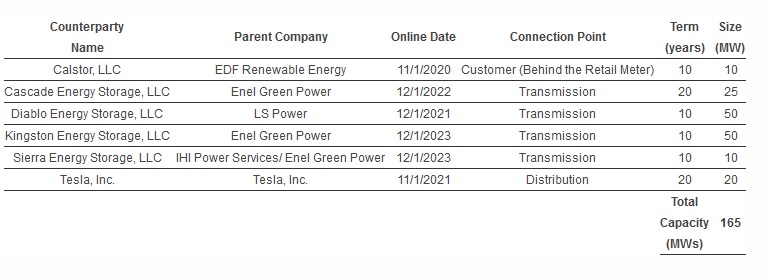
PG&E said the first of the projects will come online in November 2020. Projects were selected after a year of application reviews, with the criteria being that each project should seek to address at least one of the following three issues: optimisation of the grid, integration of renewable energy and greenhouse gas reduction. The utility issued its request for proposals (RfP) for the projects a year ago, asking for facilities of 1MW to 50MW in size each, seeking to award a total of 580MW of contracts by 2020.
PG&E was interested in proposals for storage at a distribution substation that the utility itself could own, as well as energy storage for three of its own solar PV generation assets. The former would help PG&E add resilience to its distribution infrastructure at a lower cost than a substation upgrade.
“As our clean energy portfolio grows, so does the importance of storage technology. These contracts and the storage capacity they represent will help us better integrate our growing renewable generation sources, and bring increased reliability to the grid. They are an important milestone in our progress toward a clean energy future,” Martin Wyspianski, PG&E’s senior director for energy portfolio procurement and policy said.
PG&E says that by the end of this year, a third of its electric power could be coming from renewable sources.
Enel issued its own statement that the three projects awarded to it and its partners as Capacity Storage Agreements would have an overall installed capacity of 85MW / 340MWh “to increase the reliability of PG&E’s grid”.
Enel said that pending regulatory and local approvals, the Cascade, Kingston and Sierra projects will be operational by 2023. Each is a standalone lithium battery project. Elsewhere in California, Enel has already delivered the 3MW / 12MWh Pomerando facility in San Diego for SDG&E and acquired US energy storage software maker Demand Energy Networks earlier this year.
Italy-headquartered Enel is seeking to expand its presence in the energy storage market, particularly in the US and especially in leading state California, Enel’s global head of thermal generation, Enrico Viale, said.
“Utility-scale storage applications are a key focus area for Enel in view of the great benefits they offer in terms of grid balancing and reliability. We are proud of the progress we have made in this field so far and look forward to growing our storage portfolio even further.”
The three projects will be connected to the distribution grid, charging up at times when there is plenty of renewable energy being generated and discharging during network peaks. Kingston is a 50MW / 200MWh project, Cascade is 25MW / 100MWh and Sierra 10MW / 40MWh. Enel will work with developer Sovereign Energy Storage.