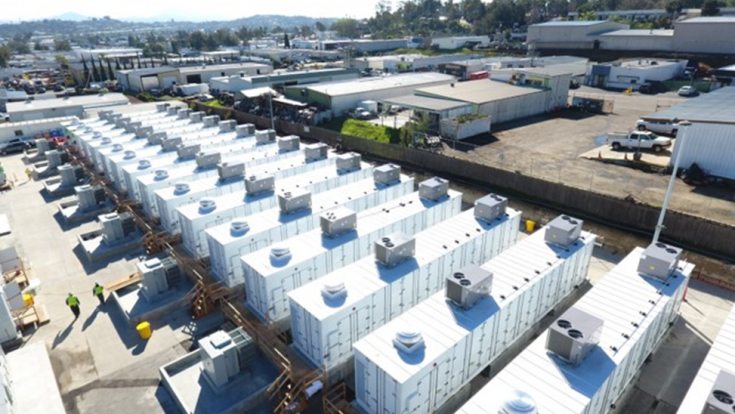
Investor-owned utility SDG&E is turning its first lithium iron phosphate-based battery energy storage system (BESS) online today, while Stanford university says it has hit 100% renewable electricity with the offtake from Goldman Sachs’ recently-commissioned Slate solar-plus-storage project.
SDG&E adds first LFP BESS to grid
San Diego Gas & Electric (SDG&E) will today (29 March) cut the ribbon on the Kearny Energy Storage in north San Diego. The 20MW/80MWh BESS is the first energy storage project by the utility to use lithium iron phosphate (LFP) chemistry-based batteries.
The BESS is the latest in SDG&E’s pipeline which will bring its total storage portfolio to 145MW by the end of 2022. It recently ordered a six-hour BESS solution for one of its sites from Mitsubishi Power.
Its BESS projects are in response to the various mandates by the California Public Utilities Commission (CPUC) to procure more energy storage to mitigate the risk of near-term capacity shortages and help the state’s transition to a zero-emissions grid by 2045.
Try Premium for just $1
- Full premium access for the first month at only $1
- Converts to an annual rate after 30 days unless cancelled
- Cancel anytime during the trial period
Premium Benefits
- Expert industry analysis and interviews
- Digital access to PV Tech Power journal
- Exclusive event discounts
Or get the full Premium subscription right away
Or continue reading this article for free
Seth Hilton, partner in the Energy Development practice of law firm Stoel Rives, told Energy-storage.news that very few projects will meet their deadlines of 2023 and 2024 due to interconnection issues on the California ISO grid and wider supply chain issues.
“I think a lot of energy is being focused on that very near-term procurement, but there’s a lot of difficulty in terms of there just not being enough projects to kind of meet some of that need and what you see now is projects getting shortlisted for multiple load-serving entities’ procurement,” he added.
California has three large investor-owned utilities. SDG&E andSouthern California Edison (SCE) have opted for owning their own BESS projects while the third Pacific Gas & Electric (PG&E) has tended to procure power from sites owned by other developers.
The direct ownership approach has, however, proved slightly controversial amongst independent developers according to a Hilton.
“So, SCE originally took the path of: “we’re going to develop our own projects,” primarily because of interconnection issues. So the deal with Ameresco (2.1GWh) was a way of getting around the interconnection issues,” he told Energy-storage.news.
“And there were some significant developer concerns about the fact that SCE was in a position where they could get around interconnection issues, and developers aren’t in a similar situation and how that should be appropriately handled. There were a lot of protests of what SCE was doing in terms of that Ameresco agreement.”
Stanford University’s offtake from Goldman Sachs project enables 100% renewable electricity transition
Stanford University has revealed that the 63MW of offtake it secured from the Slate solar-plus-storage project in Kings County, California, has completed its transition to 100% renewable electricity.
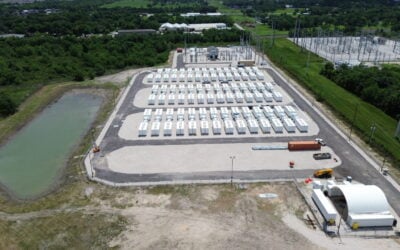
The project was completed and turned online by owner investment bank Goldman Sachs earlier this month. It comprises 300MW of solar PV paired with a 140MW/561MWh BESS and was bought by Goldman Sachs Renewable Power from Canadian Solar subsidiary Recurrent Energy just before construction started in January 2021.
“As this new solar plant comes online, Stanford will achieve the important milestone of producing enough renewable electricity to exceed what the university consumes,” said President Marc Tessier-Lavigne.
Stanford’s portion of Slate, the Stanford Solar Generating Station #2 (SSGS2), is its second major solar power site after the Stanford Solar Generating Station #1 in Rosamond, California, came online in 2016. The year before, the university campus was entirely powered by natural gas.
The university still needs to electrify its campus vehicle fleet, hospital water heating systems, its natural gas and steam appliances and its heating systems to achieve 100% renewable energy.
The other offtakers of the Slate project’s power are the San Francisco rapid transit system operator Bay Area Rapid Transit, electric utility Power and Water Resources Pooling Authority, and Community Choice Aggregators (CCAs) Silicon Valley Clean Energy and Central Coast Community Energy (formerly Monterey Bay Community Power).