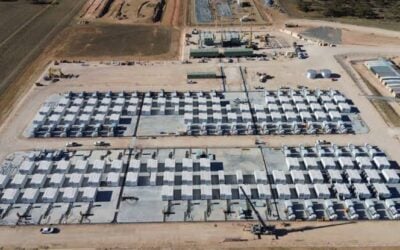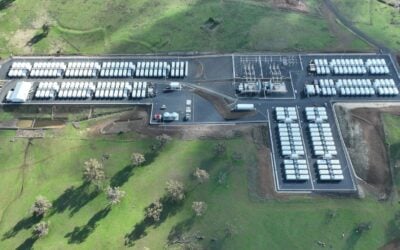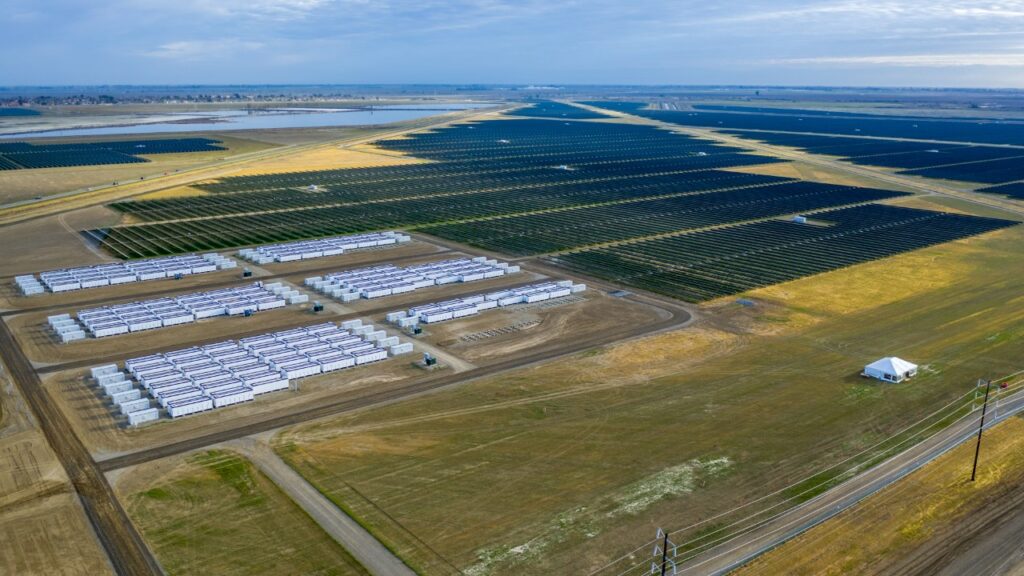
Goldman Sachs Renewable Power (GSRP) has cut the ribbon to signal the completion of work on Slate, a large-scale solar-plus-storage project in Kings County, California.
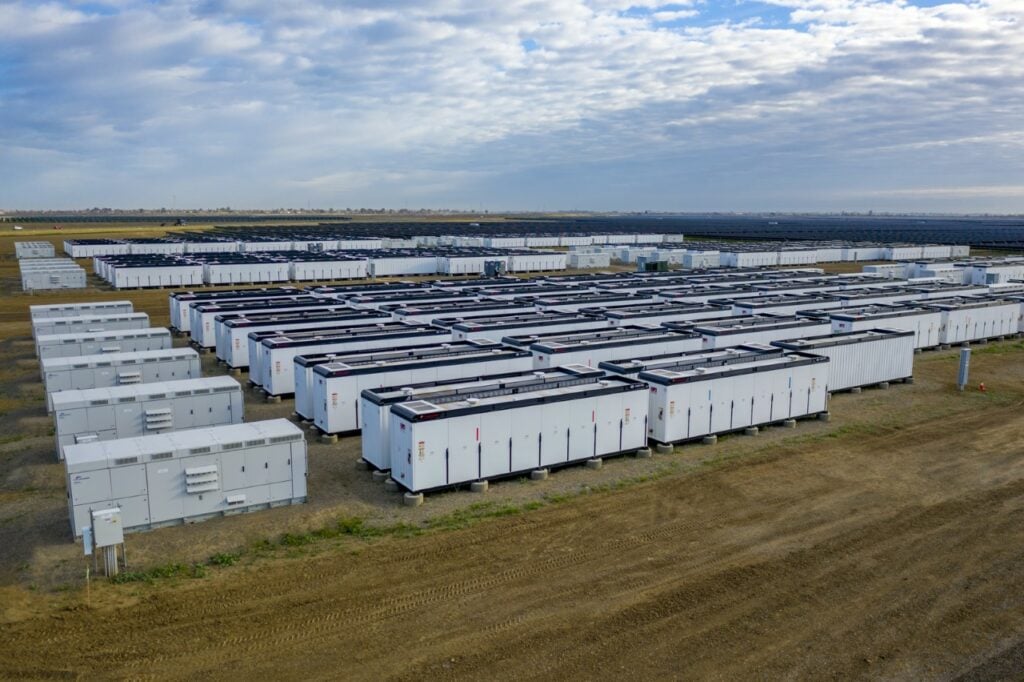
The project pairs 300MW of solar PV with a 140.25MW/561MWh battery energy storage system (BESS).
Construction began in January 2021. The renewable energy owner-operator and affiliate of Goldman Sachs Asset Management bought the project shortly before that from its original developer, Canadian Solar subsidiary Recurrent Energy.
When the project was first announced in October 2018, two California energy suppliers, Silicon Valley Clean Energy (SCVE) and Monterey Bay Community Power (MBCP) had already signed 15-year power purchase agreement (PPA) deals for the plant’s output.
Try Premium for just $1
- Full premium access for the first month at only $1
- Converts to an annual rate after 30 days unless cancelled
- Cancel anytime during the trial period
Premium Benefits
- Expert industry analysis and interviews
- Digital access to PV Tech Power journal
- Exclusive event discounts
Or get the full Premium subscription right away
Or continue reading this article for free
The pair are Community Choice Aggregators (CCAs), energy suppliers licensed as load-serving entities with the California Public Utilities Commission (CPUC) and offering their member-customers the choice of where their power comes from, while still being able to use the distribution networks of California’s three major investor-owned utilities.
Since then, three more off-takers have signed with GSRP for Slate: Power and Water Resources Pooling Authority, which represents the power management interests of nine California Irrigation Districts, San Francisco’s Bay Area Rapid Transit group and Stanford University.
The plant’s combination of solar PV with four-hour duration battery storage enables each group to purchase dispatchable renewable energy into the evenings and help manage their peak loads.
Energy-Storage.news reported on two separate financing transactions which were closed by French financial services and banking group Natixis, one for US$515.9 million in senior secured credit facilities, the other a US$150 million Equity Bridge Loan which was used to fund GSRP’s equity contribution into the project.
California has of course become the US’ leading market for battery storage in the past couple of years, with the majority of new additions being four-hour duration projects. Grid operator CAISO recently noted that 2,359MW of storage was deployed in its service area during 2021 — more than half the amount installed in the whole US during the year.
During the Bootleg wildfire in July, CAISO said it was able to access around a gigawatt of storage resources that helped keep the lights on and has repeatedly said that battery storage of four hours duration or more will be key to progressing California’s transition to renewable energy while maintaining grid reliability.
With more than 60% of solar projects in developer and utility queues in the US planned to be paired with storage, California is again at the heart of the industry trend.
Developer Terra-Gen is building the world’s largest solar-plus-storage project there, the Edwards & Sanborn project at Edwards Air Force Base, pairing 1,118MW of solar PV with 2,165MWh of BESS, albeit the project is being built in phases.
An interesting aspect of that project is that a portion of it was recently included in a PPA deal Terra-Gen signed with another CCA, San Jose Clean Energy, to guarantee the delivery of 62MW of energy from the facility between 6pm and 10pm each day, in effect making it a 16-hour daily clean energy resource.
Earlier this month, D.E. Shaw Renewable Investments announced the signing of a renewable PPA for another sizeable California solar-plus-storage plant, signing a deal with Sacramento Municipal Utility District (SMUD) for a 200MWac PV and 400MWh BESS plant to be online by 2024.
Meanwhile, Goldman Sachs Renewable Power now owns nearly 900 solar and storage projects in the US. In March last year, Jacob Steubing, one of the company’s VPs, said that battery storage “is a very exciting market,” which had led it to get involved relatively early.
Goldman Sachs Asset Management recently made a commitment to invest US$250 million into Canadian advanced compressed air energy storage (A-CAES) company Hydrostor, which is developing long-duration storage projects at very large-scale. This includes two projects in California, one of 3,200MWh and the other 4,000MWh.