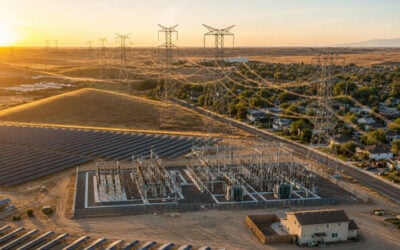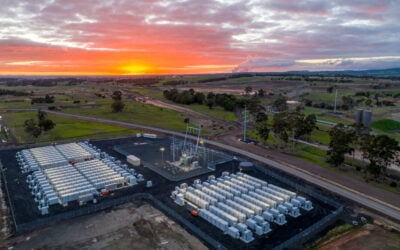
Utility Black Hills Energy has announced it will move forward with the construction of a 50MW/200MWh energy storage facility at its Pueblo Airport Generating Station (PAGS) in Colorado, US.
Announced 4 September, the battery energy storage system (BESS), dubbed the Pueblo Battery Resource was approved by the Colorado Public Utilities Commission (CPUC) in 2025 as part of Black Hills’ 2022 Clean Energy Plan filing.
Every four years, Black Hills conducts a planning process to forecast the electric resource requirements necessary to provide customers with reliable and cost-effective energy while also achieving the state of Colorado’s emission reduction requirements. The company is preparing to file its 2026 Clean Energy Plan early this fall.
The Pueblo Battery Resource project will be charged with excess renewable energy provided by other Black Hills renewable resources. It is expected to begin supplying power to Southern Colorado customers in late 2027 and is estimated to deliver approximately US$30.1 million in economic benefit through the construction, operation and maintenance of the facility.
Try Premium for just $1
- Full premium access for the first month at only $1
- Converts to an annual rate after 30 days unless cancelled
- Cancel anytime during the trial period
Premium Benefits
- Expert industry analysis and interviews
- Digital access to PV Tech Power journal
- Exclusive event discounts
Or get the full Premium subscription right away
Or continue reading this article for free
Project partners include a global engineering, procurement and construction (EPC) company Linxon, and Cloudbreak Energy, a national developer and IPP of distributed resources and utility-scale solar and storage projects.
In addition to developing the project, Cloudbreak Energy will also oversee the construction of the BESS, while Linxon will deliver the balance-of-plant infrastructure needed to support the deployment of 50 Tesla Megapack battery enclosures, including associated electrical and civil engineering work.
Colorado has a statewide goal set by Governor Jared Polis to achieve 100% renewable energy by 2040. The state says that renewable energy is now the least expensive electricity source and that by 2030 over 80% of its electricity will come from renewables.
Under Senate Bill 19-236, Black Hills is required to achieve an 80% reduction in carbon dioxide emissions by 2030 based on 2005 levels. The utility filed a preferred version of its Clean Energy Plan that would have produced a 90% reduction in carbon dioxide emissions by adding approximately 450MW of new renewables resources including BESS, in 2022.
According to the utility’s website, the plan that was approved by the CPUC in 2025 adds 250MW of renewable resources and achieves a 78% reduction in greenhouse gas emissions.
Black Hills has nine standalone BESS projects listed on its website with bidder names and contract terms. It is unclear if the Pueblo Battery Resource project is part of this list, however, the projects, listed at 50MW each, total 450MW of capacity.
In May, developer-operator GridStor acquired the 199MW/796MWh Birdseye BESS project in Adamas County, Colorado from developer Accelergen.
Birdseye’s commercial operations date is planned for the end of 2028, with construction anticipated to begin as early as 2027.
Battery Asset Management Summit USA 2026 will be held 15-16 September in Garden Grove, California, hosted by Energy-Storage.news publisher Solar Media (part of the Informa Group). The agenda emphasises addressing the roles of AI, cybersecurity, and second-life applications, broken down into two tracks: Technical Asset Management and Commercial Asset Management. This year, the conference is also co-located with Solar & Storage Finance Summit USA. Visit the official site for more details.