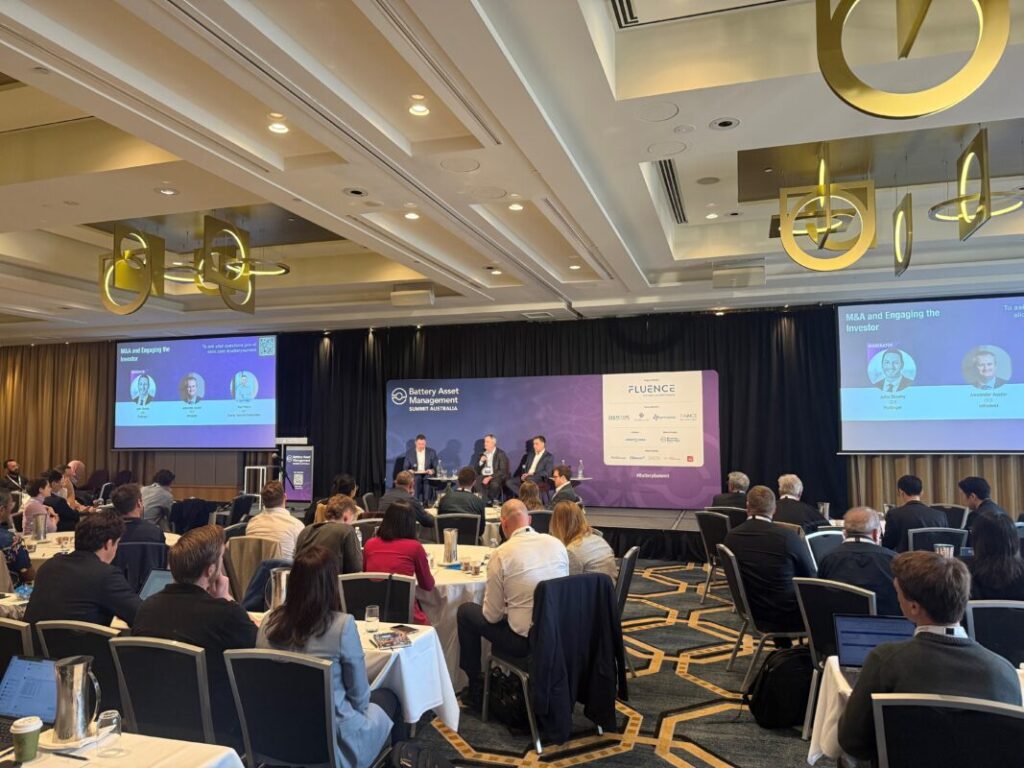
“Battery energy storage systems (BESS) typically change ownership between two and four times during their 40-year lifecycle,” John Sheehy, CEO of Pottinger, said on day two of the Battery Asset Management Summit Australia 2025 this morning.
Discussing asset management on the ‘M&A and Engaging the Investor’ panel discussion, Sheehy of investment advisory firm Pottinger also noted that mergers and acquisitions (M&A) play an “incredibly important role” in the deployment of BESS.
“M&A is really important in shifting the profile from a cost of capital, from a risk profile as you move through the development stages and into operations and through the life of the battery,” Sheehy added.
Paul Peters, CEO of the New South Wales Energy Security Corporation (ESC), which launched at the start of July, and Alexander Austin, CEO of Infradebt, also participated in the panel discussion.
Try Premium for just $1
- Full premium access for the first month at only $1
- Converts to an annual rate after 30 days unless cancelled
- Cancel anytime during the trial period
Premium Benefits
- Expert industry analysis and interviews
- Digital access to PV Tech Power journal
- Exclusive event discounts
Or get the full Premium subscription right away
Or continue reading this article for free
The ESC was established under the Energy Security Corporation Act 2024. According to its official website, the organisation will invest between AU$25 million (US$16.25 million) and AU$150 million per project.
It has been armed with an initial funding allocation of AU$1 billion and an investment mandate that focuses on short – to long-duration energy storage (LDES) projects. Peters emphasised the need for longer-duration energy storage in New South Wales to maintain grid reliability amid growing concerns that the state will likely experience grid-reliability issues in 2027-28 without intervention.
“Of the 14 battery projects in the state today, 11 of them are two hours. That’s not enough duration, so we’re very focused on longer duration, such as four hours, eight hours, and getting some momentum into the market for those to get close, but to get to operation,” Peters added.
The state’s ESC will result in an overall expansion of private sector renewable energy investment in New South Wales, similar to how the Commonwealth’s Clean Energy Finance Corporation (CEFC) has expanded total renewable energy investment across Australia.
In addition to these factors, Austin believes that it is not only possible to go 100% merchant with a BESS without input from initiatives such as the Capacity Investment Scheme (CIS), which has a revenue floor and cap, but the organisation is already delivering these.
“We have done several pure merchant BESS projects. We created a specialist battery debt fund with the unfortunate acronym of ETF: the Energy Transition Fund,” Austin begins.
“ETF was created to provide debt finance to predominantly merchant batteries. We do everything from full merchant to 50/50; it’s here. That’s part of what we see as our niche in the market.”
Our publisher, Solar Media, will host the Energy Storage Summit Asia 2025 on 7-8 October 2025 in Manila, the Philippines. The official website has more information about the event, including how to book your ticket.