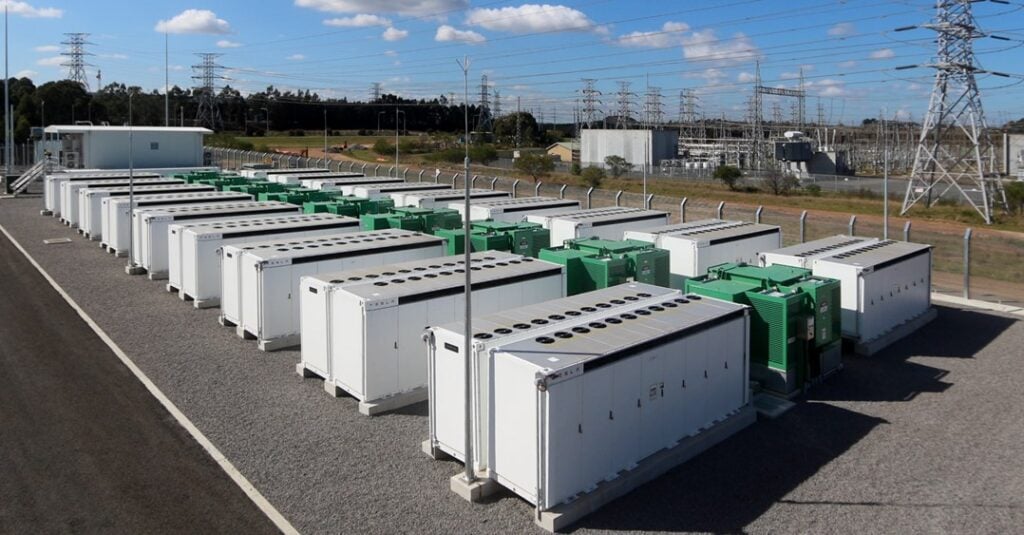
The Australian Energy Market Commission (AEMC) predicts South Australia and New South Wales could experience reliability gaps from 2026-27 and 2027-28, respectively, creating significant opportunities for battery energy storage systems (BESS) in Australia.
This is according to the organisation’s Reliability & Security Report, which covers Australia’s National Electricity Market (NEM). It was produced by the AEMC’s Reliability Panel, which is responsible for monitoring, reviewing, and reporting on the NEM’s safety, security, and reliability.
The report outlines that the NEM maintained expected reliability, security, and safety levels during the 2023-24 financial year despite undergoing significant transformation to one increasingly powered by renewable energy sources, with battery energy storage in Australia playing a crucial role.
However, due to the uptake of variable renewable energy generation sources, the grid’s long-term reliability has been questioned, with gaps expected to appear in South Australia and New South Wales within the next decade.
Try Premium for just $1
- Full premium access for the first month at only $1
- Converts to an annual rate after 30 days unless cancelled
- Cancel anytime during the trial period
Premium Benefits
- Expert industry analysis and interviews
- Digital access to PV Tech Power journal
- Exclusive event discounts
Or get the full Premium subscription right away
Or continue reading this article for free
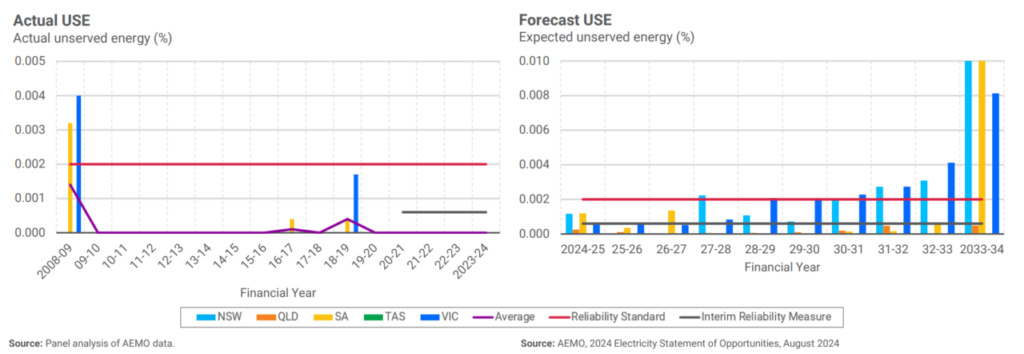
Specifically, South Australia is predicted to see reliability gaps as early as 2026-27 and 2033-34. New South Wales could see reliability gaps in 2027-28 and from 2031-32 onwards. The report also mentions that Victoria could see reliability gaps in 2027-28.
Investment opportunities for Australian BESS projects
Despite the strong uptake of renewable energy, the report cautions that additional investment in generation capacity beyond currently committed projects will be necessary to maintain reliability standards in the coming years.
This creates substantial market opportunities for BESS developers and investors to fill emerging system needs as coal-fired power and thermal generation are withdrawn from the electricity mix. AEMC notes that the NEM is transitioning from a thermal-dominated, synchronous system to an inverter-based one.
Much of the thermal synchronous generation assets are primarily replaced with inverter-based resources, highlighting the strategic importance of BESS across Australia.
BESS assets can emulate synchronous generators provided grid-forming technology is built into them. Fluence’s Rob Hills, APAC vice-president of engineering and commissioning, and Sam Markham, growth manager, Australia and New Zealand, recently spoke to ESN Premium about grid-forming BESS in Australia’s NEM.
However, the AEMC states that appropriate signals are needed to ensure that Australian BESS assets can “provide value to the system” in relation to reliability and security.
Strong growth forecast for BESS across Australia
Tim Jordan, chair of the AEMC Reliability Panel, believes that more investment beyond currently committed projects will be required to ensure reliability in future years.
“Battery energy storage in Australia is growing rapidly – utility-scale batteries doubled in capacity in FY2024, and distributed batteries tripled. That shows the market is adapting well,” Jordan said.
“Looking forward, however, the Panel recognises that AEMO forecasts reliability gaps as early as 2026-27. Continued investment beyond current commitments is crucial for maintaining a reliable electricity supply.”
The report also shows the strong growth of BESS in Australia in the last financial year. Indeed, utility-scale battery energy storage capacity doubled during FY2024, with 807MW added to reach approximately 1,553MW total installed capacity.
The NEM ended FY2024 with 16.6GW of committed and anticipated projects in the pipeline, alongside 259.6GW of proposed utility-scale solar, BESS and wind developments throughout Australia.
Distributed BESS installations across Australia also tripled over the same period. Out of the total 2,060MW of distributed BESS in the NEM, 1,315MW (+64%) was added in FY2024 alone.
This could be further supported in FY2025 with the Australian government set to launch the AU$2.3 billion (US$1.41 billion) Cheaper Home Batteries Program next week (1 July), which is set to make Australia a “red-hot market” for BESS.
Our publisher, Solar Media, will host the Battery Asset Management Summit Australia 2025 on 26-27 August in Sydney. You can get 20% off your ticket using the code ESN20 at checkout.