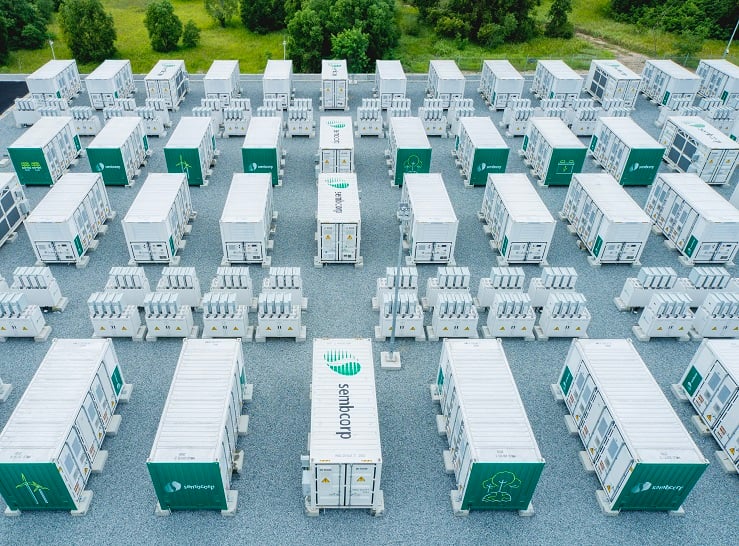
We hear from two battery storage insurance industry sources about how they view the technology and the main risks they assess when designing policies.
The last 5-7 years of energy storage becoming a major sector is a very short time for insurance companies that rely upon historical data to understand risk and exposure, said Ross Kiddie, specialist battery insurance firm Altelium’s manager for North America.
“Because this is a nascent and fast changing technology, best practices are being established and created in almost real time,” he said.
Charley Grimston, executive chairman of Altelium, said that insurance costs are nonetheless falling because of improving loss experience and better understanding of the risks. This matches up with what a battery storage system integrator previously told Energy-Storage.news.
Try Premium for just $1
- Full premium access for the first month at only $1
- Converts to an annual rate after 30 days unless cancelled
- Cancel anytime during the trial period
Premium Benefits
- Expert industry analysis and interviews
- Digital access to PV Tech Power journal
- Exclusive event discounts
Or get the full Premium subscription right away
Or continue reading this article for free
Recent high-profile thermal runaway incidents in the US and Australia have brought to the fore the need for understanding and appreciation of the risks and the role insurers can play, Kiddie added.
The main concerns that insurers have when looking at a battery storage project are, according to Kiddie:
- Design spacing between containers or cabinets.
- CAT (catastrophe) risks
- Tidal and River flood
- Tornada/Hurricane
- Design conditions
- Quality of manufacturing
- Fire protection
- Fire service response plan
“Industry best practice is an end to end process that begins at siting and should continue throughout the process from design, build, commissioning, acceptance and monitoring. Following ANSI, IEEE, NFPA, and UL applicable safety standards and codes for BESS need to be strictly adhered to, to be considered best practice,” he said.
A second source in the insurance industry, speaking anonymously, pointed out that indoor battery storage systems pose a big risk by being housed together in one space rather than spread out like a solar or wind farm.
The supply chain crunch also means it’s unlikely that battery storage designs will standardise (which would presumably lower the cost of insurance), our source added. Battery storage system integrator Fluence’s Growth & Market Development Director for EMEA Julian Jansen talked about the balance between standardisation and custom solutions in an interview with Energy-Storage.news last year.
“It‘s in growth mode and we’re actually seeing the opposite (of standardisation), including ever bigger capacities per container, multiple use cases like reactive power and load shifting, and non-lithium-ion tech such as vanadium and even gravity energy storage systems,” the source said.
They added that some fire safety systems like sprinklers can sometimes cause more harm than they prevent. This happened at the world’s largest battery system at Moss Landing, California, where a battery overheating incident was actually due to sprinklers incorrectly spraying water over the cells which had until then operating at normal temperatures.
Both Altelium and our other insurance industry source stressed the need for projects to adhere to rigorous design standards and safety certifications. Grimston has previously written a guest blog for Energy-Storage.news about data-driven insurance for energy storage.
Energy-Storage.news’ publisher Solar Media will host the eighth annual Energy Storage Summit EU this week in London, 22-23 February 2023. A few weeks later comes the 5th Energy Storage Summit USA, 28-29 March 2023 in Austin, Texas, followed by the 1st Energy Storage Summit Asia which takes place on 11-12 July 2023 in Singapore.