AI data centre battery storage announcements on both sides of the Atlantic explore the tapping of grid-balancing revenues and distributed computing.
While there appears to be widespread recognition that battery energy storage systems (BESS) can be a valuable tool for data centre developers to meet both energy capacity and computing power needs, the business models are less well established.
As Omri Tayyara, business manager at standards agency CSA Group wrote in an article for PV Tech Power Vol.46, energy storage can alleviate concerns over the available hosting capacity of the electricity grid while serving the increasing power needs of artificial intelligence (AI) training loads, which are far beyond anything seen previously from even the largest of the previous generation of data centres.
The speed-to-power that data centre developers require, locked in a race to the top, is in lockstep with the need for capacity and the ability to manage the immense power fluctuations that AI data centres (AIDCs) can cause.
Try Premium for just $1
- Full premium access for the first month at only $1
- Converts to an annual rate after 30 days unless cancelled
- Cancel anytime during the trial period
Premium Benefits
- Expert industry analysis and interviews
- Digital access to PV Tech Power journal
- Exclusive event discounts
Or get the full Premium subscription right away
Or continue reading this article for free
This week (6 July), powered land and data centre infrastructure developer VivoPower said that it could make up to US$4 million in EBITDA by playing a BESS asset at a so-called “AI-ready” data centre campus in Norway, into Nordic reserve power markets.
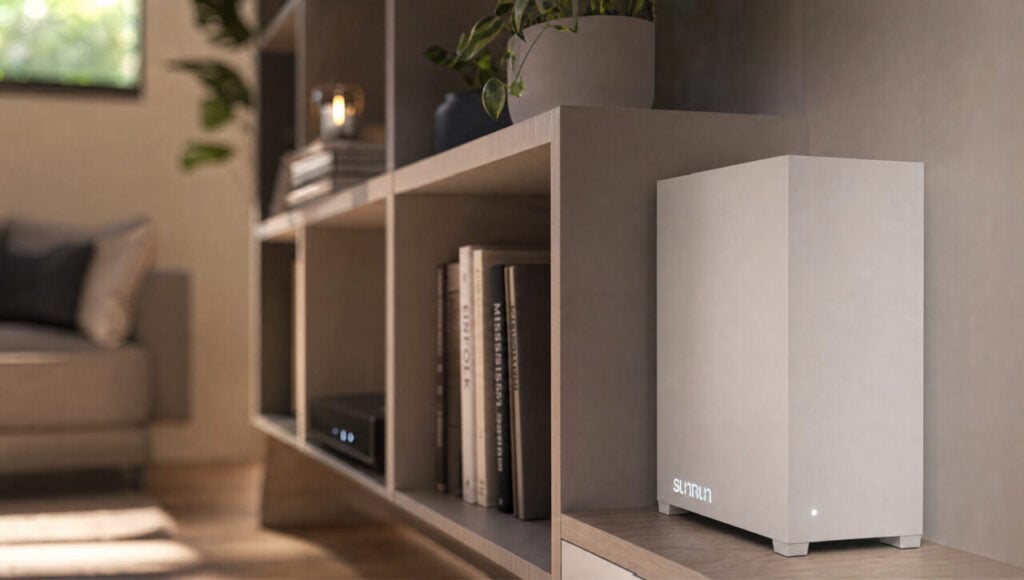
Then yesterday, US third-party solar PV and battery leasing company Sunrun announced a pilot project to put distributed AI computing power into customers’ homes.
VivoPower and Sunrun are exploring business models that the companies hope will have the potential for wider adoption as data centre power demand becomes as powerful a driver of battery storage adoption as fossil fuel replacement with renewable energy.
VivoPower sees Nordic ancillary services as a profitable revenue add-on
VivoPower is progressing with a technical and commercial feasibility study to integrate a BESS at the company’s 41.5MW data centre in northern Norway, Europe. The data centre in the city of Mo I Rana is already operational and is powered by hydroelectric renewable generation. It does not yet have a tenant, although VivoPower said at the end of June that it had selected a “global AI industry leader” as its preferred tenant from a shortlist.
The company said initial studies have indicated that putting a battery storage asset co-located with computing power into three Nordic ancillary services markets from the site could be lucrative, namely: Frequency Containment Reserve for Normal operation (FCR-N), Expanded Frequency Containment Reserve for Disturbances (FCR-D) and Fast Frequency Response (FFR).
FCR-N provides up/down frequency regulation and requires 1-hour duration of grid charging/discharging; FCR-D adds or subtracts power within a 20-minute window and FFR is a sub-second response service requiring 0.7 to 1.3 seconds activation.
VivoPower did not offer the sizing of a proposed BESS that could earn the commensurate US$4 million in profit, but it noted that the site, Mo I Rana, is in Norway’s NO4 bidding zone.
NO4 sees very low average day-ahead power prices, quoted by the developer at ~US$0.009/kWh, versus a southern Norway and continental European average of ~US$0.05-US$0.077/kWh, making it an attractive site for building a power-hungry data centre.
VivoPower said a co-located BESS would be able to access reserve markets as a stacked revenue stream on top of extending the ride-through and power quality resilience of AI tenants and preserving the site’s 41.5MW of leasable power capacity for those tenants.
The Nordic power market is shared across the grids of the countries in the region, although electricity prices are set locally. Ancillary services market prices are currently high in the Nordics, contributing to a rise in BESS development. However, as seen in other markets around the world, as the number of BESS assets competing for ancillary market opportunities increases, revenues tend to decline.
As a side note, if Mo I Rana sounds familiar to longtime readers of Energy-Storage.news, that’s because it is the city where Freyr Battery, one of Europe’s prominent failed lithium-ion (Li-ion) battery startups, was seeking to build Giga Arctic.
Freyr had also hoped to leverage the region’s abundant hydroelectricity resources to power its gigafactory, but, along with fellow Nordic battery startups Northvolt and Morrow Battery, it was unable to compete with the sheer scale and technological advancements already achieved by industry incumbents, mostly in China.
Freyr has now exited the battery space and pivoted into solar PV manufacturing under a new name, T1 Energy, and established its manufacturing base at a site formerly owned by Chinese PV manufacturer Trina Solar, in the US, where T1 Energy is now incorporated.
Sunrun could put a data centre in your house
Another business model that is sometimes discussed at industry forums but which hasn’t yet borne fruit is the potential for distributed computing power. Rather than relying on megawatt-scale or even gigawatt-scale data centre campuses, the theory is that the computing and energy load could be shared across many smaller-scale systems.
Sunrun has launched a so-called “distributed edge computing” pilot programme at undisclosed locations in the US. The US leader in residential solar PV and energy storage leasing claimed this could be a high-margin revenue opportunity.
It has already conducted a proof of concept, which it said demonstrated revenue generation and high demand for distributed computing. This is now being expanded to put compute nodes into the homes of customers with Sunrun solar and battery storage systems.
The leasing provider will sell inference capacity while also gathering operational data by testing the compute nodes under various conditions and electricity payment rate structures. Sunrun hopes that using existing electricity infrastructure could ease pressure on the grid while customer systems continue to power their homes, provide backup power, and participate in grid services markets.
The company did not disclose the planned scale of the pilot, but said that it could leverage its existing base of more than 1.1 million customers. Sunrun has already been aggregating its systems into virtual power plants (VPPs) in eligible locations, including California, where multiple megawatts of its systems have provided demand response in emergency peak load events.
“AI companies are scrambling to secure greater access to energy and computing power,” Sunrun president and chief revenue officer Paul Dickson said, with the company claiming behind-the-meter (BTM) edge computing nodes could mitigate rising utility rates, grid overload and power supply shortages.
It could also provide the speed-to-power that data centre developers are hungry for, taking away bottlenecks in acquiring land, transmission interconnection queues and infrastructure buildout.