In this news roundup, ACCURE, Hydrostor, Shoals and TerraFlow, and Qnetic claim significant advances in and for energy storage technology.
ACCURE and Aviva pilot partnership
Cloud-based battery analytics provider ACCURE has announced a pilot with global asset manager Aviva, “to support improved data transparency” for battery energy storage systems (BESS) monitored through ACCURE’s platform.
Under the two-year pilot, eligible Aviva clients receive preferential onboarding fees with ACCURE while aligning more closely with Aviva’s risk management best practices. Clients can contact their insurance broker for eligibility details.
ACCURE’s platform provides independent safety and performance monitoring for BESS owners and operators. Using field data and analytics, it detects abnormal battery behaviour, identifies heightened safety risks, and enables early fault detection to support corrective action before problems escalate.
Try Premium for just $1
- Full premium access for the first month at only $1
- Converts to an annual rate after 30 days unless cancelled
- Cancel anytime during the trial period
Premium Benefits
- Expert industry analysis and interviews
- Digital access to PV Tech Power journal
- Exclusive event discounts
Or get the full Premium subscription right away
Or continue reading this article for free
Speaking with Energy-Storage.news in March, Dr. Kai-Philipp Kairies, CEO and co-founder of ACCURE said of the demand for data analytics solutions, “I think the energy storage industry is in this really interesting phase of growing maturity. We’ve got real money flooding in. Funds have their first couple of years of experience with limited portfolios, and now everyone’s scaling up. As you scale up in a maturing industry, operational excellence becomes so much more important.”
He continued, “On the first couple of assets, market conditions were really good, and so you didn’t even have to capture all of the potential value to have a really successful year. In those early years, even if you just caught 90% of that, you were doing well. But now, as more and more players flood the market, margins are compressed, and portfolios grow larger, small changes in your efficiency can yield tens of millions of dollars across these portfolios. These are numbers that are worth looking into.”
In September 2025, BESS developer-operator Terra One raised €150 million (US$177 million) in mezannine financing from Aviva. Law firm Ashurst, which advised Aviva on its investment, said that the deal would enable Terra One to deploy 500MW of BESS in Germany, scheduled to be commissioned by 2028.
Hydrostor signs A-CAES offtake agreement with CCA
Long-duration energy storage (LDES) developer-operator Hydrostor has signed a 60MW offtake agreement for its Willow Rock Energy Storage Centre in California.
Announced 6 August, the 60MW agreement for the 500MW/4,000MWh Willow Rock Project was made with community choice aggregator (CCA) Clean Energy Alliance (CEA), based in San Diego County.
Willow Rock is an advanced compressed air energy storage (A-CAES) project that stores energy by compressing air into an underground storage medium. When electricity is needed, the compressed air is released, heated, expanded, and used to drive a turbine generator.
A-CAES differs from traditional CAES by capturing and reusing compression heat. Heat exchangers transfer the thermal energy to pressurised water stored in a reservoir. During discharge, the water flows into the storage cavern to displace air—a process known as hydrostatic compensation.
Hydrostor received approval to begin construction on Willow Rock in late 2025. In February 2026, CC Power, a joint powers agency representing the interests of nine CCAs in California, signed a 50MW offtake agreement with Hydrostor for the project.
On-site work officially began on the Willow Rock Energy Storage Centre in July. It is the company’s first utility-scale project in the US, building on its operational project in Ontario, Canada.
In May, Hydrostor announced its intention to enter the Quinte Energy Storage Centre, an A-CAES project, into Ontario’s recently announced Long Lead-Time request for proposal (LLT RFP), which looks to procure up to 800MW of LDES. Quinte has a planned capacity of 500MW/4,000MWh.
Shoals signs MOU with TerraFlow
US electrical balance-of-system equipment manufacturer Shoals Technologies Group has announced a strategic memorandum of understanding (MOU) with LDES developer TerraFlow Energy to support TerraFlow’s energy storage portfolio.
Announced 3 August, the agreement will see Shoals supporting TerraFlow’s energy storage portfolio “with its power distribution solutions for utility-scale and data centre applications.” Further, the MOU is intended to support TerraFlow’s future deployment plan of up to 5GW annually.
TerraFlow is scaling up grid-scale vanadium redox flow battery (VRFB) systems to support utilities, industrial operators, and AI data centres seeking LDES solutions. The agreement combines TerraFlow’s storage technology with Shoals’ PowerHub recombiner platform, which the companies claim will enable them to target large-scale project deployments together.
TerraFlow and Shoals are also exploring opportunities to showcase Shoals’ AirLink data centre power distribution solution within TerraFlow’s customer demonstration facilities.
Additionally, the two companies said the agreement aligns with Shoals’ and TerraFlow’s broader efforts to support the growing demand for energy storage solutions.
Last month, system integrator and project developer ON.energy agreed to pair ON’s AI uninterruptible power supply (UPS) with Shoals’ DC Recombiner. The company’s Recombiner consolidates inputs from solar arrays, BESS, and other DC microgrid sources. It enables charging the BESS using renewables and discharging it to supply power to the grid through an inverter.
In July 2025, TerraFlow announced a 9.6MW/48MWh VRFB project in Bellville, Texas. TerraFlow’s unnamed customer entered into a vanadium electrolyte lease agreement with VRFB developer Storion Energy. The company claimed at the time that while the lease is directly between the customer and Storion, TerraFlow’s relationship with Storion made it possible.
Qnetic reaches commercialisation milestones for flywheel ESS
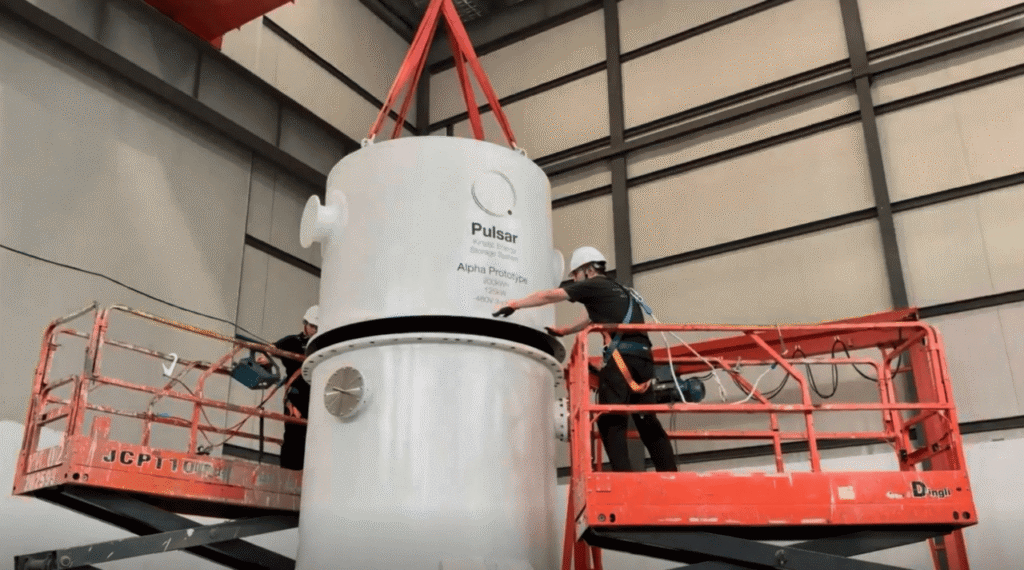
Flywheel ESS developer Qnetic has begun construction on what it believes is the world’s largest dedicated flywheel test cell, while assembly of its first full-scale Pulsar prototype, a 200kWh flywheel ESS, is underway.
Announced 16 July, Qnetic is building a purpose-designed test facility at its Shanghai Technology Centre with an investment exceeding US$1 million. The site will serve as the company’s primary validation hub for flywheel system performance, safety, and reliability. Excavation and foundation work are underway, with Pulsar prototype installation and technical validation testing to follow upon completion.
Unlike batteries that store energy chemically, flywheels store energy kinetically by spinning a rotor at extremely high speeds inside a vacuum enclosure. When power is needed, the rotating mass drives a generator to deliver energy back to the grid. Qnetic claimed that without electrochemical reactions, flywheel systems can operate at high performance for decades while providing rapid response times, unlimited cycling capability, and zero fire risk.
Qnetic’s 200kWh Pulsar system targets applications including data centres, renewable energy time-shifting, grid balancing, microgrids, and industrial power resilience. The company further claimed that its technology offers grid and commercial operators a durable, lower-lifetime-cost option for multi-hour energy storage.
Qnetic also claimed that its flywheel systems can complement or eve replace lithium-ion (Li-ion) batteries “in applications where long asset life, unlimited cycling, sustainability and predictable lifetime economics are critical.”
The world’s largest operational flywheel ESS is the 30MW Dinglun Flywheel Energy Storage Power Station in Changzhi City, Shanxi Province, from project owner Shenzen Energy Group. The first flywheel unit of the station was installed in 2024.
In 2025, technology provider Torus signed an MOU with utility Rocky Mountain Power (RMP) seeing Torus deploy its Nova Spin flywheel ESS and Nova Pulse BESS.