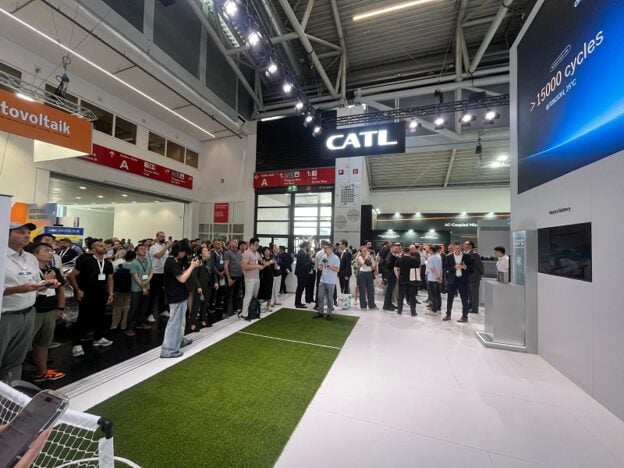
Executives from lithium-ion battery and BESS manufacturer CATL sat down with Energy-Storage.news and other trade media to discuss sodium-ion technology.
Amanda Xu, President of ESS EU and Kevin Tang, director of ESS Europe from the Chinese company gave a Q&A to journalists at The Smarter E trade show and conference in Munich, Germany, today (23 June).
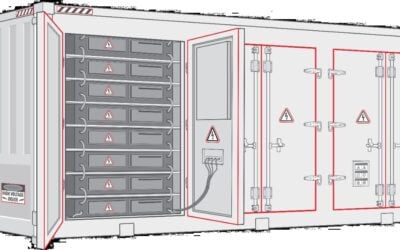
It is a modular configuration which can pack just under 30MWh of capacity into a configuration of 8 units (plus two for cooling), around 3.75MWh and 42 tons each. Lithium-ion cells can also be used in the configuration, which would increase the capacity to 50MWh.
Try Premium for just $1
- Full premium access for the first month at only $1
- Converts to an annual rate after 30 days unless cancelled
- Cancel anytime during the trial period
Premium Benefits
- Expert industry analysis and interviews
- Digital access to PV Tech Power journal
- Exclusive event discounts
Or get the full Premium subscription right away
Or continue reading this article for free
That is a marked improvement on sodium-ion’s energy density, which is normally far below half of lithium-ion LFP batteries. Amandu Xu said the improvements recently to enable this have been at the system level rather than the cell level, though the cell technology has also been worked on significantly in the past few years.
Talking to the pair, it was clear that those technology improvements plus the market demand mean this year is a real inflection point for sodium-ion technology, and not just a short-term response to lithium carbonate price spikes.
Tang said that the key to improving the economics for sodium-ion to make it a viable alternative to lithium is the scale of manufacturing and supply chain it has put together. Xu added that sodium carbonate is around 1% the price of lithium carbonate.
CATL has promised a 30-year lifetime for the sodium-ion BESS product. Xu said this length of warranty was because of market demand for a lifetime which mirrored the warranty lengths on wind and solar.
We also then asked the pair two questions on its market presence in Europe. One, what did it see as the future for Chinese companies selling batteries in Europe, in light of the ban on Chinese inverters in EU-funded solar and BESS projects. Two, was it considering pivoting its production lines in Europe from EVs to BESS as other OEMs have done?
One the first, Xu’s answer boiled down to: “It’s very complicated.”
On the second: “It’s not complicated.” That is because CATL uses the prismatic form factor for its EV batteries, which BESS use. That makes switching production lines to BESS cells much easier than a rival such as LG ES, for example, which produces cylindrical and pouch form factor cells for EVs.