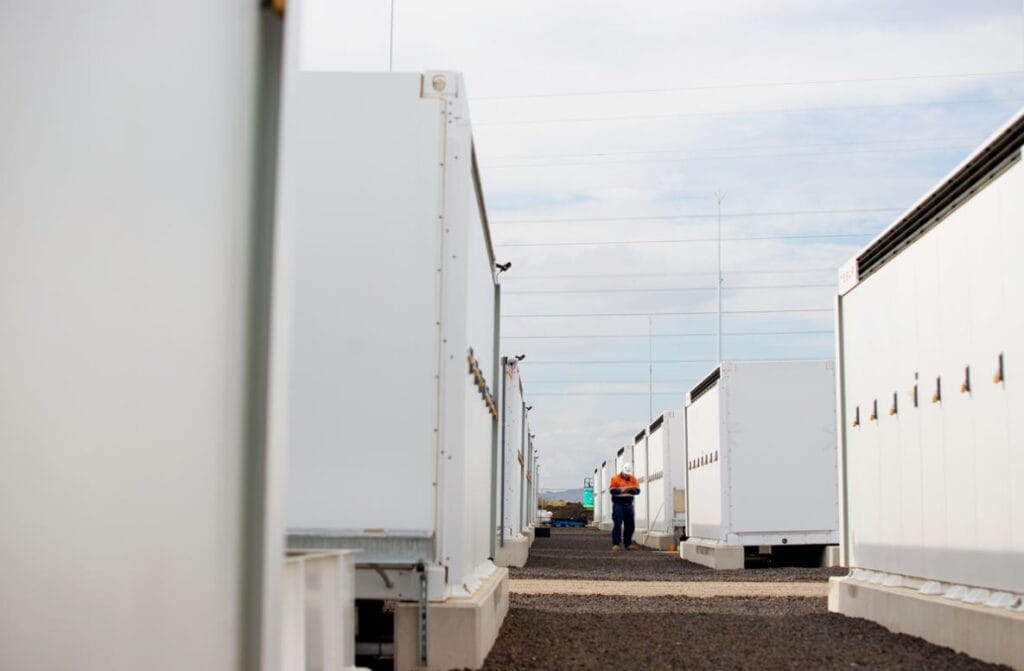
The Australian Energy Market Operator (AEMO) has released a determination to help simplify the technical requirements for solar PV, battery energy storage systems (BESS) and wind sites connecting to the National Electricity Market (NEM).
The final rule will better accommodate inverter-based energy generation projects such as solar PV, wind, and utility-scale BESS, streamlining the process of connecting to the grid and making it quicker and more affordable for them.
It will also make changes that impact the access standards for integrated resource systems and synchronous condensers. It will also amend the access standards for high-voltage direct current (HVDC) links.
The organisation said the amendments have been introduced to update the NEM and adapt to the evolving energy landscape, making it “fit-for-purpose.” AEMO predicts that grid-scale variable renewable energy will triple by 2030 and increase sixfold by 2050. In contrast, utility-scale BESS are projected to grow fivefold by 2030 and sixfold by 2040.
Try Premium for just $1
- Full premium access for the first month at only $1
- Converts to an annual rate after 30 days unless cancelled
- Cancel anytime during the trial period
Premium Benefits
- Expert industry analysis and interviews
- Digital access to PV Tech Power journal
- Exclusive event discounts
Or get the full Premium subscription right away
Or continue reading this article for free
These amendments, which are contained within the National Electricity Rules, will become effective on 21 August 2025.
Anna Collyer, the chair of the Australian Energy Market Commission (AEMC), said these reforms would help accelerate Australia’s energy transition while maintaining system security.
“This is the most significant modernisation of the NEM technical connections standards since 2018, coming at a critical time when the pace of connections needs to accelerate dramatically to meet Australia’s renewable energy targets,” Collyer said.
“With renewable energy projected to triple by 2030 and utility-scale batteries to increase fivefold in the same period, these reforms will help reduce connection bottlenecks while maintaining system security.”
The new amendments are expected to be positively received by Australia’s energy industry, especially given that the country has been described as having some of the strictest grid regulations in the world.
Indeed, Akaysha Energy’s CEO, Nick Carter, told Energy-Storage.news in 2024 that the Generator Performance Standard (GPS) approval for its flagship Waratah Super Battery in New South Wales took more than a year.
AEMO recognises that new NEM connections need to be approved much faster than currently to keep up with the pace of the transition. However, the organisation remains committed to maintaining stability and reliability across the grid.
400MWh BESS receives GPS approval in New South Wales
In light of the new final rule and changes to the connection process for BESS and large-scale generators, Risen Energy Australia has become the latest developer to have received GPS approval for its Coleambally 100MW/400MWh BESS in New South Wales.
This continues AEMO’s recent flurry of distributing 5.3.4.A letters marking GPS approval. Other recipients include UK-headquartered developer Elements Green’s 666MW/1,332MWh Eurimbula hybrid project in Queensland and Elgin Energy’s 125MW/250MWh 2-hour duration Elaine solar-plus-storage site in Victoria.
The letter approves performance standards and the System Strength Impact Assessment, as outlined in Clause 5.3.4A of AEMO’s National Electricity Rules.
Risen Energy’s Coleambally BESS is located 9km northeast of the town from which it derives its name. Coleambally, situated in the Riverina region, is recognised as one of New South Wales’ newest towns, having officially opened in 1968 and is home to some of Australia’s most endangered species, such as Bitterns, a type of heron, and the Southern Bell Frog.
The BESS will comprise lithium-ion technology and will sit adjacent to the pre-existing 150MW Coleambally solar PV power plant, owned by French independent power producer (IPP) Neoen and completed in 2018.
Although Risen Energy has received its 5.3.4A letter, the GPS process does not end here.
Since the GPS is formulated based on modelling, any alterations made during the construction phase, such as modifications in plant design or cabling setups that might impact its electrical characteristics, must be updated through a procedure known as R1.
While a project can be awarded a GPS, the R1 process demonstrates that the project meets or surpasses its performance standards as required by AEMO and the network service providers. If these standards are not met, the GPS can be retracted.
You can find out more about the grid connection process in Australia here.