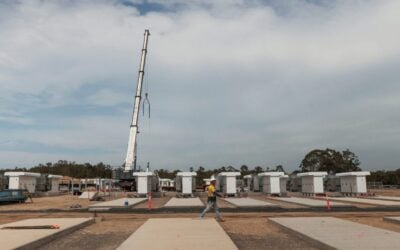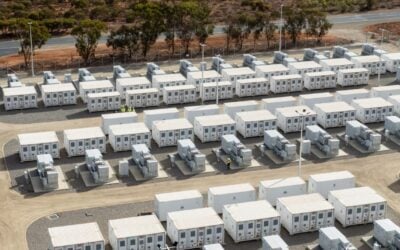
Western Power has started construction on 18 community battery energy storage systems across Perth and Bunbury in Western Australia.
The 18 new systems feature 13 low-voltage community batteries across Perth suburbs and five medium-voltage batteries in Bunbury, delivering a combined storage output of 6.6MW.
The sites were selected in consultation with local governments and residents, with a focus on suburbs with high rooftop solar uptake where network constraints are most acute.
Each of the 13 metropolitan battery storage systems will serve around 130 connected households, while the five larger Bunbury installations will collectively serve approximately 3,600 households. All 18 systems are expected to be operational by mid-2027.
Try Premium for just $1
- Full premium access for the first month at only $1
- Converts to an annual rate after 30 days unless cancelled
- Cancel anytime during the trial period
Premium Benefits
- Expert industry analysis and interviews
- Digital access to PV Tech Power journal
- Exclusive event discounts
Or get the full Premium subscription right away
Or continue reading this article for free
The total programme cost is AU$25 million (US$17 million), with AU$9.34 million contributed through Round 1 of the Australian Renewable Energy Agency (ARENA) Community Battery programme. Western Power is meeting the balance of the project cost.
The batteries are designed to absorb surplus solar generation during the day and redistribute stored energy during the evening peak, when household demand rises and solar output falls to zero.
The programme targets renters, apartment dwellers, and households where rooftop solar installation is not feasible, demographics that have historically been excluded from the financial benefits of distributed solar.
Building on an established SWIS programme
The 18 new batteries are the latest addition to a community battery programme that Western Power has been expanding steadily since its first PowerBank trial in Meadow Springs in 2018, which featured a 105kW/420kWh system.
In August 2025, Western Power commissioned five community battery storage systems, each rated at 500kW/2,800kWh, in the Perth suburbs of Coogee, Kinross, Bayswater, Stratton and Port Kennedy, with connected households able to save up to AU$132 annually alongside a 4kWh off-peak offset under a retail subscription product developed by state-owned energy company Synergy.
Those five joined 13 community batteries already in place across the South West Interconnected System (SWIS) at the time of commissioning, meaning the 18 units now under construction will more than double the deployed fleet once they come online.
Western Power’s programme runs alongside a broader WA household battery incentive framework and the federal Cheaper Home Batteries Programme.
Under the Cheaper Home Batteries Programme, which is nationwide, more than 45,000 Western Australian households and small businesses have installed residential battery storage systems.
The WA Residential Battery Scheme, which opened in July 2025, combined the AU$337 million WA Household Battery Rebate with the federal government’s AU$2.3 billion national battery programme.
Western Australia’s utility-led model stands in contrast to the more fragmented approach seen in eastern states, where community batteries have been deployed by a wider range of operators, including not-for-profits, councils, and distribution businesses.
By early 2026, the Australian Energy Regulator (AER) confirmed that around 244 community battery storage systems were connected to distribution networks across Australia.
The operational learnings from existing community battery programmes have shaped how Western Power and other operators approach deployment.
Yarra Energy Foundation stated in an exclusive article for Energy-Storage.news that operators across Australia have found that community batteries are most effective when sited in locations with both high solar penetration and constrained network capacity, with the combination of arbitrage revenue and network services providing the most robust revenue stacks.