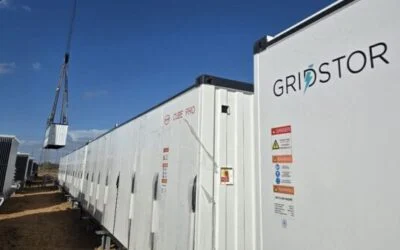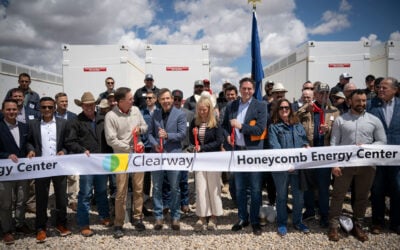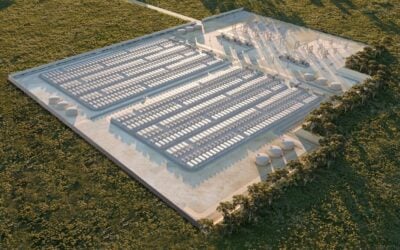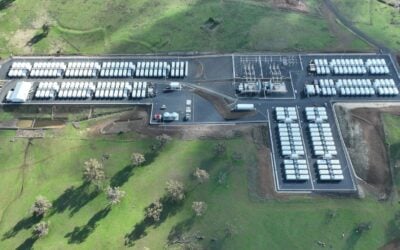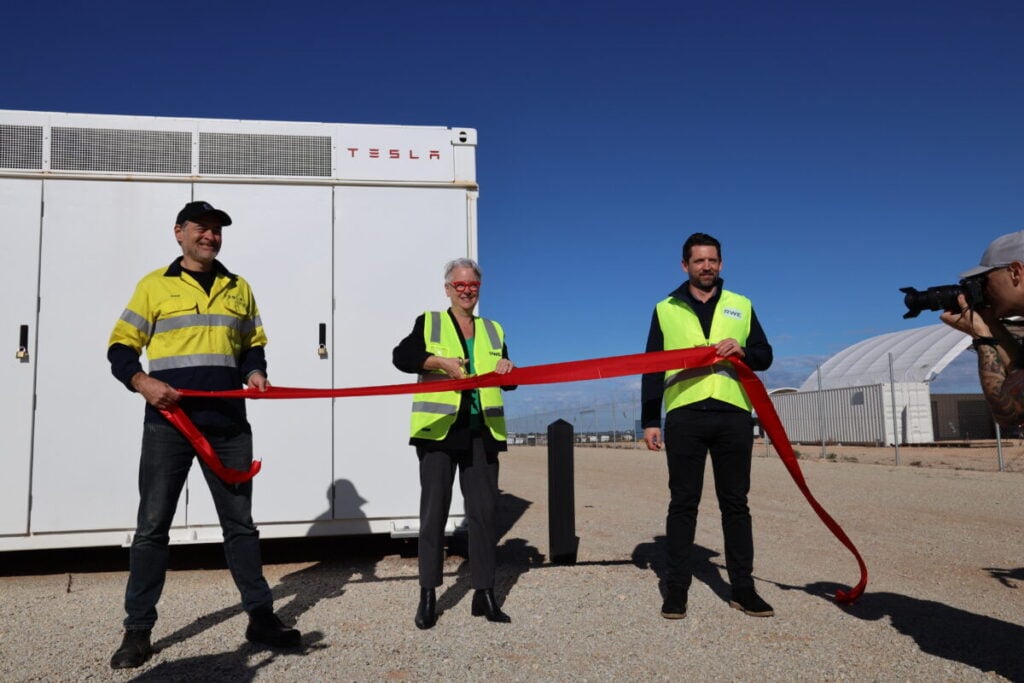
RWE Renewables Australia has officially opened the 50MW/400MWh Limondale battery energy storage system (BESS) near Balranald in south-west New South Wales (NSW).
The opening follows operational sign-off granted by the Australian Energy Market Operator (AEMO) and transmission network service provider Transgrid in late May, when the project completed grid compliance and performance testing at full capacity.
Limondale features 144 Tesla Megapacks and is uniquely registered to charge at 100MW and discharge at 50MW, with the system able to deliver its registered 8-hour+ duration maximum discharge output, making it the longest-duration battery storage system currently operating in Australia.
NSW minister for climate change and energy, Penny Sharpe, said the project would help ensure solar generation is not wasted.
Try Premium for just $1
- Full premium access for the first month at only $1
- Converts to an annual rate after 30 days unless cancelled
- Cancel anytime during the trial period
Premium Benefits
- Expert industry analysis and interviews
- Digital access to PV Tech Power journal
- Exclusive event discounts
Or get the full Premium subscription right away
Or continue reading this article for free
“It’s exciting to cut the ribbon on this Australian-first battery, which will get more renewable energy into the grid, placing downward pressure on bills. Batteries like this one mean we don’t waste an electron of solar and can power the state with renewables,” Sharpe said.
RWE Renewables Australia CEO Daniel Belton said the project represents a milestone for long-duration storage in the country.
“We are incredibly proud to deliver the Limondale BESS. As one of Australia’s most significant battery storage projects, it represents a major step forward for long-duration energy storage and contributes to a more reliable, resilient, and sustainable energy system,” Belton said.
Limondale BESS strengthens grid stability, supports energy security and enables greater integration and efficient use of renewable energy across the network.”
The facility is located in the NSW South-West renewable energy zone (REZ), adjacent to RWE’s existing 314MW Limondale solar PV power plant, which spans 770 hectares and uses 872,000 solar modules.
RWE delivered the project in partnership with Tesla, Beon Energy Solutions, Lumea and Transgrid. The BESS is connected to the National Electricity Market (NEM).
A long path from policy to operation
The Limondale project’s 8-hour duration was not an arbitrary design choice. The project was sized in response to the New South Wales government’s Electricity Infrastructure Roadmap, the first to receive a long-duration energy storage (LDES) Long-Term Energy Service Agreement (LTESA) through the first tender undertaken by ASL.
RWE won that government contract in 2023 and reached final investment decision on the project roughly a year later.
The project was registered with AEMO’s Market Management System in September 2025, moving from construction into hold-point testing ahead of the full operational approval granted in May 2026.
Other long-duration battery storage projects are being developed nationwide, including Edify Energy’s 2,400MWh, 8-hour Nowingi hybrid project in Victoria, which received federal approval in September 2025 and pairs a 300MW solar PV plant with an integrated 300MW/2,400MWh BESS.
Limondale’s commissioning arrives as Australia’s energy storage sector debates the balance between lithium-ion and alternative long-duration technologies.
Keith Lovegrove, managing director of consultancy ITP Thermal, warned against over-reliance on lithium-ion for long-duration applications (Premium Access), arguing that diversification across storage technologies, including thermal and other non-lithium chemistries, would deliver system-wide benefits that a lithium-dominated pipeline may not capture.
RWE currently operates battery storage systems with a total capacity of 1.7GW globally, with a further approximately 2.5GW under construction.
Interested in Australia? Read Energy-Storage.news’ Energy Storage Summit Australia coverage and related content.