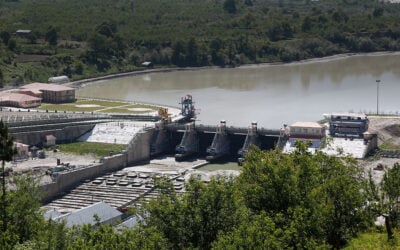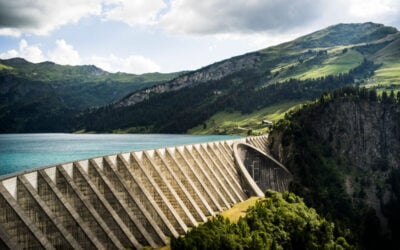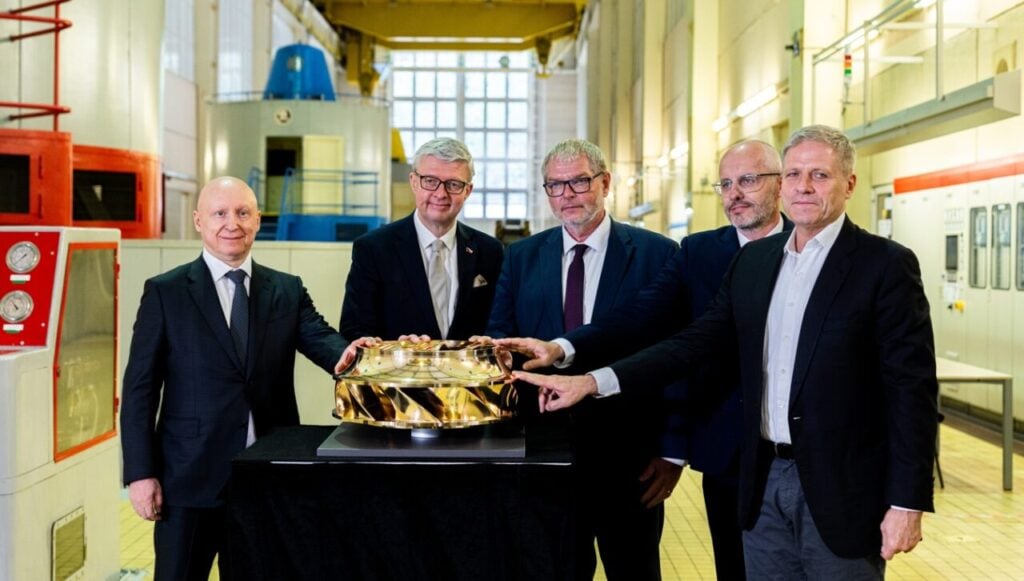
The Czech Republic’s fourth pumped hydro energy storage plant is to be built within an existing hydropower complex, converting run-of-river generation to reversible units and creating 750MWh of energy storage capacity.
The work will be undertaken at the Orlík plant by energy conglomerate ČEZ Group, in partnership with engineering firm Wikov Group. The owner of the plant is the Vltava River Basin Company.
Engineers will modernise all four hydropower turbines at Orlík while keeping its power capacity at 364WMW. Two 95MW units will remain classic unidirectional turbines, also known as run-of-river hydro.
Two 87MW units meanwhile will be turned into reversible pumped hydro energy storage (PHES) units by installing reverse Francis turbines.
Try Premium for just $1
- Full premium access for the first month at only $1
- Converts to an annual rate after 30 days unless cancelled
- Cancel anytime during the trial period
Premium Benefits
- Expert industry analysis and interviews
- Digital access to PV Tech Power journal
- Exclusive event discounts
Or get the full Premium subscription right away
Or continue reading this article for free
The pumped hydro element will therefore total 174MW/750MWh, a duration of around 4.3 hours. Construction will start in 2027 for completion in 2033.
It will use the differential between the Orlík Lake and the lower Kamýčké Lake, and ČEZ said the transformation is unique globally.
“The last pumped storage hydroelectric power plant in the Czech Republic was built in the mid-1990s, and Dlouhé Stráně represents one of the symbols of energy storage in water. Today, after thirty years, we are starting to build a new pumped storage hydroelectric power plant, and I believe that the new Orlík pumped storage hydroelectric power plant will serve the Czech energy sector well and reliably,” said Minister of Industry and Trade, Karel Havlíček .
“The advantage of this new pumped storage power plant will be that it will be built on the existing site and will not require additional land. It will therefore be not only efficient, but also ecological. It is also important that it will be a gradual reconstruction, during which at least two of the four turbines will always be in operation during the modernisation,” said Daniel Beneš, Chairman of the Board of Directors and CEO of ČEZ.
It will be the country’s fourth pumped hydro plant after the existing Dlouhé strány, Dalešice and Štěchovice plants.
ČEZ has modernised approximately forty turbines across 20 hydropower plants in the Czech Republic, also known as Czechia.
Large-scale battery energy storage systems (BESS) are also being deployed in the country, partially with support from an EU-backed funding scheme. The largest project online is a 30MW gas-paired system, while trading firm Second Foundation is set to commission 307MW of capacity across three projects this year.
Our publisher Solar Media will hold the Energy Storage Summit Central Eastern Europe (CEE) 2026 on 6-7 October in Warsaw, Poland.