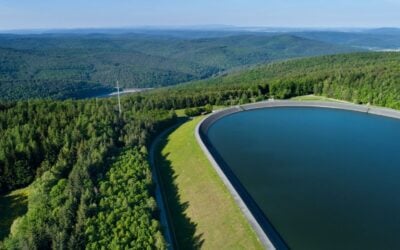
The Government of India needs to accelerate deployment of the pumped hydro energy storage (PHES) technology through faster project clearances, stronger revenue mechanisms and greater coordination between central and state authorities, as the country targets 100GW of pumped storage capacity by 2035-36.
The above recommendations, set out in the Delhi Declaration on Pumped Storage, have been published by the International Hydropower Association (IHA), bringing together industry stakeholders around five policy priorities covering strategic recognition of pumped storage, project development, revenue certainty, use of existing hydropower assets, and domestic supply chain development.
The declaration estimates that India has nearly 288GW of pumped storage potential. It argues that the technology could play a major role in integrating variable renewable generation, providing grid flexibility and supporting energy security as electricity demand and renewable capacity increase.
The push comes as the Central Electricity Authority (CEA), a statutory body under the Ministry of Power, is targeting 100GW of PHES projects by 2035-36. The CEA published its roadmap for reaching the target in January 2026.
Try Premium for just $1
- Full premium access for the first month at only $1
- Converts to an annual rate after 30 days unless cancelled
- Cancel anytime during the trial period
Premium Benefits
- Expert industry analysis and interviews
- Digital access to PV Tech Power journal
- Exclusive event discounts
Or get the full Premium subscription right away
Or continue reading this article for free
India’s requirement for storage is also expected to rise sharply as solar and wind capacity expands. The CEA’s National Electricity Plan projects a requirement for 73.93GW/411.4GWh of energy storage by 2031-32, comprising 26.69GW/175.18GWh of pumped storage and 47.24GW/236.22GWh of battery energy storage.
Eddie Rich, CEO of the IHA, said, “India has set itself an ambitious target of 100GW of pumped storage by 2035-36. The country has proven itself as a global leader in this space. However, further measures – building on recent policy progress – would accelerate the development of India’s pumped storage sector. This Declaration sets out clear, actionable policy recommendations to attract the investment and energy needed to turn plans into projects for long-term, clean, reliable, secure and affordable power.”
Clearances: A key bottleneck
The declaration identifies project development timelines as one of the main barriers to scaling pumped storage.
It notes that the CEA’s planning assumes around four years for construction of new projects, but says delays frequently arise before construction begins, particularly during environmental, forest, land and other statutory approval processes.
The industry is calling for environmental, forest and Detailed Project Report processes to run in parallel where possible, alongside single-window clearance systems, digital tracking of approvals and greater digitisation of land and forest records.
It also proposes dedicated pumped storage development zones, similar to renewable energy parks, where technically screened sites could be supported by advance feasibility studies, environmental assessments, land and forest mapping and coordinated transmission planning.
The declaration further calls for common infrastructure and clustered development of projects to reduce development costs and shorten project timelines.
Industry seeks greater revenue certainty
The declaration also calls for changes to the market framework for PHES, arguing that projects need to be compensated for the full range of services they can provide to the electricity system.
These include energy shifting, peak management, grid balancing, reserve provision, frequency regulation and other ancillary services. SECI has already awarded 1,344MW of pumped hydro capacity through a competitive tender, providing an example of the long-term contracting mechanisms now emerging in India’s storage market.
Among its recommendations is the introduction of long-term revenue stabilisation mechanisms, including the possible use of cap-and-floor structures, alongside a comprehensive tariff framework covering capacity availability and ancillary services.
The industry is also calling for a review of the existing electricity market price ceiling, arguing that it can restrict the ability of pumped storage projects to monetise flexibility and peak-shifting services.
Transmission and fiscal policy
The declaration proposes extending the full waiver of inter-state transmission system charges for pumped storage projects commissioned through 2035 and extending the waiver period from 25 to 40 years.
It also calls for equivalent treatment of intra-state transmission charges.
Other recommendations include extending Viability Gap Funding (VGF) subsidy support to pumped storage, reducing general sales tax (GST) on storage systems and components from 18% to 5%, and exempting electricity storage services from GST.
The proposals come on top of measures already adopted by the Indian government to support pumped storage development. Government guidelines have sought to facilitate project development and reduce approval timelines, while the CEA has also introduced measures to accelerate concurrence of pumped storage project Detailed Project Reports.
Existing hydro assets could provide additional capacity
The declaration also calls for greater use of existing hydropower infrastructure.
It recommends a national assessment by the CEA, in coordination with the Central Water Commission, to identify existing hydroelectric assets that could be converted into pumped storage projects.
Using existing reservoirs, land and transmission infrastructure could reduce development timelines and potentially lower the environmental and social impacts associated with new greenfield projects, according to the declaration.
It also proposes a national pumped storage atlas and targeted support for smaller and modular configurations, including closed-loop, off-river and mine-based projects.
Domestic supply chain in focus
The industry is calling for additional support for domestic pumped storage equipment manufacturing as the project pipeline expands.
Recommendations include concessional financing and Production Linked Incentive support for original equipment manufacturers, as well as greater visibility over the future project pipeline.
The declaration also calls for stronger payment-security mechanisms for contractors and argues against the use of e-reverse auctions for complex infrastructure projects where technical quality is important.
For consultants, it recommends greater use of Quality-and-Cost-Based Selection, with greater weight given to technical expertise and specific pumped storage experience.
The measures are intended to support the development of a domestic pumped storage ecosystem capable of meeting the scale implied by India’s long-term deployment plans.
With the CEA forecasting a substantial increase in storage requirements alongside the expansion of renewable generation, the declaration argues that pumped storage will need to move from individual project development towards coordinated infrastructure planning across central and state governments, regulators, utilities and developers.
The Renewable Energy India Expo and The Battery Show India will run from 22-24 October 2026 at India Expo Mart, Greater Noida, bringing together developers, utilities and global technology providers. The event is co-located with the Energy Storage Summit India, now in its second annual edition, which will offer a dedicated agenda for asset owners, developers and policymakers working through the commercial and regulatory questions shaping India’s energy storage build-out.