
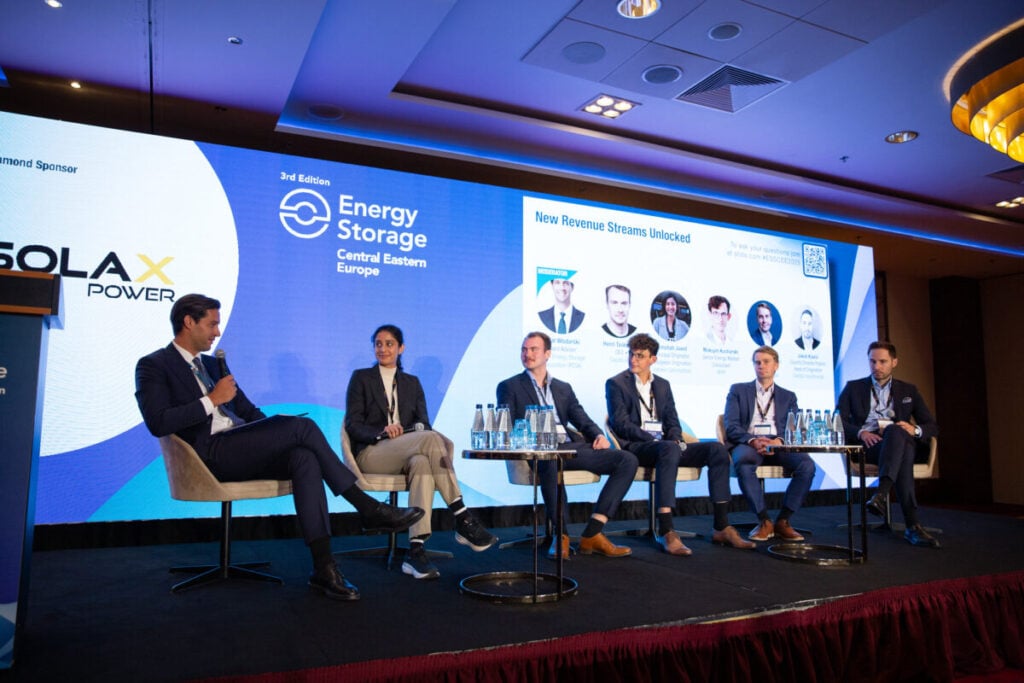
Poland’s grid-scale storage market has reached an impressive scale in the last few years, helped by the capacity market and various government schemes, but numerous challenges now need to be overcome.
That is one of the key takeaways from a Q&A with Jakub Kupcu, country director Poland and head of origination CEE at investor Claritas Investments, ahead of the Energy Storage Summit Central and Eastern Europe (CEE) 2026 next month.
Kupcu will be speaking on the ‘Unlocking Bankability & Offtake Solutions’ panel discussion at the two-day event, which runs 6-7 October in Warsaw, Poland. He will be joined on stage by other battery energy storage system (BESS) project owners and investors Nala Renewables, R.Power and Gaz Energy.
In this Q&A, he talks through the current state of play in Poland, regulatory and policy developments, new markets and applications as well as finance and project offtake trends.
Try Premium for just $1
- Full premium access for the first month at only $1
- Converts to an annual rate after 30 days unless cancelled
- Cancel anytime during the trial period
Premium Benefits
- Expert industry analysis and interviews
- Digital access to PV Tech Power journal
- Exclusive event discounts
Or get the full Premium subscription right away
Or continue reading this article for free
Energy-Storage.news: How would you characterise the current state of the energy storage market in Poland?
Jakub Kupcu: Poland is really the headline story in CEE right now, and the scale is genuinely impressive: storage has secured over 11GW of contracted capacity in the Capacity Market (CM), which is a huge vote of confidence from developers and lenders alike.
But as per leading market researchers, that headline number needs a reality check, because only around 6-7GW of it is actually expected to get built and enter the system by 2030. Grid connection bottlenecks, permitting delays, financing gaps and a wave of “zombie projects” sitting on capacity without progress are all thinning out the pipeline between signing a contract and switching an asset on.
At the same time, the reward for actually getting a project built has been shrinking: the support given to the newest capacity market vintages has dropped sharply compared to just a couple of years ago, and projected returns for newly built assets have compressed by roughly a third over that same period.
Wholesale price volatility has genuinely exploded too, with average daily price spreads now multiple times higher than they were before the energy crisis, which is good news for well-run assets but also a sign the market is maturing and getting more competitive.
So the honest picture is a market that has proven the business case beyond doubt, but is now entering a more selective, more capital-disciplined phase where execution quality matters far more than simply owning a capacity contract.
What are the other key policy questions and grey areas that industry and government in Poland still need to solve?
The biggest recent development is a new Grid Act, signed earlier this year, that genuinely reshapes how storage connects to the system, and it’s a mixed bag.
On the upside, it finally allows batteries to share a single grid connection with wind and solar, even when they’re owned by different companies, which should unlock a lot of hybrid projects that were previously stuck, and it puts hard deadlines on unused connection agreements to free up capacity currently held by projects going nowhere.
On the downside, developers now face new upfront fees and security deposits just to hold a connection, which raises the bar at the earliest, most fragile stage of a project.
There’s also a genuine open question the reform hasn’t fully answered yet: it introduces a new competitive process for allocating grid capacity in place of some auctions, but the actual rules of how that competition will work still need to be designed. And there’s a subtler grey area around subsidy schemes, where a co-located battery can sometimes be swept into the same support mechanism as the renewable asset next to it and lose access to other financing routes it might have preferred.
None of this is unique to Poland either, most CEE markets are wrestling with some version of the same tension between speeding up grid access and making sure that access is actually used, not just parked.
What new markets and applications for energy storage are opening up in Poland?
The most active area by far right now is balancing and frequency markets, which have gone through a genuine transformation over the last two years. A major balancing market reform pushed these services onto proper competitive markets, shortened settlement periods down to 15 minutes, and widened price bands dramatically, all of which have made prices far more volatile and far more interesting for a battery that can react fast.
Regional market integration is compounding that: since Poland linked into the wider European balancing platform, 15-minute price spikes have at times swung by more than PLN10,000/MWh (US$2,636) in either direction, which is exactly the kind of environment storage is built to exploit. The next wave of granularity, moving day-ahead trading itself onto 15-minute settlement, is expected to push volatility even higher once it beds in fully.
But as per leading market researchers, there’s an important caveat that often gets glossed over: the easy money in ancillary services will not last forever, and the revenue mix is already expected to shift over the coming years away from the currently generous frequency response and capacity payments and towards plain wholesale arbitrage, which is a tougher, more competitive game. A recent CAPEX subsidy scheme covering roughly half of project costs for a few gigawatts of assets is a good example of a new support channel, but it closed to new applicants almost as soon as it opened once demand proved overwhelming, so it’s best treated as a bonus rather than something to underwrite a business plan around.
How is the financing of BESS projects evolving?
The big shift in financing right now is the rise of offtake agreements, structures where a specialist counterparty effectively rents the battery’s market access from the developer in exchange for a fixed or floor-protected payment. It’s a genuinely useful bridge between pure balance-sheet risk and full project finance, because it gives a lender something predictable to underwrite without the developer giving up the asset entirely.
Poland is still relatively early on this journey, with only a handful of public offtake deals signed so far, mostly structured as long-dated floor agreements, compared to markets like Germany where well over a gigawatt of capacity is already covered by these kinds of contracts.
What’s striking is just how much difference an offtake structure makes to what a project can actually borrow: a bare capacity market contract on its own might support debt covering roughly a third of project cost, but layering a floor or tolling agreement on top can push that close to two-thirds, while also extending how long lenders are willing to lend for, often from under a decade out to well over ten years.
Across Europe more broadly, as per leading market researchers, projects with contracted revenue are now achieving equity returns roughly in the 12-16% range, with debt covering anywhere from half to three-quarters of project cost depending on the market and the strength of the offtake. The clear direction of travel is that financing is becoming less about proving the technology works, which nobody really disputes anymore, and much more about how cleverly you can structure and layer your revenue streams to give lenders the comfort they need.
How is the balance between merchant and tolling/fixed-revenue schemes changing?
In practice, Poland is seeing two main flavours of contracted revenue emerge: a floor structure where the developer keeps a meaningful share, often somewhere around two-thirds, of any upside above a guaranteed minimum payment, and a fully fixed tolling arrangement where the offtaker takes on all the market risk in exchange for a set annual fee.
Floor agreements tend to be the more popular starting point, because they let developers keep skin in the game on the upside while still giving lenders a guaranteed downside to underwrite against. Fixed tolling goes further in de-risking revenue entirely, which supports even higher levels of debt, but the trade-off is that the developer walks away from all the merchant upside, and as per leading market researchers, that lost upside often outweighs the extra leverage benefit once you look at the overall return to equity.
One thing worth flagging honestly to this audience: the pricing on these contracts is not fixed in stone. The gap between what a developer needs to break even and what an offtaker is willing to pay can be very wide for an asset entering the market today, but that same negotiating room can shrink to almost nothing for a project entering just a year or two later, simply because the market is filling up fast. So the real skill now isn’t just picking floor versus tolling in the abstract, it’s timing when you lock in a structure and choosing the right counterparty, because the same contract type can look completely different in value depending on the year you sign it.
Head to the event website to learn more about it, browse the agenda and buy tickets: use our discount code ESN20 for 20% off tickets.
