Fluence has revised downward its fiscal year 2026 (FY2026) guidance, attributing the financial hit largely to US supply chain delays.
US-headquartered energy storage technology, services, and software provider Fluence issued its revised guidance yesterday (16 September) and held a conference call with analysts to explain the situation.
Fluence is now expecting revenue of around US$2.4 billion for its FY2026, which concludes 30 September 2026. Guidance had already been revised downward last month, when the company released its Q3 2026 results: from earlier guidance of US$3.2 billion to US$3.6 billion revenue, to between US$2.9 billion and US$3.1 billion.
That effectively writes down expected revenue by US$600 million for the year. Meanwhile, Fluence had previously guided to an adjusted EBITDA loss of around US$10 million for FY2026 but has now revised the expected loss to closer to US$200 million.
Try Premium for just $1
- Full premium access for the first month at only $1
- Converts to an annual rate after 30 days unless cancelled
- Cancel anytime during the trial period
Premium Benefits
- Expert industry analysis and interviews
- Digital access to PV Tech Power journal
- Exclusive event discounts
Or get the full Premium subscription right away
Or continue reading this article for free
CEO Julian Nebreda had admitted in the previous quarter’s earnings call that Fluence’s production had been below expected levels this year, but that steps were being taken to achieve targeted levels early in fiscal 2027. The CEO had also emphasised that, with a first big data centre customer contract booked, Fluence remained “confident in the long-term opportunity ahead” and its positioning to capitalise on it.
The current situation reflects supply chain issues affecting US production, particularly at Fluence’s new contract manufacturing facility in Houston, Texas, creating a “significant impact on expected revenue” for the fourth quarter, Nebreda said in yesterday’s call.
While Fluence is a global company with deployments in 17 different countries, around half of its business is thought to be with US customers. The company has pushed towards onshoring its US supply chain in recent years, beginning the domestic manufacturing of battery modules from a factory in Utah in 2024 and BESS enclosures in Arizona since mid-2025. Cells come from the former AESC factory in Tennessee that was acquired by US startup Fixx Energy from Chinese battery maker Envision earlier this year.
Fluence had already begun shifting toward increased domestic content as the Biden-Harris Administration introduced tariffs on Chinese battery imports and the Inflation Reduction Act (IRA) tax credits with their domestic content bonuses. Since then, the ‘One Big, Beautiful Bill Act’ (‘OBBBA’) has introduced foreign entity of concern (FEOC) restrictions on tax credit eligibility for projects meeting a certain threshold of Chinese goods, investment, or assistance.
Coupled with more recent political moves by the US FCC to restrict the use of foreign inverters and a presidential executive order banning imported bulk power equipment from countries including China, companies with a strong US domestic footprint should have a competitive advantage in the US market.
Houston factory producing three units a day with manual welding
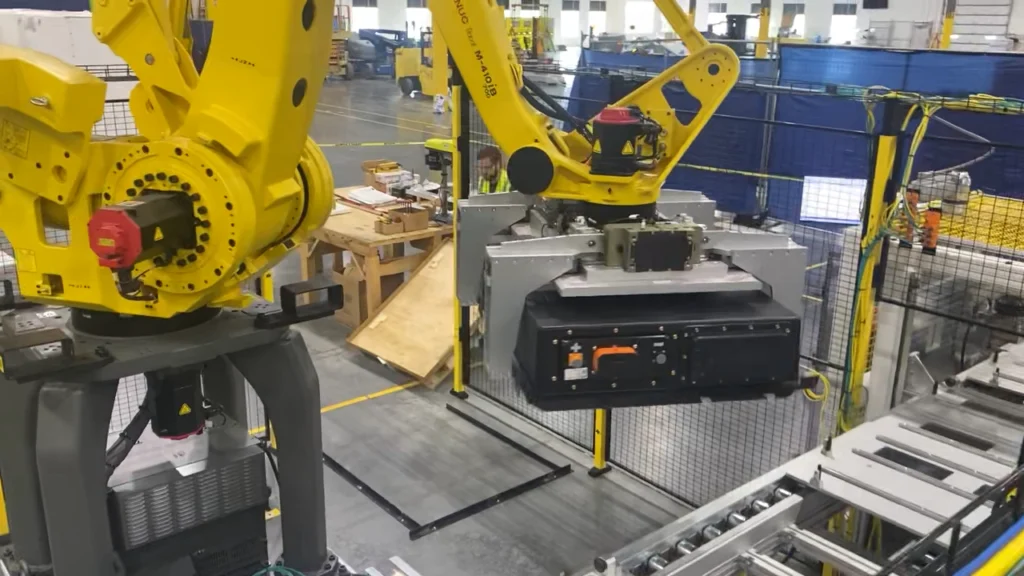
The factory in Houston produces thermal management systems (TMS), including HVAC and chiller equipment, in partnership with climate control specialist company Bergstrom.
Production began at the site in August 2025. At the time, a Fluence company statement said the factory played a crucial role in its strategy to “onshore production of every major product and component of a grid-BESS to the United States.”
CEO Nebreda said yesterday that additional delays have been experienced since issues with the Houston site’s ramp-up were referenced on the previous quarterly call.
“Our team underestimated the complexity of the ramp-up of the Houston facility, specifically the major issues that have emerged… the underperformance of the customised automated welding process, which is operating significantly below its targeted level,” Nebreda said.
“Another issue has been the speed of final assembly of components into finished products, which lags our expectations due to shortages of skilled labour.”
Corrective actions being taken include a switch to manual welding, which requires additional skilled labour and more detailed quality inspections. Subcontractors have also been engaged to increase the capacity of welding and assembly.
According to the CEO, previous guidance assumed an average of 11 units per day being produced during an August-September ramp-up. Instead, actual production in August averaged less than one unit per day, while corrective actions have since brought that figure to an average of three.
The company also experienced recent delays in balance of plant (BOP) equipment deliveries, including transformers and inverters. Occurring due to supplier constraints, BOP delays “will chip revenue out of these fiscal years,” Nebreda said.
Around 80% of the US$600 million reduction in revenues is attributable to US production issues, including US$450 million in production delays and ~US$65 million penalties largely associated with late delivery. The remaining ~US$85 million hit reflected logistics, according to the CEO.
Fluence rules out need for additional capital in FY2027
Fluence is responding to these developments with a plan to strengthen supply chains, production systems, processes and execution discipline. It has appointed a new chief operating officer (COO), Bernard Dasant, who comes with supply chain and process evaluation experience from shareholder AES Corporation and now leads efforts to address process weaknesses and evaluate contract manufacturers.
Having identified “several critical areas to be addressed,” Fluence is acting “with urgency” to incorporate findings and recommendations from those efforts led by the new COO, Nebreda said.
Key priorities will be to execute on the US$2.9 billion order backlog as a foundation for revenue, and “right-size” revenue growth to eliminate the need for additional capital in FY2027.
“Recent progress at Houston reinforces our belief that these challenges are operational in nature and can be resolved through targeted execution,” Nebreda said.
Fluence may even look to serve some US customers with non-domestic content solutions, depending on customer appetite, with CFO Ahmed Pasha highlighting that data centre developers who require speed-to-power above all may be willing to forgo tax credits by using non-FEOC-compliant equipment.
This article has been amended to reflect the current ownership of the Fixx Energy battery cell factory in Tennessee, which supplies Fluence for US projects.